



IoT, AI, and Edge Computing Revolutionize Oil Industry Operations
Each year, IoT evolves to embrace new capabilities and extend its reach into new frontiers, and now the oil industry is ripe for digital transformation.
Barcelona, IoT Solutions World Congress – The oil industry, especially in the area of production, is still operating with most of the equipment and safety standards set during the last century.
While safety levels are increasing, and the industry is managing to avoid more severe accidents and environmental disasters, its operating performance and resource uptime have not improved.
Some operators and service companies, with new data collection tools, cloud analytics, machine learning and edge computing, are starting to see the potential of IoT to provide predictive maintenance, identification of potential failures, higher safety and increased production performance of their oil fields.
During a panel session at the IoT Solutions World Congress, Jonathan Carpenter, Head of Strategy, Petrofac, gave an overview of their services to their customers, and how IoT and analytics can be a game changer for the industry. He called the concept “Petrolytics.”
The high cost of downtime
Petrofac started to realize the value of digital tools a year ago, Carpenter said, and the company had an internal conversation questioning “…how can we operate plants, or build plants, more safely, build it at a lower cost, on schedule, and when it operates, has a more lower operating cost?”
Carpenter mentioned that average uptime in the North Sea, where a lot of Petrofac operations are located, is 73 percent today. In comparison, the average airliner uptime is 99.9 percent.
“In the oil industry, we accept 73% on average because the price of the commodity is so high, that we run our economics based on that assumption.”
With that vision, Carpenter said, Petrofac asked itself: “What if we had an offering that clients would queue up for — if we could build a plant at half the cost, and always delivered on schedule, operates at 100% uptime, at half of the operating costs?”
Few failure models for cloud learning
One of the biggest challenges to realizing the potential of new technology is the lack of historical data since old sensors on existing plants were not designed to collect and store information, but only to warn about malfunctions. What that means is there is a lack of data on serious failure from which machine learning models can gain insight. For a good reason, the industry works with rigorous and conservative safety standards and procedures, managing to avoid the kind of problems they want to analyze. That is why engineers and data scientists have to train the cloud machine learning models basically blind.
While most of the equipment installed in production plants has some primary sensors, the connectivity is limited, and the bulk of the data those sensors collect is discarded.
Teresa Tung, Managing Director at Accenture Labs, which is working with Petrofac on cloud analytics, said they had to leverage the knowledge of the technicians and engineers working on those oil plants to understand the problems, simulate the data that could have been collected during an incident and initially train the models that way.
The future is the fully autonomous oil plant
According to Carpenter, “Petrolytics” is one of the company’s building blocks in the journey towards ultra-efficient operations.
Leveraging the experience of designing and implementing predictive analytics, and the data collected and processed by edge devices, it is possible to move forward to an AI optimized plant, with lower operating costs and fewer maintenance issues. Ultimately, Carpenter said, it could be possible to start talking about a fully autonomous plant, where engineers are monitoring its operation using a digital twin and schedule maintenance operations in advance to reach 100% efficiency.
“There was a study done by the World Economic Forum that says that in our industry alone, there is over 750 billion dollars of value that can be extracted by the application of AI, analytics, drones, etc. The number is potentially enormous,” Carpenter said later.
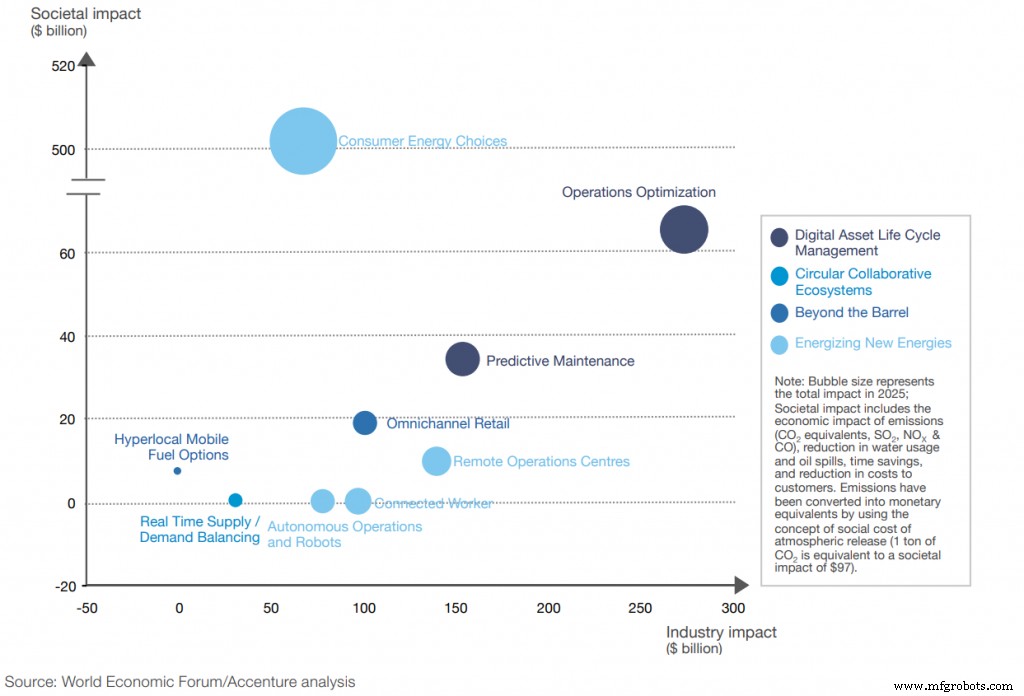
Potential Value of Digital Initiatives and Technologies in Oil and Gas, for the Industry and Society
“There is recognition today versus three years ago that this has moved from a concept, an idea, and research projects, into real life projects on real assets, and we are actually starting to see the first wave of these solutions being industrialized,” he concluded.
Industrial Technology
- Industry 4.0 & IoT in Germany: Current Landscape & Strategic Insights
- Industry 4.0 & IoT: Key Market Trends Shaping the Next Two Years
- How IoT and Cloud Computing Shape the Future of Enterprise Data
- Harnessing IoT to Transform Oil & Gas Operations
- Top 10 IoT Innovations Revolutionizing Retail
- How IoT and Edge Computing Complement Each Other
- 5 Game-Changing IoT Trends Powering the Modern Fleet Industry
- Why Edge Computing is Essential for the IoT: Unlocking Real-Time Performance
- Harnessing Edge Analytics: Empowering IoT Edge Architecture for Real‑Time Insight
- Driving the Future: How Digital Transformation & IoT Revolutionize Automotive Manufacturing