



Defining the Edge: Where Edge Computing Truly Happens
Edge computing is the IT industry’s buzzword, especially for IoT. While vendors and analysts rave about its benefits, the exact location of the “edge” remains a topic of debate. Here’s Cisco’s clear, industry‑backed definition and why it matters for latency, bandwidth costs, and real‑world use cases.
What Edge Computing Means at Cisco
In 2015, Dr. Karim Arabi, Vice President of Engineering at Qualcomm, defined edge computing as “all computing outside the cloud happening at the edge of the network.” That definition is widely accepted, but at Cisco we take a slightly broader view: the edge is anywhere data is processed before it crosses the Wide Area Network (WAN).
Key Benefits of Edge Computing
- Reduced Latency: By moving compute to the edge, you can analyze and act on time‑sensitive data almost instantly—essential for autonomous vehicles, industrial automation, and real‑time analytics.
- Lower Operational Costs: While bandwidth is plentiful, WAN links are expensive. Processing data locally means you avoid the higher costs and latency associated with sending data over the WAN.
Where Does the Edge End?
If the goal is to reduce latency and cost, any data that travels across a WAN—even to a private data center—is not edge computing. Edge means the data is processed before it ever leaves the local LAN, Wi‑Fi, or Ethernet. This includes IoT appliances, edge routers, and gateways that sit at the boundary between the LAN and the WAN.
Below is a typical Industrial IoT topology illustrating the relative positions of edge compute:
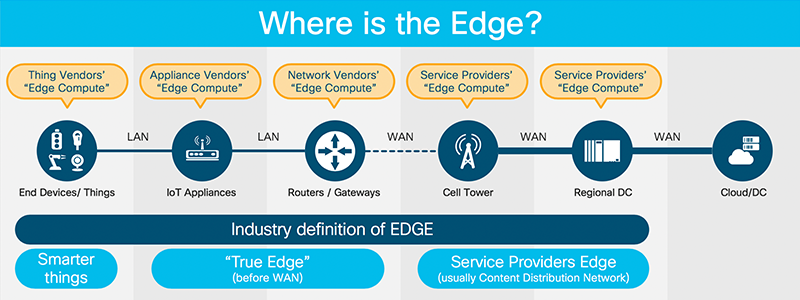
As the diagram shows, the edge is relative: the service provider’s edge is not the customer’s edge. The critical link is the last mile—usually the 4G/5G uplink to a cell tower—where latency spikes and costs rise. Devices that sit on the LAN side (end‑point sensors, actuators) are generally excluded from true edge compute because the boundary is blurred.
Edge Computing: An Old Idea Re‑branded
The concept isn’t new; it’s simply the latest name for decentralized compute. As network architectures evolve, the definition of “edge” shifts, but the underlying principle remains the same: perform compute as close to the data source as possible to meet performance and cost objectives.
Learn More
To dive deeper, read An Introduction to Edge Computing and view the presentation that inspired this blog. For a quick overview, check out the What is Edge Computing? resource.
Internet of Things Technology
- IoT Edge Computing: Bridging Devices and Cloud for Real‑Time Insights
- Edge, Endpoint, and Cloud AI: A Unified Future for Intelligent IoT
- Edge Computing: The Architecture Driving Tomorrow’s Intelligent Networks
- Edge Cloud Computing: The Essential Backbone for IoT’s Rapid Growth
- Edge Computing: The Next Revolution in Trucking Efficiency
- How Edge Computing Revolutionizes Commercial IoT Deployments
- 6 Organization Types Driving the Edge Computing Revolution
- How IoT and Edge Computing Complement Each Other
- Edge Computing & 5G: Powering Enterprise Transformation
- Why Edge Computing is Essential for the IoT: Unlocking Real-Time Performance