



Key Features of a Robust Edge Computing Solution for IoT
Edge computing brings data processing closer to IoT devices, dramatically reducing latency, enabling autonomous decisions, and enhancing local security and privacy. By keeping most of the data on edge gateways, organizations can also cut network bandwidth usage and lower cloud storage costs.
This article details the core software capabilities essential for a high‑performance edge computing platform. While hardware selection remains critical, our focus here is on the software stack that delivers flexibility, scalability, and security.
Features of an Edge Computing Solution
- Protocol support: Connectivity to sensors and actuators via industry standards such as Z‑Wave, ZigBee, KNX, Bluetooth LE, HomeConnect, Modbus, ONVIF, EnOcean, BACnet, OPC UA, LoRa, and Siemens S7.
- Local application runtime: Edge gateways should run analytics, threshold‑based alerts, diagnostics, and custom code directly on the device, enabling instant, context‑aware responses.
- Local data storage: Persistent storage on the gateway allows it to operate autonomously even when network connectivity is intermittent or unavailable.
- Integrated security: Robust access controls, end‑to‑end encryption, certificate lifecycle management, and seamless integration with enterprise security frameworks are non‑negotiable.
- Remote management and API access: Operators need to remotely start, stop, configure, and update gateways and attached devices. An open API (REST, WebSockets, JSON‑RPC) facilitates automation and third‑party integrations.
- Hardware‑agnostic software: Portability across diverse platforms prevents vendor lock‑in and maximizes deployment flexibility.
Edge Computing for IoT: Complementing the Cloud
By processing data locally, edge computing reduces latency, conserves bandwidth, and frees cloud resources for higher‑level analytics. It also provides resilience in environments with unreliable connectivity. Learn how to blend edge and cloud for a unified IoT strategy in our comprehensive guide.
OSGi for IoT Solutions
Modularity and abstraction simplify IoT complexity. OSGi offers a dynamic, plug‑in architecture that lets developers bundle, update, and replace services on the fly, without rebooting the gateway.
To meet the evolving needs of our customers, Bosch IoT Suite delivers the Bosch IoT Gateway Software—an edge solution that runs on over 40 hardware platforms, including Bosch’s own gateways. It can operate standalone or seamlessly integrate with Bosch IoT Suite cloud services.
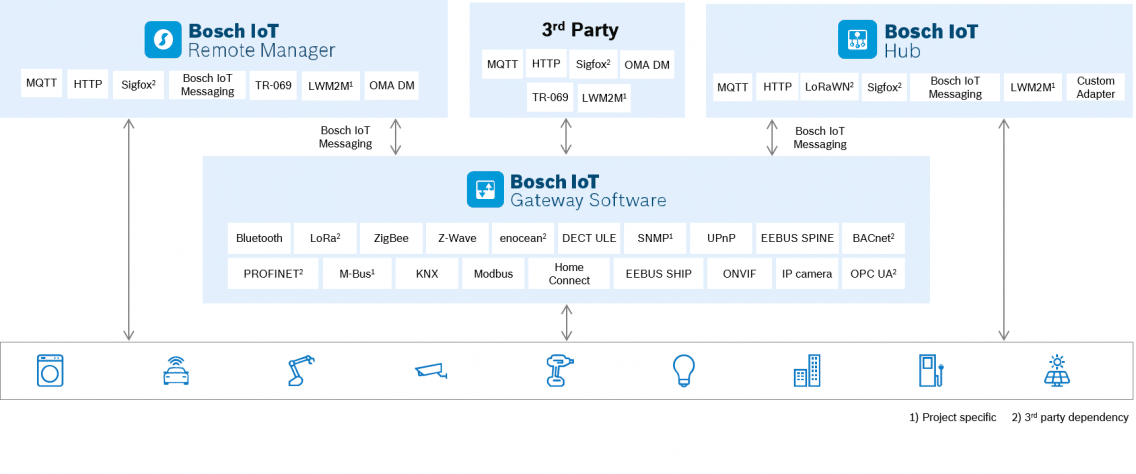
Interested in the details? Download our edge computing white paper to see how edge complements cloud in IoT.
Download edge computing white paper
Internet of Things Technology
- Defining the Edge: Where Edge Computing Truly Happens
- Edge & Cloud Computing in IoT: A Concise Evolutionary Overview
- Why Edge Computing Is Essential for IoT Success
- IoT Edge Computing: Bridging Devices and Cloud for Real‑Time Insights
- Vecow & Blaize Unveil the ECX‑2400 Workstation‑Grade Edge AI System
- How Edge Computing Revolutionizes Commercial IoT Deployments
- How IoT and Edge Computing Complement Each Other
- Open Source Powers the Rise of IoT and Edge Computing
- Why Edge Computing is Essential for the IoT: Unlocking Real-Time Performance
- Harnessing IoT Edge Computing for Real‑Time Data Analysis