



Edge & Cloud Computing in IoT: A Concise Evolutionary Overview
Edge computing is increasingly pivotal in the Internet of Things (IoT). In 2018 it ranked among the leading technology trends, underpinning the next generation of digital enterprises. Simultaneously, the sheer volume of data and the drive to maximize compute efficiency have amplified the migration of workloads to the cloud.
Edge and cloud computing are not inherently antagonistic; instead, the most ambitious IoT deployments routinely blend both paradigms. To appreciate the modern IoT landscape—and how edge and cloud complement each other—we’ll revisit their historical development.
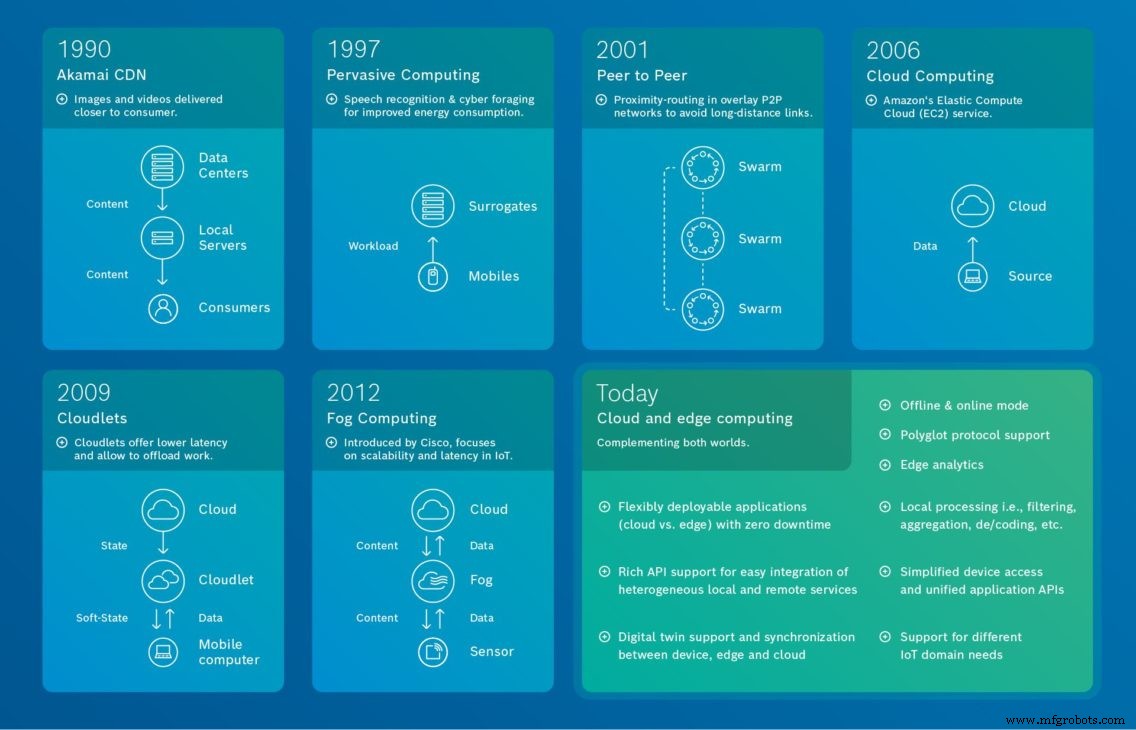 Source: Bosch.IO
The trajectory of communication and distributed systems reveals that edge computing predates the term itself. Our diagram traces its evolution and ends with a forward‑looking model that merges edge and cloud for optimal value.
The Origins of Decentralized Computing
The roots of edge computing trace back to the 1990s, when Akamai pioneered its content delivery network (CDN). The strategy was to deploy nodes closer to end users to serve cached media—images, video, and more—thereby reducing latency.
In 1997, Nobel and colleagues published “Agile application‑aware adaptation for mobility,” showing that resource‑constrained mobile devices could offload tasks—such as web browsing, video playback, or speech recognition—to powerful remote servers (surrogates). The aim was to lighten device load and extend battery life. Modern speech‑recognition services from Google, Apple, and Amazon follow a similar principle.
By 2001, Satyanarayanan et al. expanded the concept in “Pervasive computing: vision and challenges,” framing it as pervasive computing. That same year, scalable, decentralized distributed applications emerged, employing peer‑to‑peer overlay networks (distributed hash tables). These self‑organizing topologies enabled efficient routing, fault tolerance, and load balancing while leveraging network proximity to cut latency and reduce global traffic.
Cloud Computing Emerges
Cloud computing—an essential catalyst for edge evolution—gained prominence in 2006 with Amazon’s launch of Elastic Compute Cloud. The platform unlocked unprecedented compute, storage, and visualization capabilities. Yet, for latency‑sensitive domains like autonomous vehicles and industrial IoT, cloud alone could not satisfy the need for immediate, local decision making.
Cloudlets and Fog Computing
In 2009, Satyanarayanan introduced the term “cloudlet” in “The case for VM‑based cloudlets in mobile computing.” Cloudlets are low‑latency, geographically dispersed nodes that complement a high‑latency, central cloud. They provide just‑in‑time compute and storage for nearby mobile devices while retaining only a soft state, such as cached data.
By 2012, Cisco coined “fog computing” to describe a dispersed cloud infrastructure designed to support the massive scale of IoT devices and the real‑time processing of big data.
Hybrid Edge–Cloud Strategies for Enterprise‑Scale IoT
Today, comprehensive IoT solutions span a broad spectrum of requirements. Most organizations adopt a hybrid approach: cloud resources handle storage, heavy analytics, and global telemetry visualization, while edge nodes manage low‑latency processing, autonomous local actions, bandwidth‑constrained traffic, and sensitive data handling.
Curious how enterprises leverage edge and cloud to power IoT? Explore our guide “Edge computing for IoT.”
Download white paper
Internet of Things Technology
- Mastering Cloud Computing: Key Patterns & Essential Tools for Modern Architecture
- Why Edge Computing Is Essential for IoT Success
- IoT Edge Computing: Bridging Devices and Cloud for Real‑Time Insights
- Fog vs. Cloud: Optimizing IoT Deployments for Speed and Scale
- IXrouter: Seamless Edge‑to‑Cloud Connectivity for Industrial IoT
- How IoT and Cloud Computing Shape the Future of Enterprise Data
- Fog Computing Explained: Transforming IoT Data Flow and Reducing Cloud Load
- Edge & IoT: Harmonizing Data for Digital Success
- How IoT and Edge Computing Complement Each Other
- Open Source Powers the Rise of IoT and Edge Computing