



Edge Devices: Bridging Local Networks and the Cloud for Seamless IoT Data Flow
What is an Edge Device?
Edge devices are pieces of equipment that serve to transmit data between the local network and the cloud. They are able to translate between the protocols, or languages, used by local devices into the protocols used by the cloud where the data will be further processed. Local devices use protocols like Bluetooth, wi-fi, Zigbee, and NFC while the cloud uses protocols like AMQP, MQTT, CoAP, and HTTP. In order for IoT data to move between the cloud and local devices, an edge device—like a smart gateway—translates, sorts, and securely transfers information between the two sources.
Without an edge device, these types of data would be incompatible and unable to reach cloud services for deep analysis. The MachineMetrics Edge is one security-conscious example of this technology. It can be configured as an Edge Pro to support up to 50 machines over a network, or installed near, and powered by, a single machine as an Edge.
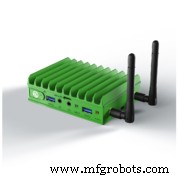
The MachineMetrics Edge device.
Why Are Edge Devices Essential for IIoT?
Edge devices are critical for modern industrial IoT implementations, especially for tasks that require real-time data analysis. IoT Edge devices offer a reliable, low-latency solution for local data analysis. In a manufacturing environment, edge devices have the following benefits:
- Enable condition-based monitoring to monitor the condition of shop-floor machines, even if they are legacy devices
- Prevent critical failures by monitoring and analyzing data to detect anomalies sooner.
- Improved equipment uptime, lower spare parts inventory, and lower maintenance costs because upcoming issues can be predicted and maintenance technicians are equipped with necessary data about the machine’s state to rectify the issue on the first visit
- Capture new business opportunities through added efficiency and self-monitoring analysis.
Because edge devices translate and transmit local data and cloud data through their associated protocols, IIoT systems utilizing edge devices reap the benefits of real-time local analysis as well as robust cloud-based analysis and storage. Cloud computing benefits manufacturers in the following ways:
- Low maintenance system because the cloud provider is off-site and generally not the responsibility of the manufacturer
- Scalability beyond what is feasible from a standalone local network due to data storage constraints, computing constraints, etc.
- Cost reductions for similar storage and computing capacities
- Data accessibility from anywhere as well as redundancy in case of disaster
However, cloud computing requires network connectivity, increases latency over local computing, and requires reliance upon 3rd party security. Edge computing, on the other hand, provides low-latency, reliable computing that can be deployed in areas with no network connections or in extreme security conditions where 3rd-party security is disallowed. However, data can become incomplete due to the higher cost of storage, and local computing has higher overall maintenance than cloud computing because it must be managed in-house.
With edge computing, IIoT systems get the best of both worlds. Bridging the gap with IoT edge devices offers manufacturers unprecedented flexibility, reliability, and speed in a cost-controlled, security-conscious way.
Edge computing devices are a crucial component in creating a digital twin of a manufacturing facility. Other reasons edge devices and IIoT gateways are critical for modern IIoT infrastructure include:
- Data Management: Edge devices are able to decide which data to keep and which to discard in order to prevent unwieldy datasets full of information that is likely to never be utilized
- Offline Capabilities: Edge devices can hold information until a system is able to gain access to a network connection, preventing data loss and allowing for deeper analysis
- Complex Event Processing: The cloud can be used for computational-heavy work to develop and recognize patterns that can then be pushed to edge devices to be acted upon locally when those patterns arise.
- Applications: Some IoT devices now utilize applications that operate on edge devices. One example of this is a monitoring and alerts system that takes advantage of the low-latency nature of edge computing.
- AI and ML: Artificial intelligence and machine learning using edge devices can enable real-time, autonomous decision-making processes for manufacturers as well as immediate BI insights.
Learn more about edge devices and edge analytics free edge eBook, which explores the important role of the edge in enabling manufacturing analytics. Or learn more about the MachineMetrics Edge Platform built for manufacturers.
Industrial Technology
- Edge & Cloud Computing in IoT: A Concise Evolutionary Overview
- Why Edge Computing Is Essential for IoT Success
- EdgeLock 2GO: Secure, Lifecycle‑Managed IoT Connectivity for Edge Devices
- Edge Computing Explained: Why It Matters for Modern Business
- How 5G Adoption Enhances IoT Security: What You Need to Know
- Unlocking Supply‑Chain Visibility: The Crucial Role of Data and Context
- Protecting Flash Memory in IoT & Edge Devices: Best Practices & Security Trends
- Edge & IoT: Harmonizing Data for Digital Success
- Metrology Testing Explained: Ensuring Precision and Reliability in Machined Parts
- Optimizing PLCnext with Azure IoT Edge: Edge Analytics & Cloud Integration