



Harnessing Energy Harvesting for Reliable Edge IoT Devices
IoT deployments are accelerating as organizations embrace digital transformation, and smart living—across cities, factories, and farms—holds the promise of improving quality of life and sustainability.
IoT endpoints are usually sensors—or, less often, actuators—that connect wirelessly to an aggregator or internet gateway. They are deployed in large numbers and spread over wide areas. Field maintenance, such as replacing depleted primary batteries, is often prohibitively expensive and creates unacceptable environmental waste.
Engineers can sidestep battery replacement by designing endpoints with sufficient energy reserves for their expected lifespan, often several years. A coin‑cell form factor is usually preferred because of size constraints. If the stored energy is insufficient, a larger cell can be used.
Alternatively, redesigning the circuitry to reduce overall power consumption below the available cell storage can help. Either strategy—or a mix of both—might still fall short of the target.
Micro‑energy harvesting, producing microwatts or milliwatts of power, offers a useful and potentially inexhaustible source of electricity captured from the ambient environment. It can supplement or replace a primary cell, depending on the application and the available ambient energy. In some cases the harvested and converted energy can power the circuitry directly; in others, storing it in a buffer until it is needed is more suitable.
In any case, a suitable ambient energy source is required to meet the application’s needs. Among the various subsystems of the IoT endpoint, the radio consumes the most energy. Analyzing its requirements can guide the design and integration of the energy‑harvesting system.
Radio subsystem power consumption
Choosing the most suitable wireless technology to provide the required data rate and communication range at the lowest possible power consumption is critical.
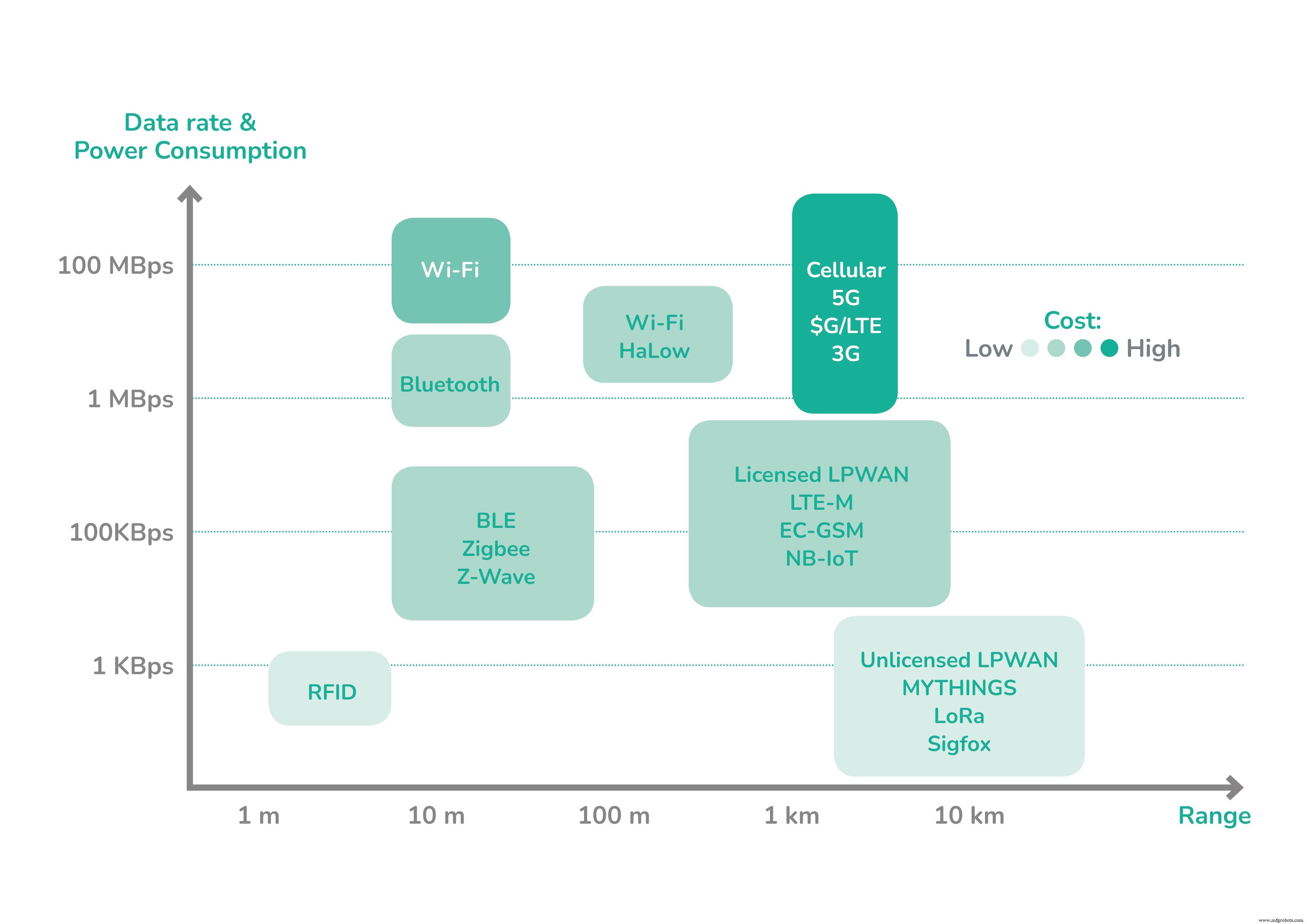
If the sensor is positioned only a short distance from an aggregator or gateway—such as a hub or router connected to the Internet or a local telecom exchange—technologies like Bluetooth, Zigbee, or Wi‑Fi may be appropriate, depending on the required data rate and cost constraints. For endpoints distributed over large geographic areas, an LPWAN or cellular connection may be necessary. Figure 1 compares the power consumption, data rate, typical maximum range, and relative costs of the major technologies used in IoT applications.
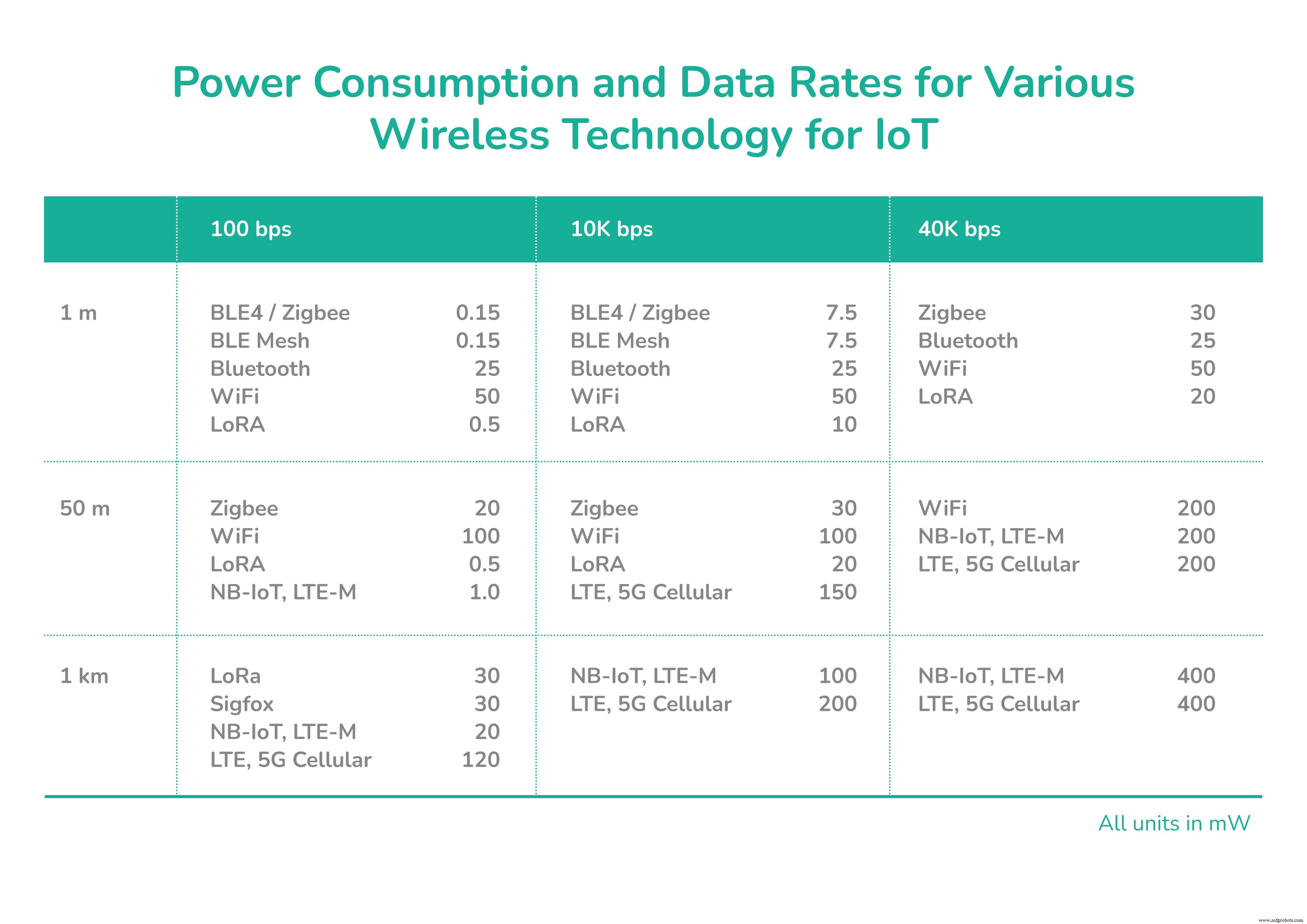
The range, data rate, and power consumption can also be expressed numerically to aid direct comparison. As Figure 2 shows, a wireless subsystem can consume from as little as 150 µW to 400 mW.
To fully understand the impact on the system’s overall energy demand, the duty cycle must be considered. Applications such as smart utility meters send small packets of data a few times per day or every few days. Others—like security cameras—may need to send large amounts of data frequently or continuously. Depending on the application, the duty cycle can be reduced by filtering data locally before transmitting; a camera, for example, might include a motion sensor to start recording only when activity is detected, or embedded image processing might discard uninteresting frames. The energy required to filter the data must be weighed against the savings from a lower duty cycle to ensure a net benefit.
Ambient energy sources
With a clear picture of the wireless subsystem’s energy needs, suitable ambient sources and micro‑energy harvesting technologies can be evaluated.
The main micro‑energy‑harvesting technologies that can power these systems are arrays of solar cells, piezoelectric or electrostatic converters activated by vibrations, and Peltier devices that convert a temperature gradient into an electromotive force (EMF). RF energy captured through patch or coil antennas is generally suitable only for the most frugal IoT applications. Figure 3 compares the typical energy densities of these technologies. Using this information, a technology can be selected and a specification developed by assessing component sizes and performance.
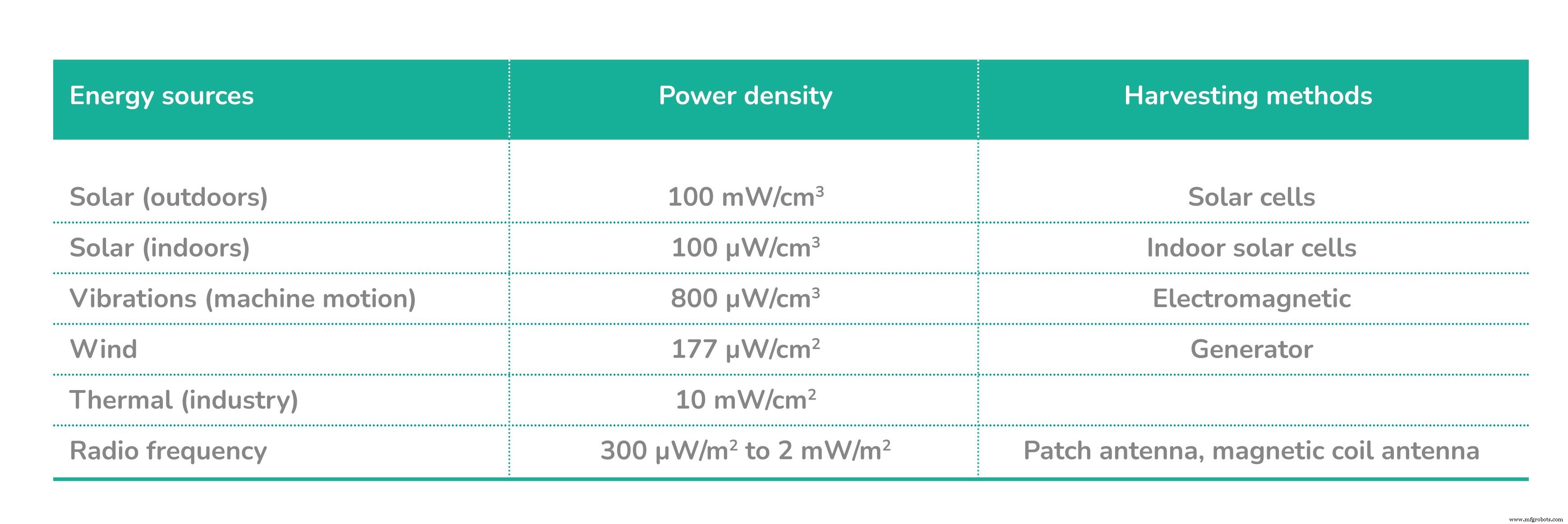
Solar cells with an area of 35–40 cm² can generate about 0.5 W, assuming an efficiency of roughly 20 %. These cells are available for less than $1 each in volume, whereas piezoelectric harvesters are typically at least an order of magnitude more expensive and produce less energy. Solar cells are less efficient indoors, but recent indoor harvesters claim sufficient output for low‑power radios.
Bringing it all together
Leveraging these advances, micro‑energy harvesting can reduce or eliminate batteries in IoT endpoints. Because ambient sources are irregular and may not be available when the device needs to transmit or receive data, an energy buffer—such as a rechargeable battery, capacitor, or supercapacitor—is usually required. An energy‑harvesting power‑management IC (EH PMIC) manages the energy from the harvesting subsystem, charges the buffer, and powers the load when needed, as shown in Figure 4. Different harvesting technologies have distinct electrical characteristics. Thermoelectric harvesters produce continuous low‑voltage DC current and are low impedance; solar cells also produce low DC voltage, but the current—and therefore impedance—varies with light level.
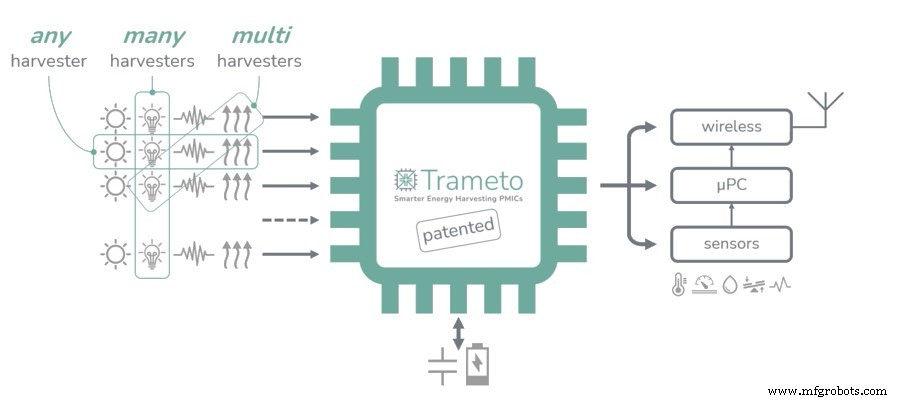
Typical EH PMICs on the market today have fixed architectures and input‑voltage ranges tailored to a particular harvester type. This limits the ability to combine multiple energy sources if one alone cannot meet the system requirement. When several sources are needed, a dedicated EH PMIC is required for each, adding cost, size, power consumption, and design complexity.
Some EH PMICs can be tuned with external circuitry to condition a harvester’s output. To simplify system design, Trameto’s EH PMICs—called OptiJoule—offer inputs that automatically adapt to various connected harvesters and maximize the power delivered to the buffer, without external circuitry. Versions are available for single inputs or up to four inputs. The multi‑input versions allow connection of similar or different harvesters. With OptiJoule devices, micro‑energy harvesting capacity can be scaled, a single PMIC can serve multiple applications, and the choice of harvesting technology can be deferred until later in product development.
Conclusion
Advances in optimized radio protocols, low‑energy microprocessor design, low‑power sensors, and increasing micro‑energy‑harvesting efficiency have made ambient energy a viable source for reducing or eliminating batteries in edge IoT devices. The latest EH PMIC developments provide the flexibility to manage size, cost, and complexity when integrating selected micro‑energy‑harvesting technologies.
Embedded
- How IoT’s Surge is Driving the Shift to Edge Computing
- Why Edge Computing Is Essential for IoT Success
- IoT Edge Computing: Bridging Devices and Cloud for Real‑Time Insights
- Battery-Free Sensors Powered by Energy Harvesting Drive the Next IoT Revolution
- IXrouter: Seamless Edge‑to‑Cloud Connectivity for Industrial IoT
- Optimizing Your IoT Launch: Proven Strategies for Success
- Turning IoT Data into Business Value: A Practical Guide
- Why Edge Computing is Essential for the IoT: Unlocking Real-Time Performance
- Edge Devices: Bridging Local Networks and the Cloud for Seamless IoT Data Flow
- Harnessing IoT Edge Computing for Real‑Time Data Analysis