



Battery-Free Sensors Powered by Energy Harvesting Drive the Next IoT Revolution
Internet of Things (IoT) adoption has surged worldwide, yet its rapid expansion introduces complex challenges for engineers and policymakers alike. Forecasts indicate that by 2025, the global IoT network could host over 75 billion connected devices, a figure that underscores the urgency of preparing robust, scalable solutions.
Industry experts predict a future where millions of electronic gadgets share a unified communication fabric—typically a wireless link to cloud services. To support the explosive data demands of this ecosystem, innovative sensor technologies are essential.
“I believe that the next challenges for IoT will be focused around identifying which devices will be part of the IoT. Just because it is technically possible to design a smart device doesn’t necessarily mean that there is value to having every device connected to the IoT,” says Greg Rice, Technical Marketing Manager at ON Semiconductor.
Connected sensors will be pivotal across automotive, industrial automation, smart homes, consumer electronics, agriculture, and mobile health. With projected daily traffic of 125 exabytes by 2025, efficiently managing this data deluge will be a critical hurdle.
Rice emphasizes that sending every edge‑generated byte to the cloud can congest network infrastructure. “It might be more efficient to perform some basic data analysis and aggregation at the edge of the IoT, rather than sending everything through the cloud to the core of the network,” he notes.
Energy harvestingEnergy harvesting is key to sustaining the IoT’s exponential growth. The primary hurdles are harvesting efficiency and device reliability. Harvest‑powered devices often operate on minuscule power budgets, forcing designers to balance performance against consumption.
Another challenge lies in the power source itself. Solar‑powered units thrive during daylight but falter at night, while RF‑harvested devices require a sufficiently strong electromagnetic field. Scaling RF fields to support widespread harvesting also raises important health‑risk considerations that must be rigorously assessed.
Battery‑free sensorsON Semiconductor has introduced a cutting‑edge, wireless, battery‑free sensor suite—the Smart Passive Sensors™ (SPS) family—that monitors temperature, pressure, moisture, and proximity at the network edge. These sensors are ideal for remote or expansive deployments where battery replacement is impractical.
The SPS sensors are battery‑free, microprocessor‑free RFID tags that use the industry‑standard UHF Gen 2 protocol for communication. When interrogated by an RF reader, the tag harvests energy from the signal, enabling rapid and accurate readings without a dedicated power source.

Figure 1: SPS sensor functional block
Rice explains, “This sensor network is designed to work using RF energy harvesting. A central sensor hub transmits RF power through a connected antenna, and the individual sensor nodes are wireless and battery‑free, operating by converting the surrounding RF field into electrical power.”
As shown in Figure 2, each sensor hub integrates a reader module—handling protocol‑specific communication and exposing raw data (EPC, Temp, RSSI, Code, etc.)—and a processing module that aggregates and formats the data for further analysis. The hub supports Wi‑Fi, Ethernet, Bluetooth, and other protocols to forward sensor data to the cloud.
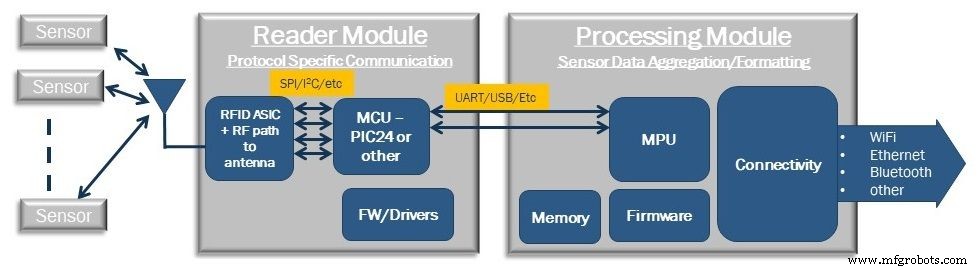
Figure 2: Sensor hub block diagram
The overall architecture is depicted in Figure 3: the hub collects data from multiple sensors and communicates with other devices via the cloud, enabling new IoT applications.
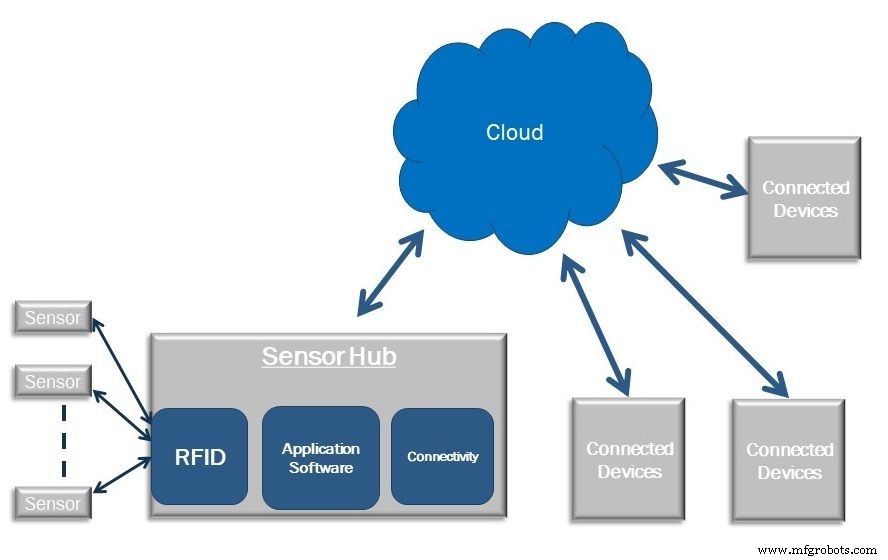
Figure 3: Sensor IoT architecture
At the heart of the sensing block lies the Magnus‑S2© Sensor IC from RF Micron, a UHF RFID chip powered by RF energy harvesting from the UHF reader. The Magnus‑S2 incorporates a patented self‑tuning Chameleon engine that optimizes the RF front‑end across varying environmental conditions. It operates in both FCC‑defined UHF and ETSI UHF bands, delivering a compact, battery‑free solution that fits easily into size‑constrained applications.
The SPS family includes:
- Temperature sensors for passive sensing on metal, non‑metal, and ceramic surfaces—ideal for predictive maintenance in data centers and industrial settings.
- Moisture sensors for passive detection on plastics, wood, ceramics, soil, and plaster—useful for leak detection and quality control.
- Fluid‑level sensors that passively sense fluid through thin plastic surfaces.
With the number of connected devices continually rising, the IoT’s success hinges on sensor performance and capabilities. Battery‑free, wireless sensors that seamlessly integrate with cloud analytics empower smarter monitoring across data centers, industrial maintenance, construction, power distribution, cold chain logistics, digital agriculture, and healthcare.
>> This article was originally published on our sister site, Power Electronics News.
Embedded
- RF Energy Harvesting Drives the Expansion of AI‑Powered Wireless Applications
- Harnessing Energy Harvesting for Reliable Edge IoT Devices
- Building IoT with Java ME 8 on Raspberry Pi: Part 1 – GPIO Sensor Integration
- Everactive Launches Battery‑Free IoT Sensors Powered by Light and Heat
- Zoltek Pioneers Renewable-Powered Carbon Fiber Manufacturing
- Revolutionizing Sensor Deployment with Wind-Driven Floating Devices
- Energy Harvesting Unlocks 1 Trillion Battery‑Free IoT Sensors
- Graphite‑Based Sensor Boosts Sensitivity & Flexibility for Wearable Medical Devices
- Ultra‑Thin, Battery‑Free MXene Strain Sensors Revolutionize Industrial Robotic Arms
- 50‑Million‑Electron Pulse Enables Self‑Powered Sensors to Operate for Over a Year