



Dukosi’s Wireless BMS: Eliminating Wiring Harnesses with Intelligent Cell‑Level Chips
The global shift toward electrification—especially in electric vehicles—has made battery monitoring essential for safety and longevity. Dukosi, a UK‑based innovator, is set to disrupt the BMS market with a wireless solution that embeds a dedicated silicon chip and firmware in every lithium‑ion cell, removing bulky wiring harnesses and adding intelligence directly to the battery pack.
In a conversation with Joel Sylvester, founder and CTO of Dukosi, we explored how the company’s technology differs from existing wireless BMS offerings and what this means for the battery industry.
“We’ve developed a cell‑monitoring device for large, high‑voltage lithium‑ion packs used in EVs, buses, marine vessels, and grid storage,” Sylvester explains. “These applications rely on precise monitoring of cell voltage, temperature, and current to ensure safety and extend life.”
The core of Dukosi’s innovation is a compact CMOS chip paired with proprietary software that measures voltage, current, temperature, and other key parameters for each cell individually.
What sets the solution apart is the chip’s placement on the cell itself. “By integrating intelligence at the cell level, we enable flexible pack design—any size, shape, or configuration—while keeping the hardware footprint minimal,” Sylvester says. “This fundamentally changes how manufacturers monitor and manage batteries.”
When speaking with potential customers, the first priority is always eliminating wiring harnesses. “Harnesses reduce reliability, create safety risks, and inflate design and manufacturing costs,” he notes. “Our system offers consistent, high‑quality measurements across every cell, dramatically improving pack performance.”
The Necessity of Advanced Battery Management
Accurate battery monitoring is critical for safety and optimal performance, especially in EVs. Traditional BMS designs rely on legacy wiring and centralized monitoring, which can be cumbersome and error‑prone. Dukosi’s truly wireless approach leverages edge computing to provide fast, flexible data collection.
The primary function of a BMS is to maintain safe charge/discharge cycles, protecting cells from degradation, damage, or fire. Beyond safety, precise state‑of‑charge (SoC) readings enable accurate range estimation, reducing range anxiety and shortening charge times. Long‑term data on temperature, voltage, and cycle counts inform state‑of‑health (SoH) assessments, critical for second‑life applications and cost‑effective recycling.
Wiring: A Persistent Challenge
While wiring harnesses are acceptable in low‑voltage systems—such as a 48V lead‑acid UPS—applying the same principles to high‑voltage EV packs (up to 800V) in harsh, confined environments is problematic. Oversized cables add weight, occupy space, and increase installation complexity. Existing wireless solutions often rely on multiplexing several cells per module, limiting the number of cells monitored and degrading measurement accuracy as the string lengthens.
Key drawbacks of conventional wireless BMS include:
- Limited cell count per module (12–16 cells) due to voltage constraints on the multiplexer.
- Increased noise pickup and reduced precision on distant cells.
- Dependence on line‑of‑sight for RF antennas, leading to unpredictable latency.
Edge Computing: The Dukosi Advantage
Dukosi embraces edge computing by equipping each cell with its own micro‑controller. The ultra‑low‑power CMOS chip draws power directly from the cell, eliminating the need for analog multiplexing and ensuring optimal measurement accuracy. Local processing interprets raw data and sends concise, aggregated information via proprietary embedded software.
Connection to the external system is achieved through patented NFC technology. A thin, low‑voltage loop runs around the battery pack, coupling inductively to each sensor’s loop with only millimeters of separation. This design provides a fast, robust data link while maintaining electrical isolation even at the highest pack voltages. Each IC carries a unique identifier and is polled by a radio manager that forwards data to the vehicle’s main electronics. The entire architecture meets ASIL C safety standards and is suitable for ASIL D‑rated packs.
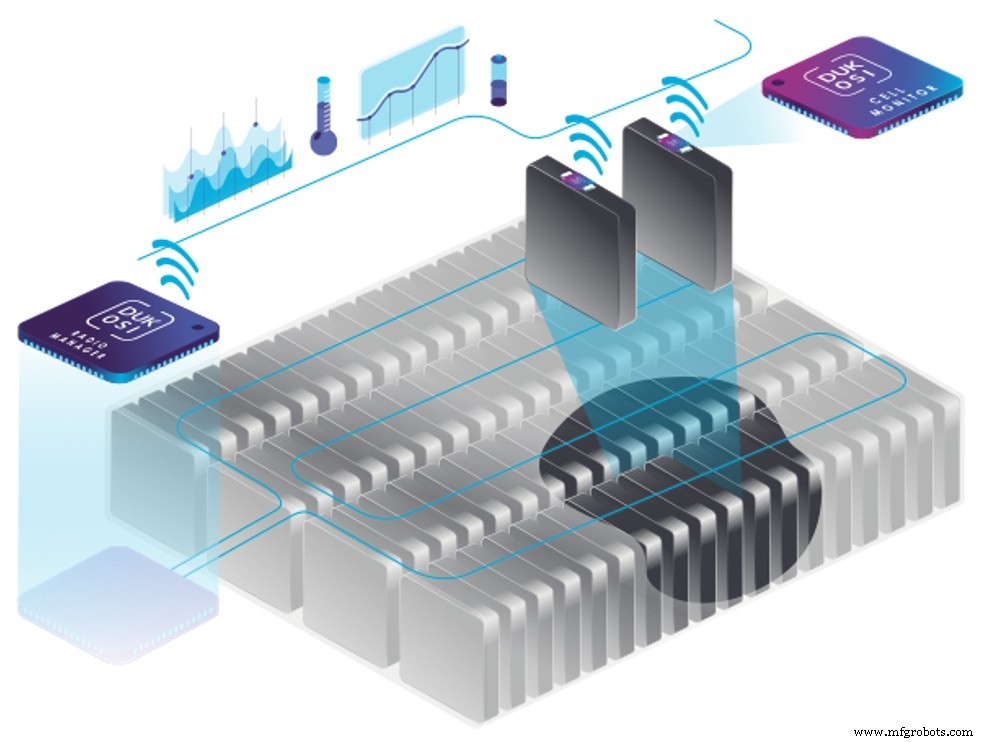
Embedding “always‑on” intelligence in each cell opens the door to continuous logging of usage and performance data, enabling real‑time state‑of‑health analysis and comprehensive provenance tracking throughout the battery’s lifecycle. By eliminating hardware, cabling, and installation costs, Dukosi’s solution offers long‑term benefits across all EV types and broader energy storage markets.
Sylvester emphasizes that the true disruption lies in the cell‑by‑cell approach. “Existing market offerings still resemble late‑1990s designs, focusing on higher cell counts per module and higher voltages. Our technology prioritizes measurement precision—each cell is monitored individually, providing industry‑leading accuracy for voltage, temperature, and more. This allows manufacturers to assemble packs without additional connectors or harnesses, vastly simplifying design and enhancing reliability.”
For a deeper dive, listen to Joel Sylvester’s full interview on the Embedded Edge with Nitin podcast.
Embedded
- How Battery‑Powered Long‑Range Wireless Is Transforming Connectivity
- STM32WLE5: Low‑Power, LoRa‑Compliant SoC for Advanced IoT Devices
- Understanding Battery Management Systems (BMS): Core Concepts and Key Components
- Mitigating Battery Management System Failures: Preventing Thermal Runaway in Li‑Ion Batteries
- Mitigating Battery Management System Failures: Strategies to Prevent Thermal Runaway
- Bosch Unveils AI-Driven Manufacturing Solution at Hannover Messe
- AI-Driven Battery Health Monitoring Enhances Longevity and Safety
- Enhanced Accuracy in EV Battery Leak Testing for Safer Lithium‑Ion Packs
- Cables Transform Manufacturing: Ensuring Power, Data, Safety, and Connectivity in the Wireless Age
- Inside the Making of Car Batteries: From Cells to Power Packs