



The Evolution and Production of the Classic Toy Wagon
Background
A toy wagon is a lightweight, four‑wheel cart featuring a sturdy body and a steering handle. Traditionally crafted using a semi‑continuous process—cutting, painting, and assembling the parts—this simple yet enduring toy dates back to the 1880s. Its basic design has remained largely unchanged, reflecting a timeless appeal that continues to resonate with children worldwide.
History
Archaeological evidence suggests that the earliest wagons were developed around the mid‑4th century B.C. in Mesopotamia, primarily for transporting agricultural and construction materials. The Romans revolutionized the design by introducing a pivoting front axle, vastly improving steering and maneuverability.
The toy wagon itself emerged in the 1880s, initially handcrafted from wood. As demand surged, manufacturers transitioned to steel and later plastic, each material offering enhanced durability and safety. Radio Flyer, founded by Italian immigrant Antonio Pasin in the early 1920s, pioneered mass production. Pasin’s adoption of automotive metal‑stamping techniques allowed the company to meet growing consumer demand, eventually becoming the world’s largest producer of coaster wagons by the 1930s. Production slowed during World War II due to steel rationing, but post‑war demand spurred a rapid rebound, leading to continuous incremental design improvements that prioritise safety and versatility.
Design
The classic toy wagon comprises four key components: the main body, undercarriage, wheels, and steering handle. The body—typically rectangular with a flat base—features rounded corners and curled top edges to eliminate hazards. Modern wagons may include removable walls or integrated storage for added functionality.
The undercarriage, built from support brackets and axles, connects the body to the wheels. The rear axle permits forward‑only motion, while the front axle is pivot‑mounted, enabling steering. Wheels incorporate ball‑bearing hubs that ensure smooth rotation and, in some models, a braking mechanism to lock the wheels in place.
The steering handle, traditionally a steel or plastic rod, extends from the front axle and is attached via a ball joint for fluid motion. Contemporary designs offer ergonomic handles that can be raised or lowered, enhancing comfort for children of various heights. All components are fastened with screws, nuts, bolts, or welds to ensure structural integrity.
Raw Materials
Toy wagons are manufactured from steel, wood, or high‑density polyethylene (HDPE). While early models were entirely wooden, steel dominates today due to its superior strength and lightness. HDPE plastic offers a modern alternative, benefiting from advances in polymer technology. Finishing touches involve non‑toxic acrylic paints—commonly red, black, or white—applied to the body and other parts. Fillers and colorants modify plastic properties and aesthetics, while rubber provides the wheels’ outer treads.
The Manufacturing Process
Production methods vary with material choice, but steel wagons typically follow these steps:
Forming the Body
- 1. A rolled steel coil is de‑spooled and straightened to eliminate kinks, then cut into rectangular sheets by a precision cutting machine. Scrap is recycled for sustainability.
- 2. The sheet is fed into a die‑casting press, forcing it into a cavity that shapes the wagon body. After ejection, trimming removes excess metal, and a crimping machine curls the top edges to soften sharp points. For added strength, some bodies undergo selective welding.
- 3. The finished body is washed, dried, and coated with a layered spray paint system, typically ending with a vibrant red finish. An oven cures the paint, followed by stenciling to imprint branding. The entire coating sequence takes roughly 30 minutes.
Making the Wheels and Other Parts
- 4. Wheels are formed by stamping circular steel discs, which are then bent into a bowl shape and welded into a rim. After painting, a rubber tire is affixed. Axles, the undercarriage, and steering rods are also stamped, cut, welded, and painted.
- 5. Plastic components—such as decorative panels or detachable accessories—are produced via injection molding. Heated plastic pellets are forced into a two‑piece mold, held under pressure, then cooled before ejection.
Packaging and Assembly
- 6. Once all parts are ready, they move to the packing area. Skilled workers assemble pre‑constructed wagons or arrange individual components for a kit. Products are wrapped in protective plastic, boxed, and sealed. For kit versions, parts are loaded onto a conveyor, boxed, and palletised before shipment to retailers.
Quality Control
Compliance with stringent toy‑safety regulations—such as those from the U.S. Consumer Product Safety Commission—guides every stage of production. Raw materials undergo initial inspection, and throughout manufacturing, trained quality‑control technicians conduct visual checks of welds, paint, and assembly. Defective parts are rejected and recycled, ensuring only safe, durable wagons reach consumers.
The Future
Innovation will focus on design refinement and production efficiency. Companies like Radio Flyer continue to secure patents for enhanced storage solutions and ergonomically improved steering handles. Advances in steel and polymer technology, coupled with automation and digital design tools, promise faster, more sustainable manufacturing. Emerging safety features—such as low‑profile wheels and advanced braking systems—are expected to set new industry standards.
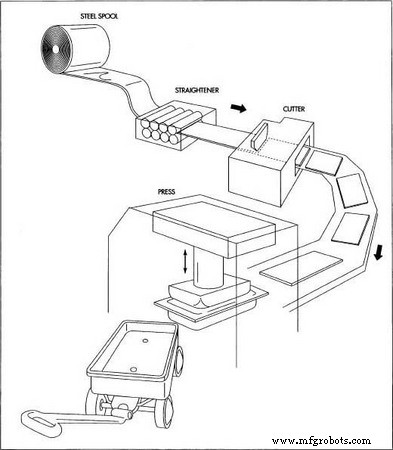
The wagon body is produced using a drawn steel stamping process. The steel is cut into rectangular sheets, which have the proper dimensions, and then molded into the shape of the wagon body.
Manufacturing process
- Amber: From Ancient Resin to Scientific Treasure – History, Properties, and Modern Uses
- The Guillotine: History, Design, and Legacy
- Silicon: Properties, Production, and Market Outlook
- The Ukulele: From Portuguese Roots to Modern Craftsmanship
- The Complete Guide to the U.S. Chicken Industry: History, Production, and Quality Control
- Compost: The Ultimate Soil Enrichment Solution
- Gelatin: From Ancient Protein to Modern Applications – Production, Uses, and Safety
- The Evolution and Manufacturing of Modern Pin‑Tumbler Locks
- Vodka: From Ancient Distillation to Modern Production
- Milk: Production, Processing, and Nutrition in the United States