



Evolution of the Goalie Mask: From Leather to High‑Tech Protection
Background
Hockey’s formal roots trace back to the 1870s in Halifax, Nova Scotia, with the first organized league forming in 1885 in Kingston, Ontario. While the sport has been played for over a century in North America and half a millennium in Europe, the goalie mask is a comparatively recent innovation. Early goalies wore no facial or head protection, relying on the fact that shots were lower‑powered and less frequent.
In 1930, Montreal Maroons’ goaltender Clint Benedict became the first to wear facial protection—a modified leather mask that covered a broken nose and cheekbone. Though he only used it for two games due to vision obstruction, it marked a significant, albeit informal, step toward protective gear.
In 1934, Roy Mosgrove, a regular glasses wearer, introduced a wire cage—originally used by baseball catchers—to safeguard his lenses. This adaptation paved the way for the wire cages that would later be integrated into modern fiberglass masks.
As players grew stronger and the slapshot evolved, facial injuries surged. The 1950s saw experimental wire cages and clear shatter‑proof shields used only in practice, plagued by fogging, glare, and blind spots. Many goalies resisted game‑use, fearing ridicule and perceiving protection as a sign of weakness.
History
While Benedict’s 1930 mask is often cited, the first formally recorded goalie mask debuted on November 1, 1959, when Jacques Plante of the Montreal Canadiens was hit by a rising shot from New York Ranger Andy Bathgate. Plante, after being stitched up, returned wearing a flesh‑tone fiberglass mask with eye cutouts.
Plante’s mask was engineered by Bill Burchmore of Fiberglass Canada. After witnessing Plante’s injury, Burchmore envisioned a contoured, lightweight fiberglass mask that fit like a second skin. The prototype—0.125 in (3.2 mm) thick, 14 oz (397 g)—was molded using a woman's stocking, Vaseline, and plaster, setting a new standard for goalie safety.
By January 1960, Burchmore introduced the “pretzel” design, featuring fiberglass bars that improved airflow and reduced weight to 10.3 oz (292 g). In 1970, Plante added hard ridges and an ear protrusion, and epoxy resins further enhanced impact absorption. These masks survived rigorous tests, with pucks fired at 120 mph (193 km/h) breaking only the pucks themselves.
In 1973, the NHL mandated mask usage for all goaltenders. Today, the rule is enforced across major leagues. A standard puck weighs 6 oz (170 g) and can travel over 100 mph (161 km/h), underscoring the necessity of robust protection.
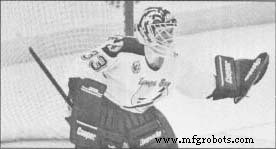
Manon Rheaume
Born in 1972 in Lac Beauport, Quebec, Manon Rheaume began skating at four and quickly transitioned to goalkeeping. She played for boys’ teams through high school, advanced to Canada’s Junior B and briefly Junior A leagues, and shone with the national women’s team, securing a gold medal at the 1992 World Championships.
Rheaume’s NHL debut came after a tryout with the Tampa Bay Lightning in 1992, where she posted seven saves in the first period of an exhibition. She became the first woman to play in an NHL game, cementing her legacy.
Raw Materials
Modern goalie masks retain fiberglass and epoxy resins but now incorporate Kevlar, carbon fiber, and Capron nylon resin for added strength and lightness. Fiberglass remains popular due to its durability, moldability, and varied weight options.
Kevlar, the same material used in bullet‑proof vests, boosts impact resistance without significant weight gain. Carbon fiber offers superior stiffness and strength, though at a higher cost; it’s employed sparingly in high‑performance masks.
Padding uses rubber and foam, while cages are constructed from stainless steel or titanium. The transition to metal cages began after Bernie Parent’s eye injury, leading to safer, more durable eye protection.
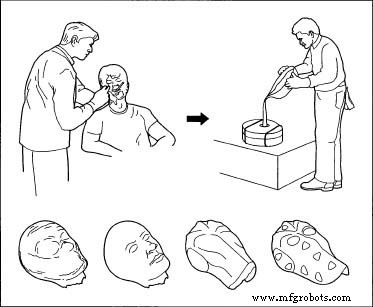
An example of mold taking and mask formation.
Alginate—a dental‑mold gel—is the standard material for head impressions, ensuring a precise fit.
Design
Goalie masks vary in size, color, and artistry. Gerry Cheevers first painted puck‑stitch scars on his mask, while Glenn "Chico" Resch’s 1976 mask became the NHL’s first artistically painted mask, thanks to art student Linda Spineela.
Decorative techniques include painting, airbrushing, and the use of epoxy primers, basecoats, automotive paints, and urethane clearcoats. The finishing process—sanding, polishing, and baking—ensures durability and chip resistance.
The Manufacturing Process
Custom masks still rely on hand‑crafted methods to guarantee a perfect fit.
- Alginate is applied over a bald cap and nostril straws to capture a full head impression. After four minutes, the mold is removed.
- Plaster is poured into the mold to create a bust, which dries before sculpting.
- Clay or paper mâché sculpts the beak area, ears, and other features onto the bust.
- Fiberglass sheets, optionally reinforced with Kevlar or carbon fiber, are layered over the sculpted bust. Epoxy resin bonds the layers, eliminating air pockets for structural integrity.
- Once cured, the mask is demolded, trimmed, primed, and painted with enamel topcoat.
- Stainless steel or titanium cages are affixed to protect the eyes.
- Interior rubber padding, chin straps, and a snug fit complete the final product.
Byproducts/Waste
While fiberglass remains durable, padding and cages degrade over time. Manufacturers offer reconditioning—replacing padding, installing new cages, and repairing chips—to extend mask life and reduce costs.
The Future
As player speed and puck velocity rise, ongoing research into advanced materials and manufacturing techniques will drive future mask designs, ensuring greater safety without compromising performance.
Where to Learn More
Books
Hunter, Doug. A Breed Apart: An Illustrated History of Goaltending. Triumph Books, 1998.
Other Resources
Classic Mask Web Page (Dec 2001)
Dillon’s Custom Goalie Mask, LTD Web Page (Dec 2001)
NHL.com (Dec 2001)
Pro‑Masque Web Page (Dec 2001)
Sportmask Web Page (Dec 2001)
The Science of Hockey Web Page (Dec 2001)
Manufacturing process
- Amber: From Ancient Resin to Scientific Treasure – History, Properties, and Modern Uses
- The Guillotine: History, Design, and Legacy
- Silicon: Properties, Production, and Market Outlook
- The Ukulele: From Portuguese Roots to Modern Craftsmanship
- The Complete Guide to the U.S. Chicken Industry: History, Production, and Quality Control
- Compost: The Ultimate Soil Enrichment Solution
- Gelatin: From Ancient Protein to Modern Applications – Production, Uses, and Safety
- The Evolution and Manufacturing of Modern Pin‑Tumbler Locks
- Vodka: From Ancient Distillation to Modern Production
- Milk: Production, Processing, and Nutrition in the United States