



Vodka: From Ancient Distillation to Modern Production
Vodka is a neutral spirit crafted by distilling a fermented mash of vegetables or grains to a high proof. Proof is a measure of alcohol content: each proof unit equals 0.5 % ABV. A 100‑proof spirit contains 50 % ABV, 90 proof 45 %, and so on. Distilled vodkas may reach proofs as high as 145, during which the distillation process removes flavor and aroma, resulting in a neutral spirit. Water is then added to dilute the spirit to a final proof between 80 and 100.
Background
The tradition of fermenting grains, fruits, and sugars to produce alcohol dates back to antiquity. Yeast, bacteria, and mold catalyze fermentation, converting sugars into ethyl alcohol. The first recorded description of distillation appears in the 10th‑century writings of Arabian alchemist Albukassen, with later mentions by 13th‑century Majorcan mystic Ramon Llull. Distillation—a heating and condensing process that isolates vapor from liquids or solids—gave rise to ardent spirits.
Scholars debate whether Russia or Poland pioneered vodka distillation, but most historical references attribute the earliest production to Russia. Vodka drinking is documented in Eastern and Northern Europe since the 4th century, where spirits were distilled to very high proofs to eliminate aroma and flavor.
For centuries vodka remained largely an Eastern and Northern European specialty. It was not until the 1930s that it began to permeate Western Europe and North America. A 1930 British publication, the Savoy Cocktail Book, was the first to feature vodka cocktails. The “Blue Monday” combined vodka with Cointreau and blue vegetable juice, while a “Russian Cocktail” added creme de cacao and dry gin to the neutral spirit.
The Smirnoff family distillery, founded in 1818 in Moscow, produced one million bottles daily by the 1910s. Following the 1917 Bolshevik Revolution, the family lost the business. In 1934, Russian immigrant Rudolph Kunitt secured American rights to the Smirnoff name, opened a distillery in Bethel, Connecticut, and struggled for five years before selling to the Heublein Company in 1939.
Heublein executive John C. Martin identified vodka’s popularity within the California film industry and cultivated those customers. In 1946 he met a Los Angeles restaurateur from the Cock ’n’ Bull who was trying to offload excess ginger beer. By mixing vodka with ginger beer, adding lime, and naming the creation the “Moscow Mule,” they achieved instant success.
By the 1950s, vodka sales in the United States surged—from 40,000 cases in 1950 to just over one million in 1954, and 4.5 million cases in 1955. By the mid‑1960s vodka surpassed gin, and by 1976 it eclipsed whiskey. By the end of the 20th century, vodka accounted for 25 % of the distilled‑spirits market.
Until the mid‑18th century, vodka production was a home‑based, single‑pot operation known as batching. Grains or potatoes were heated until starch was released, then fermented, and finally distilled at high temperature.
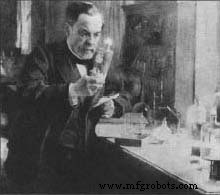
Louis Pasteur
Louis Pasteur, a foundational figure in microbiology, elucidated how microorganisms drive fermentation and disease. His research revealed that yeast converts sugars into alcohol and carbon dioxide, and that fermentation only occurs in the presence of living yeast cells.
Pasteur’s work also addressed the spoiling of wine and beer, a major economic loss in France. By heating wine to about 120 °F, he killed lactic‑acid bacteria that caused souring, thereby extending proper aging. His 1866 book Etudes sur le Vin sparked a revolution in winemaking, emphasizing cleanliness and heat to eliminate bacteria. This concept later extended to pasteurization of milk, championed by American bacteriologist Alice Catherine Evans.
Multiple distillations yield higher‑proof, purer spirits. In 1826, Robert Stein invented the continuous still, allowing repeated recycling of steam and alcohol. Aeneas Coffey later refined Stein’s design. Modern continuous stills feature three primary sections: still heads for vapor collection, fractionating columns to separate ethanol, and condensers to re‑condense vapor into liquid.
Pasteur’s work on lactic acid fermentation informs modern vodka production, where lactic acid inoculation combats bacterial contamination.
Initially, charcoal filtration purified vodka. In the early 20th century, rectification replaced it: spirits pass through multiple purifying cylinders to eliminate impurities such as solvents, fusel oil, and methanol.
Raw Materials
Vegetables or grains
Vodka’s neutral character allows it to be distilled from virtually any fermentable ingredient. Historically, potatoes were primary; many Eastern European vodkas still use potatoes and corn. Most high‑quality imports and all U.S. vodkas are distilled from cereal grains such as wheat, sourced from suppliers or company‑owned fields.
Water
Water is added after distillation to reduce alcohol content to the desired proof. Sources include external suppliers or company‑owned wells.
Malt meal
Because grains and vegetables contain starch rather than sugar, an enzymatic conversion step is necessary. Malted grains are soaked to germinate, then ground into malt meal, which supplies diastase to convert starches into fermentable sugars such as maltose and dextrin during mashing.
Yeast
The single‑cell fungus Saccharomyces cerevisiae provides the enzymes that ferment sugars into alcohol. Yeast is purchased from specialized suppliers.
Flavorings
Since the late 20th century, flavored vodkas have gained popularity. Herbs, grasses, spices, and fruit essences can be added post‑distillation, typically sourced from third‑party suppliers.
The Manufacturing Process
Mash preparation
- Grain or vegetables are loaded into an automatic mash tub equipped with agitators that break down the material as the tub rotates. Ground malt meal is added to promote starch‑to‑sugar conversion.
Sterilization and inoculation
- To prevent bacterial growth, the mash is sterilized by boiling. Lactic‑acid bacteria are then introduced to raise acidity for fermentation. Once the target acidity is achieved, the mash is inoculated again with yeast.
Fermentation
- The mash is transferred to large stainless‑steel vats. Yeast is added, and the vats are sealed. Over two to four days, yeast enzymes convert sugars into ethyl alcohol.
Distillation and rectification
- Ethyl alcohol is pumped to stainless‑steel columns—vaporization chambers stacked vertically. The alcohol cycles repeatedly, heated with steam, until vapors are released and condensed. This process removes impurities. Vapors rise into the upper chambers (still heads) for concentration, while lower‑grade materials are discarded. Grain residue may be sold as livestock feed.
Water added
- Concentrated vapors contain 95–100 % alcohol (190 proof). Water is added to lower the alcohol to 40 % ABV, yielding 80 proof for consumption.
Bottling
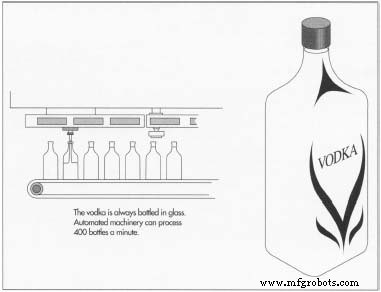
- Vodka is bottled in glass, the non‑reactive material that preserves purity. The bottling line is highly automated: bottles are cleaned, filled, capped, sealed, labeled, and packed into cartons, with production rates up to 400 bottles per minute.
Quality Control
While tasters sample vodka throughout the production process, regulatory oversight provides the bulk of quality assurance. The Bureau of Alcohol, Tobacco and Firearms (ATF) enforces strict guidelines for production, labeling, importation, advertising, and plant security. For instance, charcoal‑filtered vodka imports are prohibited, flavored vodkas must list their primary flavor on the label, and supplier relationships are heavily regulated.
Manufacturing process
- Amber: From Ancient Resin to Scientific Treasure – History, Properties, and Modern Uses
- The Guillotine: History, Design, and Legacy
- Silicon: Properties, Production, and Market Outlook
- The Ukulele: From Portuguese Roots to Modern Craftsmanship
- The Complete Guide to the U.S. Chicken Industry: History, Production, and Quality Control
- Compost: The Ultimate Soil Enrichment Solution
- Gelatin: From Ancient Protein to Modern Applications – Production, Uses, and Safety
- The Evolution and Manufacturing of Modern Pin‑Tumbler Locks
- Milk: Production, Processing, and Nutrition in the United States
- The History and Modern Production of Mascara: From Ancient Kohl to Contemporary Formulations