



The Rise of the Vegetarian Burger: History, Production, and Future
A vegetarian burger—also known as a veggieburger—is a meat‑free patty crafted from a blend of plant‑based proteins, such as soy, grains, legumes, and finely diced vegetables. It offers a savory, satisfying alternative for those seeking health, sustainability, or ethical dining.
Background
The modern American love affair with burgers dates back to the 1850s when German immigrants introduced the Hamburg steak, a seasoned ground‑beef patty served on a roll. By the early 20th century, a 15‑30% fat content had become the benchmark for juiciness, yet rising health concerns and the growing popularity of vegetarian diets spurred food processors to innovate meatless options.
Vegetarianism is not a new phenomenon. Buddhist monks in the 8th century introduced tofu to Japan, and ancient Greek philosophers like Pythagoras championed a diet free of animal flesh. In Christianity, monastic orders and Catholic penitential practices avoided meat on Fridays and during Lent, setting a religious precedent for vegetarianism.
By the mid‑1800s, organized vegetarian societies emerged: the Vegetarian Society of Great Britain (1847) and the American Vegetarian Society (1850). In the 20th century, health advocacy intensified, notably through the Seventh‑Day Adventist Church, whose emphasis on plant‑based nutrition led to pioneers such as John Harvey Kellogg and the creation of the first meat substitute, “nuttose.” Worthington Foods (est. 1939) began producing the Morningstar Farms veggieburger, laying groundwork for a burgeoning industry.
The 1970s marked a pivotal era: Frances Moore Lappe’s *Diet for a Small Planet* (1971) and Peter Singer’s *Animal Liberation* (1975) galvanized public concern for animal welfare and environmental impact. By the late 1990s, vegetarianism had roughly 15 million adherents in the U.S., and companies like Gardenburger, Inc. (founded 1985) had secured a foothold in the mainstream market.
Raw Materials
Veggieburgers are made from a diverse ingredient palette: soybeans, rice, whole wheat, black beans, corn, lentils, mushrooms, carrots, zucchini, and occasionally stabilizers such as tapioca starch or vegetable gum. Sourcing is strict—each batch is inspected for quality, and any spoiled or contaminated material is discarded.
The Manufacturing Process
Washing
- Grains and vegetables are washed separately using high‑pressure spray or tumbling drums to remove dirt, bacteria, and chemical residues.
Cooking the Grains
- Base grains (e.g., whole wheat, rice, beans) are cooked in vats until softened, then strained to remove excess water.
Dicing the Vegetables
- Vegetables are diced into uniform pieces—machine‑cut for consistency, though artisanal producers may still do it by hand.
Combining Grains and Vegetables
- Measured grain puree and diced vegetables are mixed in large industrial bowls to ensure even distribution.
Forming the Patties
- The blended mixture is fed into a cylindrical patty‑press that shapes it into uniform patties.
-
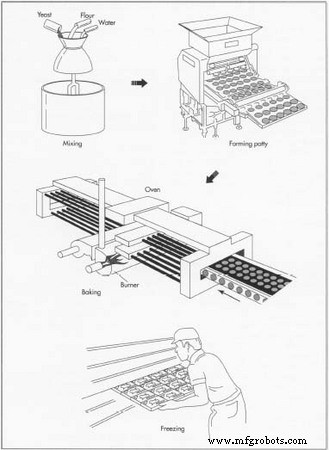
After forming, patties are placed on perforated baking trays, baked, then quickly frozen to lock in texture and flavor.
Baking the Patties
- Patty trays are baked at a controlled temperature for about 90 minutes.
Patties are Quick‑Frozen
- Within 30 minutes, trays enter a sub‑freezing chamber (<32°F/0°C) to form fine ice crystals that preserve moisture during later cooking.
Patties are Vacuum‑Packed and Packaged
- Patty trays move to a vacuum‑packing machine that seals each patty in a plastic sleeve, then packages four per cardboard carton. Frozen products are stored and shipped in temperature‑controlled environments.
Quality Control
Compliance with FDA regulations governs sterilization, ingredient quality, and storage. Raw materials are evaluated visually and by taste, and product samples are taken throughout the line to ensure consistency and safety.
The Future
Consumer demand for healthier, sustainable options continues to rise, yet the challenge remains to replicate the flavor profile and mouthfeel of beef, especially for consumers accustomed to high‑fat patties. Media exposure—such as Boca Burgers served at the White House and Gardenburger’s advertising on *Seinfeld*—has boosted visibility, but true market penetration likely hinges on major chains like McDonald’s or Burger King adding veggieburgers to their menus.
Manufacturing process
- Amber: From Ancient Resin to Scientific Treasure – History, Properties, and Modern Uses
- The Guillotine: History, Design, and Legacy
- Silicon: Properties, Production, and Market Outlook
- The Ukulele: From Portuguese Roots to Modern Craftsmanship
- The Complete Guide to the U.S. Chicken Industry: History, Production, and Quality Control
- Compost: The Ultimate Soil Enrichment Solution
- Gelatin: From Ancient Protein to Modern Applications – Production, Uses, and Safety
- The Evolution and Manufacturing of Modern Pin‑Tumbler Locks
- Vodka: From Ancient Distillation to Modern Production
- Milk: Production, Processing, and Nutrition in the United States