



The Evolution and Craft of the Modern Swimsuit: From Ancient Pools to High‑Tech Fabric
Background
A swimsuit is a specialized garment designed for swimming and sunbathing. Women typically wear a two‑piece bra and panty set or a one‑piece maillot, while men opt for a bikini‑style brief or a longer swim trunk.
History
Although swimming is not a natural human ability, people have been drawn to water since antiquity. The Romans constructed the first swimming pools, and by the first century B.C. they even introduced heated baths. In Japan, swimming competitions were common during this era. Europeans were slower to embrace the sport, partly due to fears of waterborne infections. By the mid‑nineteenth century, swimming clubs began to proliferate, especially in London.
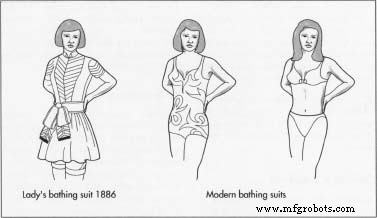
The modern swimsuit emerged in the early twentieth century. Earlier bathing attire—bloomers, overblouses, stockings, and shoes—reflected societal norms that frowned on suntanning and exposed skin. Over the following decades, styles evolved dramatically, reflecting changing attitudes toward modesty and body confidence.
In 1902, John Zehntbauer, Roy Zehntbauer, and Carl Jantzen, owners of the Portland Knitting Company in Oregon, were commissioned by a rowing club to create a wool rib‑knit suit that retained body heat. Although heavy and poorly suited for swimming, this garment sparked the idea of a form‑fitting swimwear piece. The Jantzen brand would later produce sleeveless shifts paired with long shorts, setting the stage for modern designs.
The 1930s saw sunbathing become a mainstream pastime. Women’s swimsuits began to feature lower‑cut backs and armholes for increased sun exposure. Jantzen introduced the Shouldaire model, adding a drawstring above the bustline to adjust shoulder straps for better suntan coverage. That decade also marked the first public appearance of women’s midriffs, eventually leading to the two‑piece swimwear.
Synthetic fabrics revolutionized swimwear. Rayon was the first fabric used, followed by the American Rubber Company’s Lastex—an extruded rubber encased in fiber. Lastex, however, was not colorfast and lost shape when stretched, limiting its longevity. In 1939, E. I. duPont de Nemours & Company unveiled nylon 6.6, which dramatically advanced the synthetic textile industry. Subsequent materials such as Dacron, Orlon, Lycra, and Spandex further enhanced performance and comfort.
1946 marked a pivotal moment with the introduction of the bikini in Paris. Named after the Pacific atoll where atomic bomb tests were conducted, the two‑piece suit sparked controversy but quickly gained popularity in Europe. It did not become mainstream in the United States until the 1960s.
The 1970s brought Lycra into widespread use, enabling designers to manipulate the garment’s shape for flattering silhouettes. Soft one‑piece maillots gained popularity and remain a staple today. In 1977, designer Rudi Geinrich launched the thong bikini, featuring a minimal rear strap—a style that remains popular worldwide, though it often faces controversy in the U.S.
The 1980s introduced UV‑transmitting fabrics that allowed wearers to tan through the material. This trend faded as public awareness of skin cancer increased. The decade also saw the French cut, characterized by high leg openings at the hip.
Competitive swimming has continually pushed design boundaries. During the 2000 Sydney Olympics, full‑body suits like Speedo’s Fastkin, made from shark‑skin‑like material, generated debate over performance enhancement. While some teams requested a ban, the Olympic governing committee ultimately allowed their use.
Raw Materials
The primary component of a swimsuit is fabric. Some manufacturers produce their own textiles, while others source them externally. Synthetic dyes color the fabric. Historically, dyes were extracted from animal, vegetable, and mineral sources. In 1856, chemist William H. Perkin accidentally synthesized mauveine, a purple dye, while attempting to produce quinine.
Dye application varies by dye type, fabric, and desired effect. Simple processes involve dipping cloth in a dye solution, sometimes with an oxygen reagent for uniformity. In mordant dying, a wet metallic solution (tin, chromium, iron, or aluminum) is applied to the fabric before the dye, embedding color within the fibers. Hot‑dyeing immerses fabric in a heated dye solution. Patterns arise when woven fabrics containing different yarns react variably to dyes.
In addition to fabric, the bra component of a bikini or two‑piece may feature metal or plastic fasteners. Men’s swim trunks often include a drawstring waistband, and elastic is used for straps, leg openings, and waistbands.
Design
Design is pivotal in swimsuit manufacturing, balancing aesthetics, comfort, colorfastness, and elasticity. Designers combine hand sketches with computer‑assisted design (CAD) to prototype new styles. A sketch is enlarged to a paper pattern, and a muslin sample is cut and fitted on a mannequin. Colors and fabrics are chosen, and the sample is trialed on a human model, allowing iterative refinements.
With CAD, designers use a stylus on a digitizing pad to create digital garments. Color and fabric choices are previewed on screen. Templates are then sent to factories for cutting.
The Manufacturing Process
The manufacturing of swimsuits is largely automated, with factory workers guiding machinery to ensure precision.
- Spools of cotton and synthetic thread are fed into knitting machines that weave them into rolls of fabric. These rolls are then washed and dyed in tanks containing measured bleach and color dyes. After drying, the fabric is re‑rolled and stored.
- Workers spread bolts of fabric on tables, wrap them around a new bolt, and feed predetermined length data into an encoder. The encoder controls blades that cut the fabric.
- Cut lengths are stacked and fed into a piece‑cutting machine. In larger plants, computer‑fed patterns guide the cutting; in smaller shops, manual pattern marking is used. The number of pieces depends on the style: a one‑piece maillot typically uses two pieces; a bikini requires two brief panels and four to six bra panels, plus cups and lining. Men’s trunks use two to four panels.
- Pieces are stitched together at dedicated stations. For a bikini, the bra cup is placed between lining and front panels, then stitched together. Elastic is inserted for straps, and hooks or loops are added for closure. Briefs are assembled similarly, with elastic at waistbands and leg openings.
- Finished garments are pressed, labeled inside, packaged in plastic bags, and shipped in cartons to retailers.
Quality Control
Swimsuits undergo rigorous testing: repeated washings in fresh, salt, and chlorinated water, simulated sunlight exposure, and tensile tests before and after washings to assess shape retention. Volunteer testers provide feedback on comfort and wearability.
By‑products / Waste
Primary waste arises from dyeing and synthetic fabric production. A dedicated recycling industry re‑purifies dye solutions and repurposes synthetic residue, often into plastic bottles. Post‑sewing waste is minimal thanks to precise cutting; stray thread and fabric scraps are discarded.
The Future
While design changes have been modest over the past two decades, demand for swimwear continues to grow alongside the sport’s popularity. Future innovations are likely to focus on figure enhancement and performance. Computer‑assisted design and manufacturing will increase, and industry groups are working toward a universal CAD language standard.
Where to Learn More
Books
I Want to be a Fashion Designer. San Diego: Harcourt Brace, 1999.
Other
Good Housekeeping Magazine Web Page. December 2001. https://goodhousekeeping.women.com
Jantzen Web Page. December 2001. https://www.jantzen.com
"The History of the Bathing Suit." Retro Web Page. December 2001. https://www.retroactive.com/mar98/swimsuit.html
Mary MeNulty
Manufacturing process
- Amber: From Ancient Resin to Scientific Treasure – History, Properties, and Modern Uses
- The Guillotine: History, Design, and Legacy
- The Art and Craft of Headstones: History, Materials, and Modern Manufacturing
- Silicon: Properties, Production, and Market Outlook
- Skateboarding: History, Design, and Modern Manufacturing
- The Ukulele: From Portuguese Roots to Modern Craftsmanship
- The Complete Guide to the U.S. Chicken Industry: History, Production, and Quality Control
- Compost: The Ultimate Soil Enrichment Solution
- The Evolution of the Sword: From Bronze to Modern Ceremonial Weaponry
- Build a Real‑Life Portal 2 Turret Gun with Arduino – 3‑Axis Motion & Audio