



The Tuba: From 19th‑Century Innovation to Modern Craftsmanship
The tuba, the lowest‑pitched member of the brass family, combines a massive conical bore, a flared bell, and a cup‑shaped mouthpiece to deliver a resonant, powerful tone. Built from machined brass tubes that are bent, soldered, and finished by skilled artisans, the instrument evolved in the early 19th century to meet orchestras’ need for a true bass voice.
Background
As a brass wind instrument, the tuba produces sound by the player’s lip buzz against the cup mouthpiece. This vibration sets the internal air column into motion; valves change the effective length of the tubing, allowing musicians to play a range of pitches. In orchestral settings the tuba anchors the harmonic foundation, reaching as low as a bottom‑D on the piano and often delivering both staccato passages and sustained melodic lines.
History
The tuba’s origins lie in the 1820s with the ophicleide, a keyed bugle‑like instrument that could play as low as F. Its complexity and limited playability prompted instrument makers to seek a more practical solution. In 1835, Johann Gottfried Moritz and Wilhelm Wieprecht patented the first true bass tuba, featuring the Berliner‑Pumpe piston valve. Their prototype, pitched in F, had five valves and was constructed from brass with silver fittings.
Moritz and Wieprecht’s later design, the bombardon, introduced a wider bore and later adopted rotary valves. By 1845 Adolphe Sax’s sax‑horn family included a contrabass member that closely resembled the modern tuba. The 1849 hellicon, a shoulder‑rested circular‑coil instrument, was popular in British brass bands. John Philip Sousa’s commission of C. G. Conn in the 1860s led to the sousaphone, a more audience‑friendly version that remains a staple of marching ensembles.
By 1880 the tuba had largely supplanted the ophicleide in Germany, Britain, and France, becoming the standard bass instrument in orchestras and concert bands.
Design
The core design of the tuba has remained remarkably stable. The instrument’s bell ranges from 14 in to 30 in (35.6 cm–76.2 cm) in diameter, and the main tube is formed into an elliptical coil with the bell pointing upward. Variants such as the sousaphone feature a forward‑facing bell, while some upright models have sideways bells, each orientation affecting tonal coloration.
Most tubas employ four piston valves, though models with two to six valves exist, and rotary valves are used by select manufacturers for faster action. The mouthpiece is a large, cup‑shaped piece typically made of brass. Tubas are available in five principal keys: BB♭, C, E♭, F, and the contrabass G bugle.
Raw Materials
Brass, an alloy of copper and zinc, is the primary material. The most common composition is yellow brass (70 % copper, 30 % zinc), chosen for its malleability and warm tone. Alternative alloys such as red‑gold brass (80 % copper, 20 % zinc) and silver brass (copper, zinc, and nickel) are used to achieve specific acoustic or aesthetic qualities. For bell construction, high‑purity Ambronze (85 % copper, 13 % zinc, 2 % tin) delivers a distinctive resonance.
Stainless steel provides the screws and some valve components, while chromium or nickel alloys may coat sliding parts to reduce friction. Mother‑of‑pearl adorns valve buttons, cork lines the water key, and the sousaphone’s body is often lightweight fiberglass.
The Manufacturing Process
Because tubas are produced in smaller quantities than trumpets or trombones, production is largely hand‑crafted. The process follows three core stages: piece making, assembly, and final finishing.
Piece Making
- 1. The main body, valves, bell, and mouthpiece are forged and drawn from brass blanks. Each component is first shaped on a mandrel or die, then heated, acid‑etched to remove oxides, and cooled to a workable state.
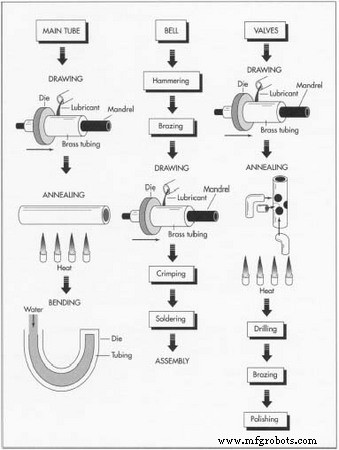 A tuba’s parts are crafted by drawing, hammering, and bending operations.
 - 2. Tubes are bent into the instrument’s characteristic curves using hydraulic or ball‑bearing methods that force the metal to adopt a die’s shape. Precision is maintained by computer‑guided drilling for valve casings and piston holes.
- 3. Valve casings and pistons are threaded, heated, and soldered together on a jig. The assembly undergoes a second acid bath to remove excess solder, followed by polishing.
- 4. The bell is formed from a flat brass sheet, wrapped around a mandrel, hammered into shape, and finished with lap and butt joints. A wire rim is crimped for reinforcement.
- 5. Mouthpieces are cast in two‑piece dies, cooled, and then ejected for inspection.
Assembly
- 6. Valve groups are attached to the main tube and soldered. The bell is affixed, and water keys, thumb rings, and other accessories are mounted. Precision alignment ensures optimal playability.
Final Finishing
- 7. The completed instrument is cleaned, polished, and may be electroplated with gold or silver alloy for visual appeal. The manufacturer’s logo is engraved by hand or machine. Each tuba is then boxed in a lightweight, felt‑lined case with its mouthpiece and shipped to the customer.
Quality Control
Quality checks occur at every production stage. Visual inspections identify deformities, poor solder joints, or dimensional errors. Precision instruments such as vernier calipers and micrometers verify dimensions of tubing, bell, and valves. Acoustic tests are performed by professional musicians to confirm pitch, intonation, and tonal consistency under various conditions.
Manufacturing process
- Amber: From Ancient Resin to Scientific Treasure – History, Properties, and Modern Uses
- The Guillotine: History, Design, and Legacy
- The Saxophone: History, Design, and Modern Manufacturing
- Silicon: Properties, Production, and Market Outlook
- The Ukulele: From Portuguese Roots to Modern Craftsmanship
- The Complete Guide to the U.S. Chicken Industry: History, Production, and Quality Control
- Compost: The Ultimate Soil Enrichment Solution
- Gelatin: From Ancient Protein to Modern Applications – Production, Uses, and Safety
- The Evolution and Manufacturing of Modern Pin‑Tumbler Locks
- Vodka: From Ancient Distillation to Modern Production