



Condensed Soup: From Dorrance’s 1899 Innovation to Global Markets
Background
Condensed soup is a canned product made by reducing the liquid content of a traditional soup. After rehydration with water or milk, the mixture is heated to serve. The concept was pioneered by John T. Dorrance of the Campbell Soup Company in 1899, revolutionizing how Americans accessed ready‑to‑eat soups.
Historical Context
Boiling foods in water, as opposed to open‑flame cooking, concentrates flavors and produces denser textures. This practice dates back to prehistoric times, evidenced by Iron and Bronze Age pots filled with food residues. The Romans enjoyed fish broths, and medieval cookbooks such as Robert May’s Accomplished Cook (1660) listed “soops” featuring spinach, carrots, and more. Soup was often served over toasted bread, a practice rooted in the word “soup,” derived from “sop.” In colonial America, soup’s popularity grew slowly. The first American cookbook, published in Williamsburg, Virginia by William Parks in 1742, included “Soop Sante,” “Pease Soop,” and “Brooth.” German immigrants in Pennsylvania introduced diverse soups, turning preparation into a communal ceremony. French immigrants, fleeing the Revolution, further popularized soup; Jean Baptiste Gilbert Payplat dis Julien’s Boston restaurant (1794) earned the nickname “Prince of Soups.” American cookbooks expanded their soup offerings in the 19th century, notably Mary Randolph’s Virginia House-Wife (1824), which featured 16 recipes and offered seasoning tips. However, soup remained less prevalent in the U.S. compared to Europe until Dorrance’s breakthrough.
John Dorrance’s Innovation
After studying chemistry in Germany, Dorrance returned to Campbell’s, where he observed only two U.S. companies canned soup: Franco‑American and Huckens. These small, perishable batches were difficult to ship and unprofitable. Dorrance applied chemical principles to create a more concentrated, shelf‑stable soup. By halving the water content, he reduced weight while preserving flavor—a process akin to creating a sauce.
Within a year, he launched five condensed soup varieties: tomato, consommé, vegetable, chicken, and oxtail. Door‑to‑door sales introduced families to this convenient option. His success turned Campbell’s profitable for the first time, leading to the 1921 corporate renaming. Dorrance’s recipes were tightly guarded, split into ingredient lists with precise measurements and separate cooking instructions, and the production process was divided between two plant departments.
Raw Materials
Condensed soups rely on a broad palette of ingredients:
- Meat: Beef or chicken for stock.
- Vegetables: Broccoli, cabbage, corn, green beans, lima beans, okra, onions, peas, tomatoes, white potatoes.
- Grains: Noodles, rice, barley.
- Seasonings: Allspice, bay leaves, celery seed, cloves, curry powder, parsley, pepper, salt, sugar, thyme.
- Thickeners: Flour, mashed sweet potatoes.
- Oils: Vegetable or soybean oil to coat pans.
- Flavor enhancers: Worcestershire sauce (anchovy essence, clover, garlic, malt vinegar, meat extract, molasses, shallot, sugar, tamarind).
- Preservatives: Monosodium glutamate (MSG), a seaweed‑derived salt, extends shelf life.
Manufacturing Process (Tomato Soup Example)
Stock Preparation
- Equal parts lean beef and heavy bones are placed in 220‑gal iron kettles, covered with cold water, and soaked 15‑20 minutes before heating.
- The stock simmers for 6‑8 hours, with regular skimming of scum via mechanized long‑handled skimmers. Spices are added midway, and the finished stock is poured off through a screen that traps solids.
Tomato Processing
- Grade‑1 tomatoes are washed in hanging baskets, then transferred to trays for a second rinse.
- They are crushed in a hammermill, producing pulp that is simmered in 600‑gal copper breaker kettles.
- Cooked pulp passes through cyclones and fine‑mesh sieves to remove seeds and skins, yielding a smooth tomato liquid stored in stainless‑steel tanks. Seeds are saved for planting.
Seasoning the Water
- A proprietary blend of celery seed, cloves, allspice, and bay leaves is boiled for 10 minutes, then filtered through graded cheese cloth.
Paste Creation
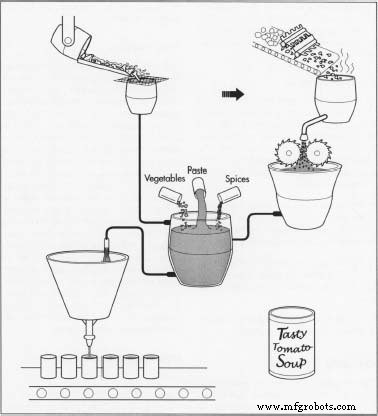
- Flour and raw tomato pulp are mixed in an industrial mixer to form a homogeneous paste.
Assembly
- Cooked tomato liquid is pumped into 10‑gal kettles, gradually stirred until the volume reaches 95 gal.
- Salad oil, chopped garlic, onions, the tomato paste, and the seasoned water are added sequentially. Flavors like pepper, salt, sugar, and Worcestershire sauce are incorporated.
- The mixture boils 2‑3 minutes, allowing flour to thicken. It then passes through a cyclone fitted with a #16 iron sieve and paddle brushes, followed by a tightly woven brass wire screen that removes any specks.
Canning
- The condensed soup, now sauce‑like, is piped to the canning line, where valves dispense uniform portions into cans, which are then sealed.
- Cans are sterilized in a cylindrical retort, exposed to heat for ~30 minutes.
- They are cooled by a water spray, then transported to a conveyor for labeling.
Quality Control
Ingredient quality is paramount. Campbell’s, for example, contracts farmers to grow crops specifically for its products, ensuring consistency. Tomatoes are processed immediately post‑harvest and stored as pulp for year‑round use. Expert butchers prepare meat stocks, while chefs taste batches throughout production. The FDA enforces strict quality standards; any non‑compliant soup triggers recall to the plant.
The Future of Condensed Soup
Despite advances, condensed soups remain a staple: in the U.S., 2.5 billion bowls of tomato, cream‑of‑mushroom, and chicken noodle soups are consumed annually. Campbell’s adapts globally—producing watercress and duck gizzard soup in China and cream of chili poblano in Mexico. The brand also markets condensed soups as versatile sauces. To stay competitive, companies must respond to shifting consumer tastes and price sensitivity. With over a million cans sold daily and 67 varieties, Campbell’s explores genetic research to cultivate larger vegetables, potentially boosting production volume and reducing consumer cost.
Where to Learn More
Books
Collins, Douglas. America’s Favorite Good: The Story of the Campbell Soup Company. New York: Harry N. Abrams, 1994.
Other Resources
"History of Campbell’s Soup." Campbell’s Community Web Page. December 2001. https://www.campbellsoup.com/center/history.
Smith, Andrew F. "History of Soup." Chef Talk Web Page. December 2001. https://cheftalk.com/index.shtml.
Mary McNulty
Manufacturing process
- Amber: From Ancient Resin to Scientific Treasure – History, Properties, and Modern Uses
- The Guillotine: History, Design, and Legacy
- Evaporated vs. Condensed Milk: Production, History, and Quality Standards
- Silicon: Properties, Production, and Market Outlook
- The Ukulele: From Portuguese Roots to Modern Craftsmanship
- The Complete Guide to the U.S. Chicken Industry: History, Production, and Quality Control
- Compost: The Ultimate Soil Enrichment Solution
- Gelatin: From Ancient Protein to Modern Applications – Production, Uses, and Safety
- The Evolution and Manufacturing of Modern Pin‑Tumbler Locks
- Vodka: From Ancient Distillation to Modern Production