



From Ritty’s Invention to Modern POS: The Evolution of Cash Registers
Background
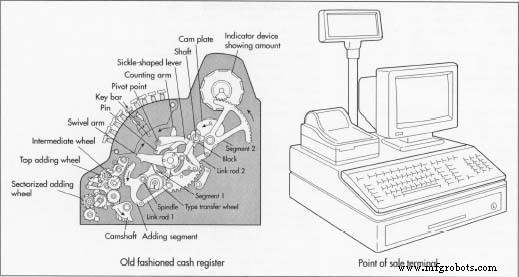
The cash register, often overlooked, is a cornerstone of retail and hospitality operations. It records sales, issues receipts, and maintains a permanent daily journal. Modern registers—whether a compact electronic cash register (ECR) or a sophisticated point‑of‑sale (POS) terminal—extend these functions to inventory management, departmental reporting, and real‑time inventory reordering. While large chains rely on modular POS systems, small businesses typically use integrated, all‑in‑one registers that include a built‑in cash drawer, printer, and display. These units are predominantly manufactured in Asia but are engineered to meet local regulatory and business needs.
History
James Ritty, a 19th‑century Dayton restaurateur, is credited with inventing the first cash register in 1879. Confronted with rampant employee theft and customer disputes, Ritty sought a mechanical solution to track sales accurately. Drawing inspiration from a shipboard automatic counter that logged propeller revolutions, he designed a device that recorded monetary transactions and displayed totals to both cashier and customer. His early models featured two rows of keys for denominations ranging from five cents to one dollar, a dial display, and a daily counter that made pilferage immediately apparent. The prototype earned a patent in 1879, and a third model, dubbed the “Incorruptible Cashier,” cemented Ritty’s reputation.
After selling his company to Jacob Eckert, Ritty’s invention caught the attention of John H. Patterson, who purchased the firm in 1884. Under Patterson’s leadership, the National Manufacturing Company was rebranded as the National Cash Register Company (NCR). NCR rapidly innovated: by 1890, registers printed receipts; by 1906, they were electrified. NCR pioneered modern sales techniques and expanded globally, achieving sales in China by 1896 and covering 50 countries by the end of World War I. The company’s product line grew steadily, amassing 2,400 patents by 1944 and selling over two million registers in 1922 alone.
The 1970s ushered in microprocessor technology, reshaping the industry. Manufacturing shifted to Asian factories, giving rise to two main categories: low‑end ECRs, sold ready to use, and modular POS terminals that customers assemble onsite. Both share similar manufacturing processes, yet POS systems offer advanced data processing capabilities.
Raw Materials
Cash registers share the same raw materials as other consumer electronics: an ABS plastic casing, a printed circuit board, a metal printer and drawer, a keyboard, and an LCD panel. Production facilities often overlap with those that manufacture televisions and VCRs, emphasizing cost efficiency and quality control.
Design
Despite mass production in Asia, register design is highly localized. Domestic distributors collaborate with retailers to tailor software and hardware to specific operational needs—be it a bar’s bright, easy‑to‑read display or a restaurant’s kitchen‑display interface. Custom features may be integrated into existing models or require new engineering from the manufacturer.
The Manufacturing Process
Registers are assembled on large production lines. A 200‑ft conveyor transports components, while 20–25 skilled workers perform tasks at a pace of 2–3 miles per hour.
The Cash Drawer
- Workers laser‑cut sheet metal to client specifications and feed it to a hydraulic punch press that shapes the drawer and case.
- After punching, welders assemble the drawer, apply paint, and allow it to cure.
- The drawer, complete with a removable till and solenoid‑activated latch, is integrated onto the back of the machine by attaching the latch bracket.
Assembly Line Operations
- Power supplies are constructed first, followed by manual assembly of the logic board through soldering and snapping.
- Printer modules, LCD panels, and keyboards are installed sequentially as the unit moves along the line.
- The ABS plastic casing is then mounted, and a subset of units undergoes quality‑control testing before final packaging.
Shipping
- Finished units are boxed, labeled, and shipped directly to distributors or end customers.
Installation
- Distributors provide on‑site installation and training, ensuring that complex POS terminals are properly integrated into existing systems.
Quality Control
Quality assurance varies by product tier: low‑end ECRs receive minimal checks, mid‑grade models are inspected at 10–15% of the output, and premium units may undergo up to 50% inspection. Distributors also perform functional tests, overnight reliability checks, and software diagnostics to meet the expectations of their clientele.
Byproducts/Waste
Cash register production generates no significant hazardous waste. Many industry players specialize in refurbishing older units, extending their lifecycle. While most U.S. registers are 13–15 years old, early models have become collectible artifacts.
The Future
Innovation continues to flow from the POS sector, where large retailers deploy advanced software and hardware. Features once considered high‑tech, such as inter‑register communication, are now standard even on mid‑tier machines. Software evolution is driven by evolving customer expectations and regulatory demands.
Where to Learn More
Books
Cortada, James W. Before the Computer. Princeton: Princeton University Press, 1993.
Crandall, Richard L., and Same Robins. The Incorruptible Cashier. Vestal, New York: The Vestal Press Ltd., 1988.
Marcosson, Isaac F. Wherever Men Trade: The Romance of the Cash Register. New York: Dodd, Mead & Company, 1945.
Periodicals
McCrory, Anne. “Jargon Judge: Point of Sale Device.” Computerworld (20 July 1998): 51.
Angela Woodward
Manufacturing process
- Amber: From Ancient Resin to Scientific Treasure – History, Properties, and Modern Uses
- The Guillotine: History, Design, and Legacy
- Silicon: Properties, Production, and Market Outlook
- The Ukulele: From Portuguese Roots to Modern Craftsmanship
- The Complete Guide to the U.S. Chicken Industry: History, Production, and Quality Control
- Compost: The Ultimate Soil Enrichment Solution
- Gelatin: From Ancient Protein to Modern Applications – Production, Uses, and Safety
- The Evolution and Manufacturing of Modern Pin‑Tumbler Locks
- Vodka: From Ancient Distillation to Modern Production
- Milk: Production, Processing, and Nutrition in the United States