



Corsets: From Ancient Waist‑Cinnning to Modern Foundations
Background
The corset is a tightly laced undergarment traditionally crafted from stiffened fabric to sculpt a woman's waist. Archaeological evidence indicates that Cretan women wore waist‑cinching garments between 3000 and 1500 B.C. Narrow waists became fashionable across Europe during the Middle Ages, with early forms called “stays” or “bodies.” By the sixteenth century, the rigid, bust‑to‑hip corset dominated fashion, persisting in various styles until the mid‑twentieth century. While some contemporaries claimed health benefits, others condemned the garment as a form of physical restraint. Skilled artisans—known as staymakers—hand‑stitched corsets, a craft that evolved with the advent of elastic textiles. By the 1930s, the corset’s popularity waned as fashions shifted toward natural silhouettes, leaving the modern equivalent: the all‑in‑one foundation undergarment.
History
Evidence of corset‑like undergarments dates back to 3000 B.C. in Babylonia and to a 2000 B.C. Cretan figurine discovered by Sir Arthur Evans. Ancient Greek texts describe linen or kid garments that cinched the waist, potentially flattening the bust. Roman women likely wore loose undergarments, but the style of laced waistlines emerged in Europe around 1150 A.D. When tailoring skills advanced in the fourteenth century, women began wearing stiffened linen undergarments tightened by front or back laces. By the fifteenth century, these were known as “stays” or “corps.” From the sixteenth century onward, corset makers incorporated thin whalebone strips, creating a more confining garment. During Queen Elizabeth I’s reign, court fashion featured a long, stiff corset paired with a whale‑bone‑stiffened farthingale. In the nineteenth century, corsets were worn with crinolines and bustles, shaping the figure to contemporary ideals. The 1920s ushered in flapper dresses that required minimal or no corsets, reflecting shifting beauty standards. The early 1930s saw the introduction of elastic, making corsets more flexible and giving rise to variations such as the roll‑on, step‑in, and corselette. By 1940, two‑piece underwear sets—bra and roll‑on or panty‑girdle—became common. A brief post‑World War II resurgence produced the waspie, a short, boned corset, but it never regained everyday status.
Health Effects of the Corset
In Victorian England, tightly laced corsets were commonplace, yet many women suffered deformed spines, ribcages, breathing difficulties, and organ compression. Illustrations from the era depict the painful process of tightening. By the early twentieth century, some corset designers—often in collaboration with doctors—introduced models aimed at reducing compression while maintaining shape. Despite medical warnings, prevailing cultural narratives claimed that tight lacing was “natural” and “necessary” for women’s health. These beliefs persisted, though a small minority advocated for abandoning the corset.
Raw Materials
Corsets were crafted from various fabrics depending on status and period. Linen, stiffened with paste or starch, formed the base of fine corsets; lower‑class garments used sturdy cotton. Decorative variants incorporated satin or silk. Whalebone—actually baleen, the tooth‑like plates of baleen whales—provided the rigid structural support. Baleen could be softened with steam, shaped, and then dried to retain its form. Over‑fishing led to the decline of baleen whales, prompting corset makers to adopt cane, steel, and later plastics. The busk— a front closure—was made from whalebone, wood, horn, or steel, ensuring a smooth line and added support.
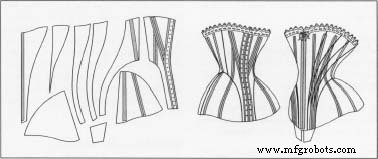 Metal eyelets for lacing were introduced in France in 1828. Elastic began appearing in corsets in the 1890s, initially as small gussets; by the 1930s, elastic fibers were woven or knitted into fabrics, becoming the standard for modern corsets. Decorative finishes included lace, ribbon, and silk or waxed cotton stitching.
Design
Each corset was tailored to the individual, with measurements taken for height, weight, and body shape. A typical fitting involved two stages: initial rough construction, followed by precise stitching after a second fitting. Fine, short stitches replaced the initial tacking to create a durable garment. Design evolved with fashion: the “Gibson Girl” era introduced the S‑curve corset, while the flapper decade favored non‑constricting styles. Health‑oriented corsets emerged in response to medical concerns, and sport or dance corsets catered to active lifestyles.
The Manufacturing Process
Professional corset makers followed a meticulous process, especially for eighteenth‑century examples:
- Measure the customer and draft a pattern on stiff paper.
- Transfer the pattern to a heavy fabric (cotton drill or linen) and cut the outer shell.
- Cut a softer inner lining from muslin or similar material.
- Optionally, add a fine outer cover such as silk.
- Tack layers together, marking slots for whalebone every 0.25 in (6.3 mm).
- Sew tight stitches to create channels for the bones.
- Trim and file whalebone strips, then insert them into the channels.
- Punch eyelets and secure them with a buttonhole stitch.
- Steam the whalebone into shape, then dry on a dressmaker’s dummy.
- Fit the corset to the customer, note adjustments, and sew final seams with strong thread.
- Add extra shaping bones and the busk for additional support.
- Finish with decorative trims or loops for petticoats and stockings.
Quality Control
Because corsets were custom‑made, quality was inherently high. In the 1930s, as demand declined, the U.S. corset industry trained saleswomen in “scientific” fitting to ensure customers received well‑fitted garments. Knowledgeable sales staff and meticulous fitting remained key to maintaining quality.
Byproducts and Environmental Impact
Whale hunting for baleen contributed significantly to the decline of Atlantic Right and Bowhead whales. Over‑fishing in the Bay of Biscay and later Greenland waters nearly wiped out these species by the late eighteenth and early nineteenth centuries. The shift to synthetic materials in the twentieth century reduced reliance on baleen, aligning with conservation efforts.
Where to Learn More
Books
- Ewing, Elizabeth. Dress and Undress. London: B. T. Batsford Ltd., 1978.
- Shep, R. L. Corsets: A Visual History. Mendocino, CA: R. L. Shep, 1993.
- Waugh, Norah. Corsets and Crinolines. London: B. T. Batsford Ltd., 1954.
Periodicals
- Fields, Jill. “Fighting the Corsetless Evil: Shaping Corsets and Culture, 1900‑1930.” Journal of Social History (Winter 1999): 355 ff.
Manufacturing process
- The Complete Evolution and Production of Modern Bras
- Materialise Marks 30 Years by Giving Back: A Sustainable Anniversary Gift
- International Women in Engineering Day: Meet the Women Driving Innovation at Markforged
- Women in Tech: Why the Apprenticeship Scheme Could Be the Game Changer
- Women in Tech: Leading Female Innovators to Watch
- Celebrating Women in Manufacturing: Advancing Leadership & Breaking Stereotypes
- Women Shaping U.S. Manufacturing: Driving Innovation & Equality
- Driving Equality: The Transportation Industry’s Growing Gender Diversity
- 20 Trailblazing Women Shaping the Future of Robotics & Automation
- Shopfloors Expand Opportunities for Women CNC Machinists – See the Photos