



Comprehensive Guide to Laser Marking: Types, Benefits, and Applications
- Laser Marking
- Operations
- Types
- Benefits
- Applications
- Materials
- Differentiation
- Services
Laser marking is a precision, non‑contact, non‑subtractive process that uses focused laser energy to create permanent or semi‑permanent impressions by altering the surface coloration of an object. Because it does not remove material, it is especially suited for delicate or miniature parts, and it is widely employed by industry professionals to embed serial numbers, safety ratings, and branding on finished components.
Types of Lasers Used in Laser Marking Operations
Laser marking employs several low‑powered laser technologies, each suited to specific materials and production volumes:
- Gas lasers – These use a gas mixture such as CO₂ or helium‑neon. They are well‑suited for organic substrates but offer lower precision compared to solid‑state or fiber options.
- Solid‑state lasers – Often based on Nd:YAG, these lasers provide faster marking speeds at a higher cost, making them ideal for high‑volume, high‑precision applications.
- Fiber lasers – Employing rare‑earth dopants like Erbium or Ytterbium, fiber lasers excel with inorganic materials and industrial-scale production, delivering high efficiency and excellent beam quality.
Types of Laser Marking Methods
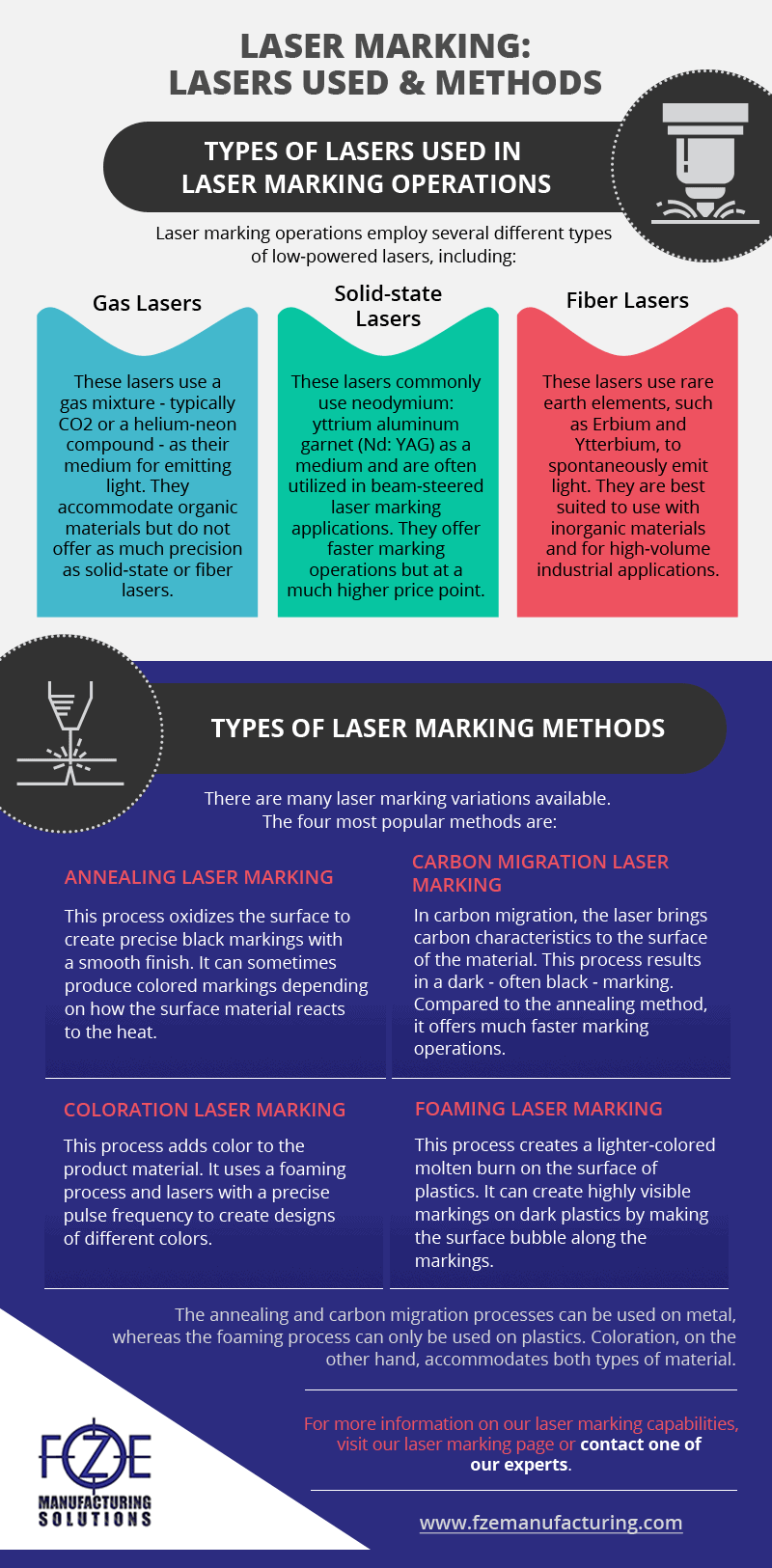
Four principal marking methods dominate the industry:
- Annealing laser marking – Oxidizes the surface to produce sharp black marks with a smooth finish; color variations can arise depending on material response to heat.
- Carbon migration laser marking – Introduces carbon to the surface, yielding rapid, dark (often black) markings; generally faster than annealing.
- Coloration laser marking – Applies color through a foaming process, using precise pulse frequencies to create multi‑colored designs on a range of materials.
- Foaming laser marking – Generates a lighter, molten burn that bubbles along the mark, especially effective on dark plastics for high visibility.
Annealing and carbon migration are suitable for metals, foaming is limited to plastics, while coloration works on both.
Benefits of Laser Marking
- Eco‑friendly – No chemicals or excess consumables; laser marking leaves a minimal environmental footprint.
- Durability – Marks are etched or burned into the substrate, resisting washing, solvents, and abrasion.
- Versatility – Choose permanent or semi‑permanent marks, and apply to metals, alloys, plastics, fabrics, or paper.
- Minimal surface damage – The process does not subtract material or alter the part’s geometry.
- Speed – Laser technology enables rapid marking, ideal for high‑volume production.
- Precision – Fine detail and high accuracy are achievable, supporting intricate designs.
These attributes give laser marking a distinct edge over traditional engraving, etching, or sticker application.
Applications for Laser Marking
Industries that rely on laser marking include:
- Aerospace – Permanent safety and serial data that withstand extreme conditions.
- Agriculture & Dairy – Traceability marks for product tracking and regulatory compliance.
- Automotive – Identifying fiberglass and metal parts without compromising structural integrity.
- Biomedical & Biopharmaceutical – Clear, non‑altering marks on sensitive equipment.
- DOT/DOD/DO – Global inventory management and logistics tracking.
- Electronics – Precise labeling of components that preserves electrical performance.
- Firefighting & Safety Equipment – Durable marks for manufacturer data, ratings, and safety instructions.
- Heavy Machinery & Hydraulics – Marks that endure harsh operational environments.
- Medical – Identification marks that avoid corrosion or contamination.
- Military & Defense – Asset tracking and secure identification.
- Oil & Gas – Marks that resist solvents, high temperatures, and corrosive chemicals.
- Professional Turf & Lawn Care – Equipment and sod identification.
- Recreational Marine – Marks that survive saltwater corrosion.
Common uses across these sectors include asset tracking, branding, part identification, security, and traceability for maintenance and repairs.
Materials Worked in Laser Marking Operations
- Metals: aluminum, brass, bronze, copper, steel, stainless steel
- Plastics: ABS, polystyrene, PVC
- Inorganics: glass, gemstones, stone
- Organics: leather, paper, wood
Laser Marking vs. Laser Engraving/Etching vs. Laser Cleaning
While all use laser technology, their outcomes differ markedly:
- Laser marking – Alters surface coloration without removing material.
- Laser engraving – Vaporizes localized areas to create a cavity.
- Laser etching – Heats the surface to melt it, producing a raised mark.
- Laser cleaning – Burns away contaminants (dirt, grease) without harming the substrate, offering a non‑abrasive alternative to sandblasting.
Laser Marking Services at FZE Manufacturing
FZE Manufacturing delivers top‑tier laser marking across a spectrum of technologies—gas, solid‑state, and fiber lasers—to meet diverse client needs. Typical marks include:
- Part identification numbers
- Brand names
- Traceability lots
- Production dates
- Serial numbers
For details on our laser marking capabilities, visit our laser marking page or contact one of our experts. Request a quote today and partner with us on your next project.
Manufacturing process
- Expert Guide to Aluminum Laser Marking: Precision, Durability, and Industry Applications
- Fiber Laser Marking: Precision, Speed, and Versatility for Modern Industries
- Metal Laser Cutting Machines: Expert Guide for Modern Manufacturers
- Laser Micromachining Systems: A Professional Guide for Modern Manufacturing
- Laser Marking Machines vs. Inkjet Printers: Which is Best for Your Production Needs?
- Three Essential Laser Marking Systems Explained
- Master Laser Cutting: A Comprehensive Beginner's Guide
- Laser Welding Basics: Mastering Non‑Contact Fusion Techniques
- Handheld Laser Welder Safety: A Comprehensive Guide
- Laser Marking Innovations: Expanding Horizons in Automotive, Oil & Gas, and Healthcare