



Fiber Laser Marking: Precision, Speed, and Versatility for Modern Industries
Fiber lasers have been a game‑changer since 1998, gaining mainstream traction in 2011 with the release of high‑power nanosecond units. While gas lasers still dominate the market, fiber laser marking systems are rapidly eclipsing them thanks to a clear set of advantages.
 What Is Fiber Laser Marking?
Fiber laser marking uses a tightly focused beam of light to create permanent, high‑contrast impressions on a wide range of materials. The laser source draws energy from a fiber‑optic cable, channels it through an f‑theta lens that preserves focus across the entire work envelope, and delivers the beam with remarkable precision. Because different materials absorb wavelengths differently, manufacturers offer a spectrum of laser wavelengths to optimize performance for each substrate.
Benefits of Fiber Laser Marking
When compared to alternative marking technologies, fiber lasers excel in several key areas:
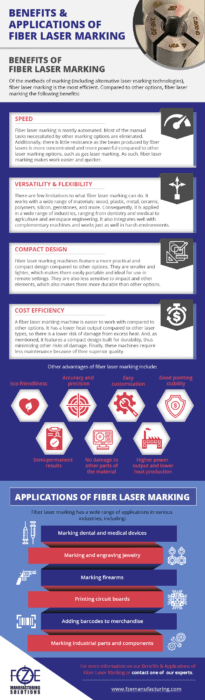
SPEED
Automation is built‑in. The beam’s high intensity and narrow spot size dramatically reduce cycle times, eliminating many manual steps required by older systems. The result is faster production with consistent output.
VERSATILITY & FLEXIBILITY
From wood and plastic to titanium and gemstones, fiber lasers adapt to virtually every material. This broad compatibility enables applications in dentistry, aerospace, electronics, agriculture, and more. The technology integrates seamlessly with CNC, PCB, and additive manufacturing workflows, and performs reliably even in harsh industrial environments.
COMPACT DESIGN
Fiber systems are smaller, lighter, and less sensitive to vibration than gas‑laser counterparts. Their rugged construction makes them ideal for remote or mobile setups, and the reduced footprint frees valuable floor space.
COST EFFICIENCY
Lower heat output minimizes collateral damage, while the durable fiber optics reduce maintenance demands. Combined, these factors lower total cost of ownership and boost return on investment.
- Eco‑friendly operation
- Exceptional accuracy and repeatability
- Easy customization of mark parameters
- Stable pointing over long runs
- Semi‑permanent, highly visible results
- No damage to surrounding material
- High power output with minimal heat generation
Ongoing advancements continue to unlock new efficiencies and capabilities for fiber laser marking.
Applications of Fiber Laser Marking
Industries leverage fiber laser marking for:
- Marking dental and medical devices
- Engraving fine jewelry
- Serializing firearms
- Printing high‑density circuit boards
- Embedding barcodes on merchandise
- Identifying industrial parts and components
Key sectors include:
- Dental, medical, and healthcare
- Electronics manufacturing
- Aerospace engineering
- Additive manufacturing
- Automotive and aerospace industries
- Integrated electronics and circuit fabrication
Laser Marking Services by FZE Manufacturing Solutions
FZE delivers high‑quality fiber laser‑marked products across a wide spectrum of materials:
- All industrial metals (Aluminum, Brass & Bronze, Copper, Iron, Steel, Stainless Steel)
- Heat‑resistant alloys (Titanium, Hastelloy, Inconel, etc.)
- Light and perforated metals
- Plastics, leather, ceramic, and wood
Want to discover how FZE’s fiber laser marking can elevate your production? Contact us today.
Manufacturing process
- Expert Guide to Aluminum Laser Marking: Precision, Durability, and Industry Applications
- Comprehensive Guide to Laser Marking: Types, Benefits, and Applications
- Selective Laser Sintering: How Powder and Laser Build Durable 3D Parts
- What Is Fiber Optic Cable? A Complete Guide to High‑Speed Data Transmission
- Unidirectional Carbon Fiber: The Strength, Lightness, and Cost‑Savings Advantage for Modern Manufacturing
- Carbon Fiber Explained: Strength, Production, and Industry Applications
- From Waterjet to Fiber Laser: Unlocking New Production Potential
- Fiber Lasers Power Up: Revolutionizing Cutting Performance
- Understanding Spinning Machines: From Fiber to Yarn
- Laser Cutting Explained: Precision, Power, and Applications