



Electropolishing vs. Passivation: Choosing the Right Stainless Steel Finishing
Metal finishing is essential for enhancing both performance and appearance of metal components. In stainless steel, electropolishing and passivation are the two most widely adopted methods.
While both methods rely on chemical baths, they differ fundamentally. Electropolishing uses an electrical current to electrolytically strip microscopic surface layers, producing a mirror‑smooth finish. Passivation, on the other hand, is a non‑electrolytic process that cleans the surface and enhances the naturally forming protective oxide layer.
Choosing the right technique depends on part specifications and desired performance. This guide outlines the core differences between electropolishing and passivation, and offers practical criteria for selecting the best finish for your stainless steel application.
Comparing Electropolishing and Passivation
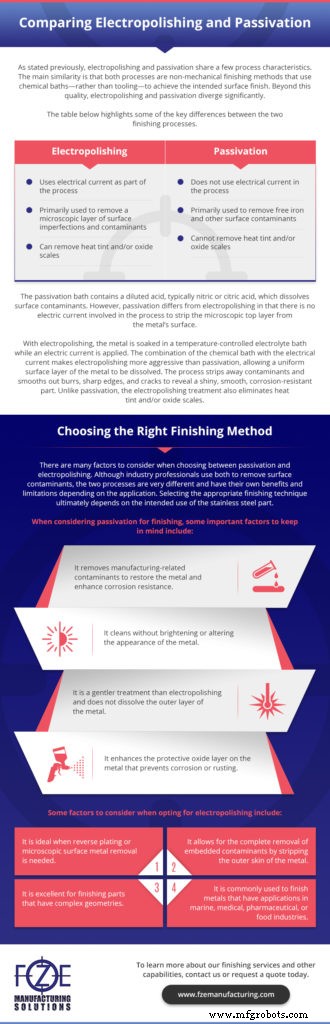
Both techniques are non‑mechanical surface treatments that rely on chemical baths rather than abrasive tooling. Beyond this shared approach, they diverge in key aspects.
The table below highlights some of the key differences between the two finishing processes.
ElectropolishingPassivation- Uses electrical current as part of the process
- Primarily used to remove a microscopic layer of surface imperfections and contaminants
- Can remove heat tint and/or oxide scales
- Does not use electrical current in the process
- Primarily used to remove free iron and other surface contaminants
- Cannot remove heat tint and/or oxide scales
Passivation baths are composed of dilute acids—commonly nitric or citric—which dissolve residual contaminants. Unlike electropolishing, no electric current is applied, so the outer surface layer remains intact.
In electropolishing, the workpiece is submerged in a temperature‑controlled electrolyte and subjected to an applied current. This electrochemical action is more aggressive than passivation, uniformly dissolving a microscopic surface layer. The result is a flawless, mirror‑like finish that removes burrs, sharp edges, and any heat tint or oxide scales, thereby delivering superior corrosion resistance.
 Choosing the Right Finishing Method
Selecting the correct finish hinges on the component’s intended function and performance requirements. Both processes clean surfaces, but their distinct mechanisms yield different advantages and limitations.
When considering passivation for finishing, some important factors to keep in mind include:
- Removes manufacturing‑related contaminants and restores the metal’s protective surface, boosting corrosion resistance.
- Cleans without brightening or altering the visual appearance.
- Provides a gentler treatment than electropolishing; it does not dissolve the outermost metal layer.
- Enhances the passive oxide layer that shields against rust.
Some factors to consider when opting for electropolishing include:
- Ideal when a high‑grade, reflective finish is required or when reverse plating is anticipated.
- Completes removal of embedded contaminants by stripping the outer skin of the metal.
- Excels with complex geometries, ensuring uniform surface smoothness.
- Preferred for components destined for marine, medical, pharmaceutical, or food‑grade applications.
Exploring Electropolishing in More Detail
While passivation remains essential for many applications, electropolishing delivers a more intensive, comprehensive finish. Its key advantages include a higher‑grade surface—deburring, brightening, and selective removal of microscopic peaks—even on delicate or intricately shaped parts. The resulting homogeneous, passive surface provides superior corrosion resistance compared to passivation alone.
Electropolishing’s effectiveness stems from its electrochemical aggressiveness. The workpiece is connected as the anode to a positive power supply, while a cathode completes the circuit. Both are immersed in a temperature‑controlled electrolyte—commonly a viscous blend of sulfuric and phosphoric acids—and an electric current is applied. The resulting anodic dissolution removes metal ions from the surface at the micron level, yielding a uniformly smooth finish.
Commonly electropolished items include:
- Blades and cutting tools
- Fasteners and pins
- Piping and tubing
- Springs
- Wire racks
Stainless Steel Finishing Services at FZE Manufacturing
Electropolishing and passivation are non‑mechanical, chemical finishing processes used to improve the functionality and/or appearance of metal parts. While both are valuable methods, they find use in different applications:
- Electropolishing is ideal when a superior level of smoothness, corrosion resistance, and durability is required.
- Passivation is chosen for a gentler treatment that preserves the metal’s natural surface.
FZE Manufacturing offers comprehensive machining and finishing services, from design and prototyping to production and delivery. Our stainless‑steel line includes both electropolishing and passivation. Contact us today or request a quote to learn how we can elevate your components.
Manufacturing process
- Stainless Steel Passivation: Enhancing Corrosion Resistance & Performance
- Passivation in Metalworking: A Technical Guide to Corrosion Protection
- 5 Key Benefits of Electropolishing in Metalworking
- Electropolishing vs. Passivation: Choosing the Right Metal Finish
- Passivation for Stainless Steel Parts & Enclosures: Boost Corrosion Resistance
- Passivation & Conversion Coating: Enhancing Stainless Steel Corrosion Resistance – CNCLATHING Surface Finishing
- Passivation: The Ultimate Post-Processing Solution to Prevent Rust & Corrosion
- Common Issues in Electropolishing: A Practical Guide
- Choosing Electropolishing: Key Situations and Benefits
- Electropolishing vs Mechanical Polishing: Which Surface Finishing Technique Wins?