



Laser‑Guided Missiles: Development, Manufacturing, and Strategic Impact
Background
Missiles differ from rockets in that they are steered toward a pre‑selected target by a guidance system. During World War II, unguided rockets proved useful but highly inaccurate, often requiring multiple launches to achieve a hit. This shortcoming spurred the integration of emerging radio‑wave technologies—such as radar and radio detection—to create the first guided missiles. Although these early systems were deployed in limited numbers, they demonstrated concepts that would transform future conflicts, ushering in the era of high‑technology warfare.
Initial radio‑wave guidance faced several challenges. The systems could only lock onto large targets like factories, bridges, or warships. Circuits were unreliable in adverse weather, and jamming became a common countermeasure. In response, military research turned to laser technology, which offers a line‑of‑sight guidance method far less susceptible to interference.
Dr. Theodore Maiman’s 1960 breakthrough at Hughes Research Laboratories produced the first operational laser—Light Amplification by Stimulated Emission of Radiation. The military quickly recognized lasers’ potential for precision targeting. Laser‑guided projectiles entered combat during the Vietnam War, earning the moniker “smart weapons.” While they did not decide the war, the experience gained, coupled with advances in electronics and computing, culminated in the widespread deployment of laser‑guided missiles during Operation Desert Storm, where their accuracy proved decisive against Iraqi forces.
Raw Materials
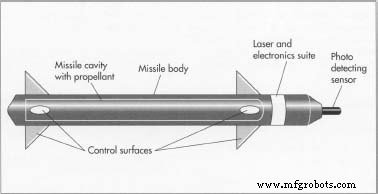
A laser‑guided missile comprises four core components: the missile body, guidance system (laser and electronics suite), propellant, and warhead. The following image illustrates their arrangement.
The missile body is die‑cast in two halves from high‑strength aluminum or steel alloys, often coated with chromium to withstand launch pressures and heat. The guidance system houses photo‑detecting sensors and optical filters that interpret laser wavelengths. Sensors feature sensing domes made of glass, quartz, or silicon, while the electronics suite may incorporate gallium‑arsenide semiconductors or traditional copper/silver wiring. Propellants are nitrogen‑based solid fuels, occasionally doped with graphite or nitroglycerine to fine‑tune performance. Warheads employ high‑explosive nitrogen mixtures, fuel‑air explosives, or phosphorus compounds, typically encased in steel or aluminum alloys.
Design
Modern laser‑guided missiles fall into two categories:
- Beam‑rider missiles track the laser beam emitted from the launching platform, using onboard control surfaces to stay aligned with the beam.
- Target‑seeker missiles employ sensors that detect laser light reflected from the designated target. The missile calculates the angular error between its trajectory and the reflected beam, adjusting its fins accordingly.
Designers begin with comprehensive computer simulations to determine optimal parameters—laser type, missile length, nozzle configuration, warhead choice, propellant mass, and fin geometry. These simulations inform engineering calculations that are compiled into a detailed design package. CAD/CAM tools then generate precise drawings and schematics for all components, ensuring that the electronics suite is fully compatible with the missile’s laser and control surfaces.
The Manufacturing Process
Constructing the Body and Attaching the Fins
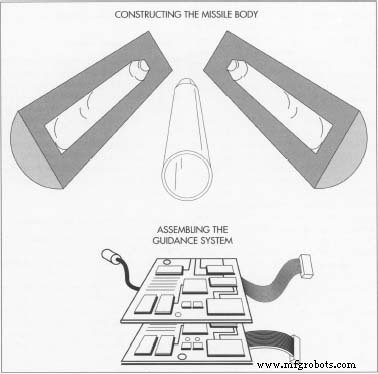
- The steel or aluminum body is die‑cast in halves. Molten metal is poured into a steel die and allowed to solidify, adopting the die’s shape. After cooling, an optional chromium coating is applied to interior cavity surfaces before the halves are welded together and tail nozzles are installed.
- Moveable fins are then affixed at predetermined positions along the body, either by welding to mechanical joints or inserting into milled recesses.
Casting the Propellant
- Uniform coating of the missile cavity with propellant is critical; uneven layers cause inconsistent burn rates and degrade performance. The preferred method is centrifugal casting, performed in a shielded industrial centrifuge located in an isolated area to mitigate fire or explosion risks.
Assembling the Guidance System
- The laser subsystem—photo‑detecting sensor and optical filters—is assembled separately from the rest of the missile. Circuits supporting the laser are soldered onto pre‑printed boards, with meticulous attention to thermal protection for optical components. The electronics suite is also assembled independently, and microchips are added as required by the design.
- Once completed, the guidance system is integrated by connecting circuit boards and inserting the assembly into the missile body via an access panel. Relay wires link the guidance electronics to the missile’s control surfaces. For beam‑rider missiles, the sensor housing is bolted to the missile’s rear exterior, oriented to detect laser signals from the parent aircraft.
Final Assembly
- The warhead is inserted as the last step, with careful fastening to avoid safety hazards. In missiles that home on reflected laser light, the photo‑detecting sensor is mounted at the warhead tip. Successful completion of this phase results in a fully integrated, sophisticated weapon ready for deployment.
Quality Control
Each component undergoes rigorous testing before assembly. Propellant samples are ignited under simulated flight conditions. The missile body is tested in a wind tunnel to assess aerodynamic performance. A subset of missiles is fired on test ranges to evaluate flight characteristics. The electronics suite is examined for signal speed and accuracy, while laser components are tested for wavelength fidelity using a test beam. Completed missiles undergo final flight tests from aircraft or helicopters against practice targets.
Byproducts/Waste
Propellants and warhead explosives are hazardous if they contaminate water supplies. Residual materials must be collected and incinerated at designated disposal sites, subject to state policies and federal inspection. Chromium‑coating effluents, which can be hazardous, are stored in leak‑proof containers. Personnel handling these wastes are provided protective gear, including respirators, gloves, boots, and overalls.
The Future
Next‑generation laser‑guided missiles will carry onboard lasers, eliminating the need for external target designators. These “fire‑and‑forget” systems allow pilots to launch and rely on the missile’s autonomous guidance. Further evolution may yield missiles capable of autonomously selecting and engaging targets. Such developments promise to enhance battlefield lethality and precision. Additionally, research is underway to integrate miniature laser‑guided missiles into infantry rifles, extending precision strike capabilities to ground forces. The success of laser guidance during Operation Desert Storm underscores its strategic value, and future military doctrine will likely pursue ever more advanced variants.
Manufacturing process
- Expert Guide to Aluminum Laser Marking: Precision, Durability, and Industry Applications
- Comprehensive Guide to Laser Marking: Types, Benefits, and Applications
- Fiber Laser Marking: Precision, Speed, and Versatility for Modern Industries
- Laser Pointer: Design, Manufacturing, and Safety Overview
- Semiconductor Lasers: Precision Light Generation for Modern Technology
- Solid State Lasers: Technology, Applications, and Future Trends
- Fibre Laser vs CO₂ Laser: Choosing the Right Cutting Technology for Your Business
- Laser Welding Primer: Precision, Speed, and Low Distortion Metal Joining
- Arduino Laser Tripwire Project: Build a Simple Intrusion Detector
- Precision Laser Cutting: Advanced Material Cutting for Industry, Small Businesses, and Hobbyists