



Evaporated vs. Condensed Milk: Production, History, and Quality Standards
Background
Evaporated and condensed milk are both concentrated dairy products, produced by removing water from raw cow milk. Evaporated milk is concentrated to 50 % or less of its original volume, typically without added sugar, and retains a specified fat and solid content. Depending on fat level, its shelf life ranges up to 15 months. Condensed milk, in contrast, is evaporated milk that has been sweetened with sugar, giving it a syrupy consistency and a shelf life of about two years. Historically, these products were crucial before refrigeration, serving as long‑lasting beverages and as key ingredients in baking, ice‑cream, and candy manufacturing.
History
In 1852, dairy farmer Gail Borden faced a crisis aboard a transatlantic voyage when rough seas prevented cows from being milked, leaving infant passengers without nutrition. Seeking a solution, Borden experimented with raw milk, discovering that boiling off 87 % of the water produced a non‑spoiling, concentrated product. By 1864, his Eagle Brand Condensed Milk plant opened in New York, and the product gained traction—despite early criticism over taste and nutrient content—especially during the Civil War when the Union Army adopted it for field rations.
Parallel innovation occurred in Switzerland: in the 1880s, John Baptist Meyenberg proposed producing evaporated milk without added sugar. After rejection, he emigrated to the U.S. and, by 1885, founded the Helvetica Milk Condensing Company, pioneering commercial evaporated milk. Later, Eldridge Amos Stuart developed canned, sterilized evaporated milk for hot‑weather regions and gold miners, while 1904’s Scientific American article on homogenization spurred industry advances. In 1934, the Pet Milk Company fortified evaporated milk with vitamin D using ultraviolet irradiation, a process patented by Harry Steenbock.
Raw Materials
The foundation of both products is raw cow milk sourced from nearby dairy farms. To stabilize and preserve the milk, processors add:
- Potassium phosphate, a salt that prevents separation.
- Carrageenan, a red‑algae derived additive that acts as a suspender.
- Powdered lactose crystals, which raise sugar content and extend shelf life.
Additionally, ultraviolet light exposure enriches the milk with vitamin D, meeting nutritional standards.
The Manufacturing Process
Evaporated Milk
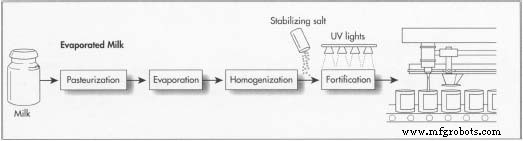
- The milk arrives in refrigerated tankers and undergoes rigorous testing for odor, taste, bacterial load, and composition using infrared spectroscopy.
- Pasteurization follows: either High‑Temperature Short‑Time (HTST) at 161 °F for 15 s or Ultra‑High‑Temperature (UHT) at 280 °F for 2 s, both ensuring safety and stability.
- The warm milk enters a vacuum evaporator where pressure is lowered, boiling at 104–113 °F, concentrating the milk to 30–40 % solids without a cooked flavor.
- Homogenization compresses fat globules under high pressure, yielding a uniform, creamy texture.
- A measured dose of potassium phosphate stabilizes the product, giving it a pale tan hue.
- UV irradiation fortifies the milk with vitamin D.
- The final product is poured into pre‑sterilized cans and vacuum‑sealed.
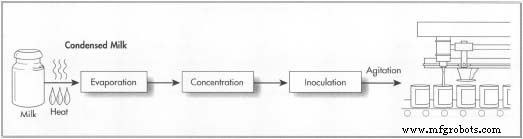
Condensed Milk
- Milk is flash‑heated to ~185 °F (85 °C) before being sent to the evaporator.
- Under vacuum, it is concentrated to 30–40 % solids, producing a syrupy base.
- Powdered lactose crystals (≈40 %) are added, then agitated to crystallize, forming the sugar that preserves the product.
- The mixture is canned in sterilized containers and vacuum‑sealed.
Quality Control
Both products must meet stringent FDA requirements. Sweetened condensed milk must contain at least 28 % total milk solids and 8 % milk fat. Evaporated milk must have at least 6.5 % milk fat, 16.5 % non‑fat solids, 23 % total solids, and 25 IU of vitamin D per serving.
Freshness tasting occurs at the farm and upon arrival at the plant, with the milk traveling exclusively through sealed pipelines and automated machinery—no manual handling. Cleaning, sterilization, and inspections account for at least one‑third of labor hours, ensuring compliance and product integrity.
Manufacturing process
- Amber: From Ancient Resin to Scientific Treasure – History, Properties, and Modern Uses
- Condensed Soup: From Dorrance’s 1899 Innovation to Global Markets
- The Guillotine: History, Design, and Legacy
- Silicon: Properties, Production, and Market Outlook
- Milk: Production, Processing, and Nutrition in the United States
- Inside the Milk Carton: Production, Materials, and Sustainability
- Butter vs. Margarine: History, Production, and Health Insights
- Modern Documentation Practices for Integrated PCB and Mechanical Design
- Building Allies: The Key to Success in Maintenance & Reliability
- Loctite and Duct Tape: Why Quick Fixes Fail on Industrial Equipment