



Chalkboard: From Medieval Hornbooks to Modern Porcelain Enamel
Background
The chalkboard—a flat, vertical writing surface—has become an iconic educational tool, yet it also finds use in workplaces, homes, and even restaurants. While many materials can be used, porcelain enamel remains the industry standard today.
Tracing its roots to the early 19th century, the chalkboard evolved from the medieval hornbook, a wooden strip with a paper insert bearing the Lord’s Prayer, alphabet, and other learning aids. Hornbooks were often worn around the neck, and their popularity spread through colonial America’s schools. The hornbook’s successor, the reading board, was a 15‑inch (38 cm) strip hung at classroom front windows, eventually giving rise to the communal chalkboard that all students could view and use.
In 1823, Samuel Reed Hall—an educator and founder of Vermont’s Concord Academy—patented the first modern chalkboard. Early models were simple pine boards painted black or coated with lime, plaster of Paris, and lampblack applied directly to classroom walls.
Raw Materials
Today, porcelain enamel is the preferred material for chalkboards. The process begins with a steel base—typically 22‑gauge—providing strength and durability. Silica, a crystalline compound derived from quartz, forms the core of the enamel coating. The finished surface blends inorganic glass opacifiers and oxides, sometimes with organic colorants, to create a smooth, non‑reflective writing area.
Design
Chalkboards are manufactured in a range of sizes, colors, and styles. The most common hues are green and black, but brown, blue, and gray options are available. Custom graphics—such as musical staffs for a college music department or court layouts for a basketball team—can be imprinted or fused into the enamel during production. Typical dimensions include 120" × 48" for classroom boards, 42" × 25" for court layouts, and 72" × 48" for portable models.
The Manufacturing Process
Preparation of Steel
- Large steel sheets arrive cold‑rolled and are inspected for defects. They are then washed, rinsed, and dried in a chemical washer before a second inspection.
Applying Slip
- Silica‑based slip is applied to both sides of the steel in a coating chamber, ensuring a minimum thickness of 0.0025 inches (0.062 mm). After drying, the sheets undergo a third inspection.
Firing
- In a large furnace, the coated steel is heated until the slip fuses with the metal—a critical step that integrates porcelain and metal.
Applying Surface Compounds
- Post‑firing, a glass opacifier‑based surface coating—at least 0.0025 inches thick—is applied to smooth the board and introduce color oxides. After drying and cooling, a final visual inspection checks for blemishes and color uniformity.
Fusing the Coats
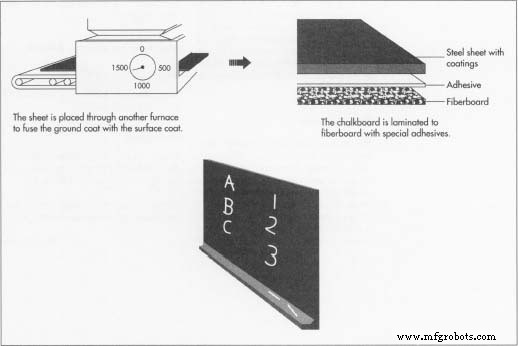
- Boards enter a cover‑coat furnace where a temperature of at least 1,200°F (649 °C) fuses the ground and surface coats. A controlled cooling chamber then reduces the temperature to prevent warping.
Final Surface Preparation
- The finished enamel surface is laminated to a 0.44‑inch (11 mm) fiberboard backing using a specialized adhesive. Edge trim—wood or aluminum—is added, and optional accessories such as chalk trays, map rails, hooks, and flag holders are attached.
Quality Control
Manufacturers adhere to standards set by the Porcelain Enamel Institute (PEI). One key specification is the gloss level, measured with a 45‑degree gloss meter; the gloss must not exceed three units to ensure a consistent writing surface. PEI also outlines durability and performance criteria that every product must meet.
The Future
While traditional chalkboards remain popular in classrooms, many manufacturers are shifting toward dry‑erase boards—smooth polypropylene surfaces that can be wiped clean with a cloth. These boards eliminate chalk dust, which is considered a health hazard and can damage sensitive electronic equipment, making them the preferred choice in modern business environments.
Manufacturing process
- Amber: From Ancient Resin to Scientific Treasure – History, Properties, and Modern Uses
- The Guillotine: History, Design, and Legacy
- Silicon: Properties, Production, and Market Outlook
- The Ukulele: From Portuguese Roots to Modern Craftsmanship
- The Complete Guide to the U.S. Chicken Industry: History, Production, and Quality Control
- Compost: The Ultimate Soil Enrichment Solution
- Gelatin: From Ancient Protein to Modern Applications – Production, Uses, and Safety
- The Evolution and Manufacturing of Modern Pin‑Tumbler Locks
- Vodka: From Ancient Distillation to Modern Production
- Milk: Production, Processing, and Nutrition in the United States