



Electronic Ink: How It Works, History, and Future Applications
Electronic ink—often called e‑ink—is a cutting‑edge pigment that changes color when exposed to an electric field. The technology relies on charged, two‑tone polymer particles encapsulated in a transparent shell, suspended in a solvent until they’re applied to a surface. First developed in the early 1990s, e‑ink offers the familiar look and feel of paper while adding the ability to update content on demand.
Background
Ink has been a reliable medium for centuries, prized for its portability, low power needs, and durability. Its main limitation is that once printed, the content cannot be altered. Electronic ink bridges this gap by preserving the tactile qualities of traditional paper and ink while providing dynamic, high‑capacity data storage that can be refreshed with minimal energy.
Like conventional ink, e‑ink is a liquid that can be coated onto almost any substrate. Embedded within the liquid are millions of microcapsules that house tiny, two‑tone polymer particles. One side of each particle is dark, the other is light, and the two sides carry opposite electrical charges. When an electric field is applied, the particles rotate so that either the dark or light side faces the surface, making the area appear black or white.
High‑resolution displays are possible because e‑ink can achieve over 1,200 pixels per square inch—far beyond the 300 pixels per square inch found in a typical newspaper. This density makes it suitable for almost any printed medium.
In practice, a computer can control each pixel of ink, turning groups of adjacent pixels on or off to form text, numbers, or images. Although this would be difficult on ordinary paper, researchers are developing special “paper‑like” substrates embedded with microelectronics that can address each pixel, or alternatively, scanners that can interpret the electric field.
One of e‑ink’s most compelling features is that it retains its configuration once the electric field is removed. Only a tiny amount of power is needed to re‑configure the ink, enabling devices such as electronic books to display thousands of different texts while consuming less energy than conventional displays.
History
Although the printed word dates back centuries, the concept of electronic ink emerged in the late 1970s at Xerox PARC. The team built a prototype that used millions of tiny magnetic particles with opposing black and white faces on a flexible rubber surface. The particles flipped in response to an electric charge, mimicking pixels on a video screen. The device never entered the market because of its bulk and complexity.
Over the next decade, researchers refined the idea, eventually leading to the first commercially viable electronic book. In 1993, MIT researcher Joe Jacobson explored a version using reversible polymer particles. By 1996 he filed a patent, which was granted in 2000, and in 2002 he founded E Ink Corporation to bring the technology to market.
E Ink’s inaugural product, the Immedia display, is a paper‑like sign that can be programmed to change its message. The company envisions a future where e‑ink is used on newspapers, books, magazines, apparel, and beyond.
Raw Materials
E‑ink production relies on a range of materials, including polymers, reaction agents, solvents, and colorants.
Polymers such as polyethylene or polyvinylidene fluoride are chosen for their ability to be melted, then solidified while maintaining stable dipoles. These polymers form the charged, colored segments of the ink.
Filler materials adjust the polymers’ physical properties. Because polymers are typically colorless, dyes or pigments are added to create the required contrast. Titanium dioxide yields white, iron oxides produce yellow, red, or brown, and organic dyes like pyrazolone reds or quinacridone violet provide additional hues. Plasticizers modify electrical characteristics, while stabilizers—such as unsaturated oils (e.g., soybean oil)—prevent polymer degradation during heating.
Protective additives include UV absorbers (e.g., benzophenones) and antioxidants (e.g., aliphatic thiols) to guard against UV damage and oxidation.
During encapsulation, water forms an emulsion that carries monomers, cross‑linking agents, and silicone oil—a hydrophobic, colorless medium that keeps the particles suspended. Gel or polymeric additives can be introduced to enhance system stability.
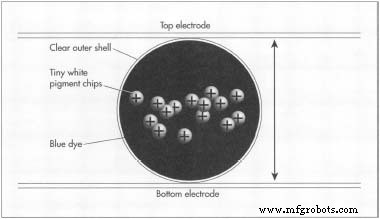
These charged nanoparticles can be oriented by an electric field, allowing a surface to switch from white to black—or vice versa—at will.
The Manufacturing Process
E‑ink is produced through a methodical, step‑wise approach. First, two contrasting inks are assigned opposite charges, then encapsulated into conductive microspheres before being applied to the target surface.
Producing Charged Ink
- 1 Two liquid polymers are fed into separate containers equipped with atomizing nozzles. While the polymers remain heated, one nozzle carries a positive potential and the other a negative. Pressurized flow atomizes the liquids into fine droplets that acquire the assigned charges. The droplets meet in a mixing chamber, where their opposite charges attract and form larger, electrically neutral particles.
- 2 The newly formed particles cool and solidify into small, two‑tone spheres with one positively charged side and one negatively charged side. They then pass through a heating element that reduces surface tension, producing nearly perfect spheres.
- 3 Electrodes screen the particles, removing any that are improperly charged. The remaining, well‑charged particles are transferred to the encapsulation stage.
Encapsulating Ink
- 4 The charged particles are suspended in a tank containing a monomer solution dispersed in silicone oil. An aqueous phase is added, creating a stable oil‑water emulsion. The particles stay in the silicone oil while the water surrounds them.
- 5 A cross‑linking agent initiates polymerization, forming tiny polymer shells that enclose the particles and any residual silicone oil. After the reaction, the particles are separated from the aqueous phase via evaporation and solvent washing.
- 6 The finished e‑ink particles are stored in a liquid solvent until they’re ready for application. Depending on the final product, the ink may be spread onto specialized paper, fabric, or other fibers.
Quality Control
Because e‑ink is still a niche technology, production volumes are moderate, allowing each step to undergo rigorous testing. Quality assurance begins with raw material inspection—checking pH, viscosity, specific gravity, color, and appearance. Finished ink is then tested for responsiveness to electric fields: a sample is coated on a thin surface, a field applied, and the color shift verified. Particle size is also measured using mesh screens to ensure consistency.
The Future
Early e‑ink devices are simple two‑tone displays, comparable to flat‑panel electronics. However, subsequent generations promise broader applications and could reshape how we consume information. Initially, e‑ink is slated for outdoor billboards, handheld devices, books, and newspapers. Ultimately, it could be applied to virtually any surface—clothing, walls, product labels, bumper stickers—making dynamic messaging ubiquitous.
Current e‑ink formulations are limited to black and white, which constrains color fidelity. Research is underway to introduce additional colors and to control them independently. Once achieved, e‑ink‑coated surfaces could rival the visual richness of conventional displays while retaining paper’s low power and high readability.
Manufacturing process
- From Electric to Electronic: The Evolution of Control in Circuits
- The Evolution and Modern Manufacturing of Ballpoint Pens
- Iron‑On Decals: The Science, Process, and Future of Fabric Graphics
- The History, Production, and Future of Markers: From Ancient Inks to Modern Innovations
- 4x4 Electronic Chessboard Prototype – RFID & Arduino Integration
- Electronic Chameleon: Arduino Nano RGB LED & Color Sensor Project
- Arduino Sunflower: Build an Electronic Sun-Tracking Sunflower
- Smart Electronic Check‑In System for Hackerspaces
- Build a Precise Electronic Scale with Arduino UNO – Step-by-Step Guide, Parts, and Code
- Electronic Pumps Explained: Types, Uses, and Applications