



From Electric to Electronic: The Evolution of Control in Circuits
Introduction
This third volume of the Lessons In Electric Circuits series marks a pivotal transition: we formally move from the realm of simple electric circuits to the dynamic world of electronic circuits. While electric circuits rely on conductive paths for the steady flow of charge, electronic circuits introduce a new dimension—control of that flow by another electrical signal, whether voltage or current.
Electronic Circuits
Students already understand that switches, potentiometers, and rheostats can regulate charge flow. The key distinction is how that control is achieved. Mechanical devices respond to external physical forces; electronic devices respond to electrical signals. In other words, in an electronic circuit, "electricity controls electricity." This self‑referential control underpins amplification, oscillation, and digital logic.
History of the Modern Electronics Era
Thomas Edison
In 1880, Thomas Edison discovered that a modest current passing through a heated filament in an incandescent lamp could drive electrons onto a metal plate inside the vacuum envelope—what we now call the Edison effect. The battery’s sole role was to heat the filament; any heat source would enable electron flow. This phenomenon laid the groundwork for vacuum electronics.
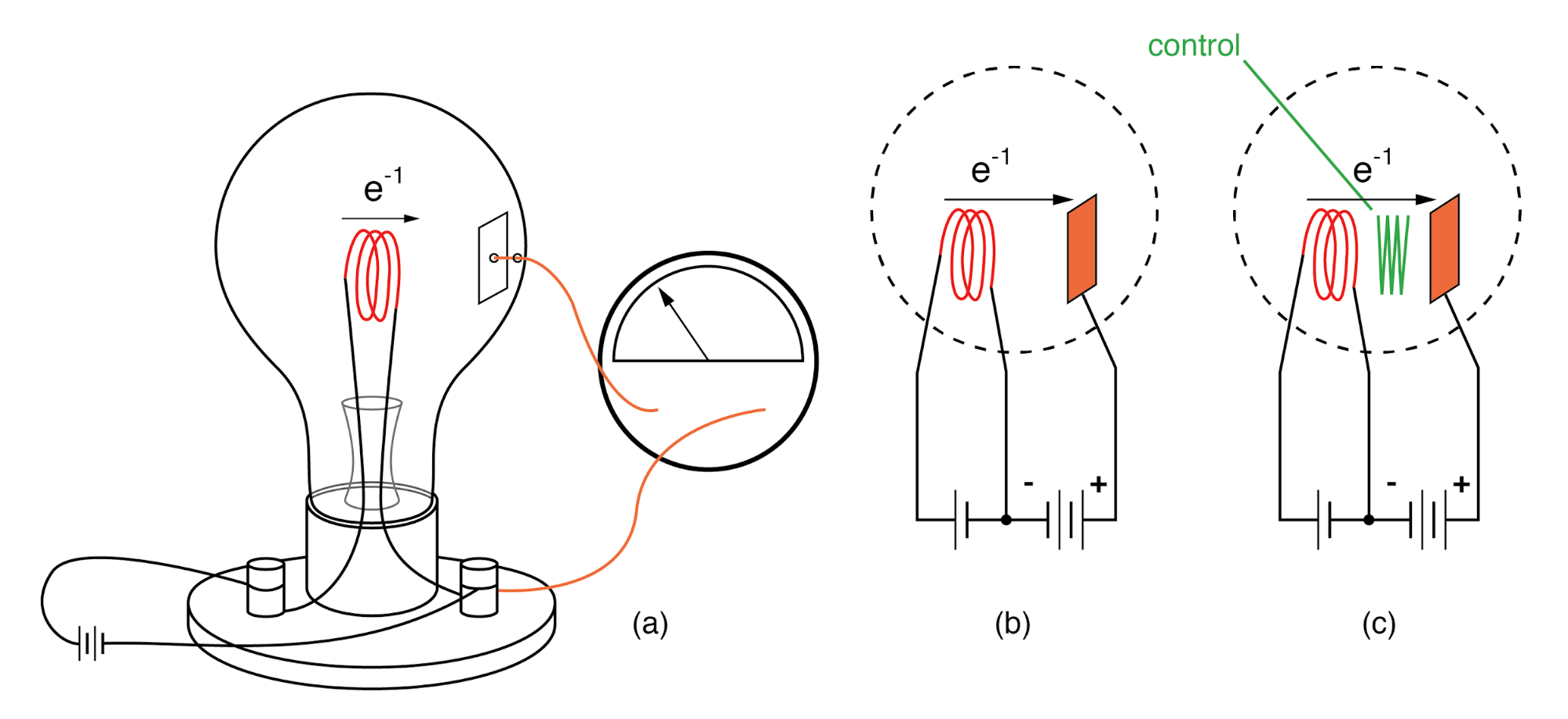
Key devices stemming from this discovery include the Fleming valve (vacuum diode) and the DeForest audion triode amplifier.
Vacuum Diode
By 1904, John Flemming of the Marconi Wireless Company demonstrated that an externally applied plate voltage allowed current to flow from the filament to the plate but blocked reverse flow—creating the first vacuum diode. This device enabled the rectification of alternating currents into direct current.
Audion Tube
The Audion tube, introduced by Lee DeForest, added a third electrode—a grid—allowing a small voltage to modulate the larger electron flow from filament to plate. This breakthrough ushered in the era of electronic amplification and signal control.
A comprehensive overview of vacuum tube technology appears in the final chapter of this volume for interested readers.
Transistor
1948 marked a watershed moment with the invention of the transistor. Replacing bulky vacuum tubes, the transistor achieved the same amplification and switching functions in a compact, solid‑state package. Transistor technology uses semiconductor materials, drastically reducing size, power consumption, and cost, and is the foundation of modern electronics.
RELATED WORKSHEETS:
- Elementary Amplifier Theory Worksheet
Industrial Technology
- Detecting AC Electric Fields: A Hands‑On Guide to Electrostatic Coupling and Shielding
- Converting Decimal Numbers to Binary, Octal, and Hexadecimal: A Practical Guide
- Understanding Data Flow: From Simplex to Full‑Duplex Communication
- Understanding Electric Circuits: Continuous Charge Flow and the Impact of Breaks
- The Electric Guitar: History, Design, and Modern Innovations
- Electronic Ink: How It Works, History, and Future Applications
- How 3D Printing Is Transforming Electronic Component Design: 5 Key Applications
- Safeguarding Industrial Electronics from Lightning Damage: Proven Protection Strategies
- Protein Nanowire Electronics: Self‑Powered, Intelligent Microsystems from Sustainable Green Materials
- Electronic vs Electric: Clarifying Their Distinct Meanings