



Understanding Electric Circuits: Continuous Charge Flow and the Impact of Breaks
In everyday electronics, electrons move in a steady stream along conductors without relying on external “sources” and “destinations” that would need infinite charge capacity. That’s because the movement occurs within a closed loop—a circuit—where the flow is sustained by an internal motive force rather than external reservoirs.
The classic marble‑and‑tube analogy helps illustrate this: if you imagine marbles flowing through a pipe, the pipe must form a complete, uninterrupted loop. Only then can the marbles keep circulating without the need for infinitely large reservoirs at each end.
What Is a Circuit?
A circuit is a closed, continuous pathway composed of conductive material. By connecting the ends of a wire (or multiple wires) in a loop, electrons can travel endlessly around the circuit, driven by voltage, without requiring infinite sources or sinks.
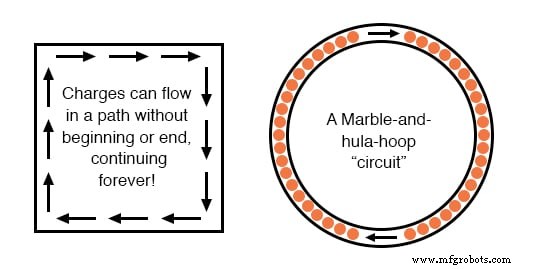
In this loop, each charge carrier pushes the next, creating a self‑sustaining chain reaction—much like a hula‑hoop of marbles. The key is that the pathway never ends, so the flow can continue indefinitely as long as a motive force (voltage) is present.
What Happens When a Circuit Is Broken?
Continuity is essential. Any interruption—no matter where it occurs—disrupts the loop and stops the flow of charge entirely.
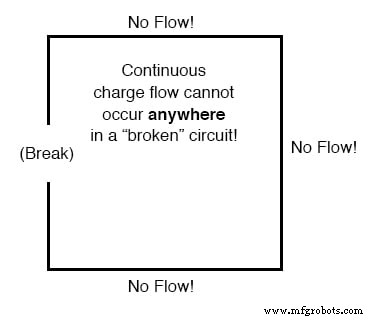
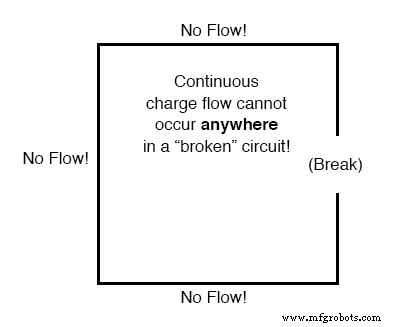
Because the conductive path is no longer complete, electrons cannot travel around the loop, and the circuit behaves as if it were disconnected. The location of the break is irrelevant; the entire circuit loses its ability to conduct current.
Key Takeaways
- A circuit is an unbroken loop of conductive material that allows charge carriers to flow continuously without an explicit start or end.
- If a circuit is broken, its conductive elements no longer form a complete path, and continuous charge flow cannot occur.
- The specific location of a break is irrelevant—any discontinuity halts the entire current flow.
Related Worksheets
- Elementary Circuits Worksheet
Industrial Technology
- Advanced Motor Control Circuits: Latching, Stop, and Time‑Delay Techniques
- From Electric to Electronic: The Evolution of Control in Circuits
- Mastering Electric Circuit Simulation with SPICE: A Practical Guide for Designers and Students
- Understanding Series and Parallel Circuits: How They Work and Why They Matter
- Analyzing Complex RC Circuits Using Thevenin’s Theorem
- Smart Circuit Breakers Explained: Future of Power System Protection
- Understanding the Key Differences Between DC and AC Electric Motors
- Inside the Manufacturing of Electronic Circuits
- Understanding Auxiliary Contacts: Function, Types, and Applications
- Voltage Relays Explained: Switching High Currents with Low Control Signals