



The Evolution and Modern Manufacturing of Ballpoint Pens
A ballpoint pen is a compact writing instrument that delivers ink via a tiny metal ball. The ball sits in a socket beneath an ink reservoir; as the pen glides over paper, the ball rolls, transferring ink. Though first patented in the late 19th century, ballpoints only gained commercial traction in the early 1950s, and today they account for more than 100 million units sold worldwide each year.
History
It took nearly 60 years and three inventors to turn the concept into a reliable tool. The first patent, issued on 30 October 1888 to John J. Loud, described a rotating ball bearing kept wet by an ink reservoir. However, the design leaked and smudged on paper. Ladislas and Georg Biro refined the idea, producing the first commercially successful ballpoint in the 1930s; sales peaked in 1944. The leakage issue was finally solved by Baron Marcel Bich in 1945, who began manufacturing Bic pens in Paris. Subsequent advances have focused on ink viscosity, ball hardness, and ergonomic housing.
Background
Ballpoints addressed the limitations of fountain pens, which required frequent dipping. The pen’s self‑contained ink reservoir uses capillary action to keep ink from seeping. At the tip, a freely rotating ball, only partially exposed, rolls against paper, pushing ink forward. Most designs share core components: a ball, a point, ink, a reservoir or cartridge, and an outer housing. Caps, retractable tips, multi‑color cartridges, refillable designs, and even pressurized cartridges for underwater or zero‑gravity writing are all variations that meet specific user needs.
Raw Materials
Early ballpoints used plain steel balls, but modern pens employ textured tungsten‑carbide spheres—over 50 000 micro‑polished facets and interconnecting channels—to resist deformation and maintain ink flow. Brass (copper‑zinc alloy) forms most points and mechanical parts for its strength and corrosion resistance; aluminum and stainless steel are used for housings, while gold, silver, and platinum plating adorn premium models.
The ink itself must be slightly viscous, slow‑drying, and particle‑free to prevent clogging. Manufacturers blend pigments, dyes, lubricants, surfactants, thickeners, and preservatives into a base of oleic acid, castor oil, or sulfonamide plasticizer. Rapid evaporation and absorption on paper ensure quick drying once ink contacts the surface.
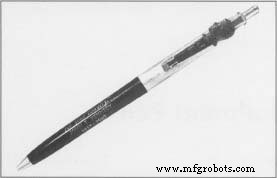 A 1963 plastic and metal ballpoint pen commemorating the assassination of President John F. Kennedy, Jr. (From the collections of Henry Ford Museum & Greenfield Village.)
From the earliest burnt‑stick marks in sand to Sumerian reed pens, Egyptians’ hieroglyphic brushes, and ancient Chinese hair brushes, writing tools have evolved dramatically. The quill dominated for over a millennium until Joseph Gillott’s steel nib in the late 1800s eliminated the need for sharpening. Fountain pens introduced ink reservoirs, yet smears persisted until ballpoints nearly eliminated messes by the 1950s.
Nancy EV Bryk
Plastics play a vital role in ballpoint construction. Thermosetting resins (e.g., phenolic) form the body, cap, and other rigid components, while thermoplastics such as high‑density polyethylene and vinyl resins create the pen body, cartridge, push‑button, and cap. Each material is chosen for formability, weight, corrosion resistance, and cost efficiency.
The Manufacturing Process
Ballpoint pens are produced en masse, with each manufacturer adding slight variations. The general workflow comprises ink compounding, metal component stamping, plastic molding, assembly, packaging, labeling, and shipping—often from raw material to finished product in under five minutes in advanced facilities.
Making the Ink
- Large batches are produced in dedicated compounding rooms. Compounders follow precise formulas, mixing raw materials in batch tanks. Heated or cooled as needed, the mixture is pumped via computerized controls that set mixing speeds, temperature, and metering. Quality checks occur at multiple stages.
Stamping and Forming
- Metal parts such as tungsten‑carbide balls and brass points are stamped and forged. Brass discs are compressed in a die‑cast mold using a steel ram and spring‑back plunger; excess metal is trimmed and recycled.
- Finished pieces are cleaned, oiled, dimensionally trimmed, polished, and the ball inserted into the point cavity.
Molding the Housing
- Extrusion or injection molding produces the plastic body, reservoir, caps, and mechanical parts. In extrusion, granules are heated and forced through a die; in injection, molten plastic is injected into a mold and solidifies.
Ink Filling and Assembly
- Components are assembled on conveyor belts; the ball attaches to the reservoir, then ink is injected. Springs are installed if required.
Final Assembly, Packaging, and Shipping
- Point and reservoir are inserted into the main body; caps and ends are added. Finishing steps include coating, decoration, and final cleaning. Pens are packaged in blister packs or bags, palletized, and shipped to distributors.
Quality Control
Quality assurance occurs at every stage. Line inspectors sample random parts for size, shape, and consistency, using vernier calipers, micrometers, and microscopes. Surface coatings are tested with optical flats or gauges. Ink batches undergo pH, viscosity, and appearance tests; adjustments are made if out of specification. Final product samples ensure proper writing performance.
The Future
Ongoing research targets new inks and ergonomic designs that extend durability and reduce cost. A key trend is the use of minimally processed metals and plastics, which lowers waste, speeds production, and cuts manufacturing expenses.
Manufacturing process
- The Fountain Pen: From Ancient Origins to Modern Mastery
- Electronic Ink: How It Works, History, and Future Applications
- Iron‑On Decals: The Science, Process, and Future of Fabric Graphics
- The History, Production, and Future of Markers: From Ancient Inks to Modern Innovations
- Smart Pen: Real‑Time Handwriting & Movement Tracking with Raspberry Pi and IMU
- Are 3D Printing Pens Safe? A Comprehensive Safety Guide
- Are 3D Pens Worth the Investment? A Comprehensive Review
- Why Won’t My 3D Pen Work? Quick Troubleshooting Tips
- How a 3D Pen Works: From Filament to Finished Model
- Unlock 3D Creativity: How a 3D Pen Transforms Ideas into Tangible Art