



The Fountain Pen: From Ancient Origins to Modern Mastery
Background
Humans have expressed ideas through various tools—from the humble finger marking dirt to sophisticated instruments that capture thoughts with elegance. Ancient civilizations used styluses on wax tablets, reeds on papyrus, and metal or bone tools. In the Middle Ages, quill pens—feather shafts split and sharpened—dominated until the early 19th‑century steel dipping pen offered smoother use but still required dipping in ink.
The quest for a self‑contained, practical writing instrument culminated in 1884 when Lewis E. Waterman introduced the first commercially viable fountain pen. Unlike its predecessors, the fountain pen stored ink in a built‑in reservoir, eliminating the need for frequent dipping. Its convenience and durability made it the writing choice for the next six decades, until the ballpoint pen arrived in 1938. Today, fountain pens remain prized for their elegance, prestige, and collectible value.
History
Early attempts at a self‑feeding pen date back to the 10th century, but it wasn’t until 1884 that Waterman’s design succeeded. The pen’s mechanism matched the precision of a dipping pen but without the ink bottle. Waterman initially sold 36 pens weekly at a New York City cigar kiosk; demand surged, prompting the opening of a six‑story factory on Broadway, later expanded to meet global demand. The fountain pen dominated the market for 60 years.
By 2001, the Writing Instrument Manufacturers Association boasted 25 members. Large firms now use automated production, while small makers and artisans continue handcrafting pens, echoing Waterman’s original method.
All fountain pens share core components: the nib (point), the barrel (ink reservoir), and the cap (protects the nib). Ink flows by capillary attraction—a principle that also powers blotters and wick‑filled flame fuels.
Gold alloy nibs, often iridium‑plated, were early favorites. As costs rose, steel replaced gold, though high‑karat gold nibs (18–22 kt) persist in premium models. Each nib’s tip slit controls ink flow. Barrels began as black hard rubber, then evolved to durable plastics; premium barrels feature gold, silver, brass, wood, bone, or even crushed velvet.
Initial filling methods employed medicine droppers, replaced by rubber sacs in 1890. These early sacs failed due to ink incompatibility, but improved rubber and later plasticized vinyl resin sacs extended lifespan. The Parker Pen Company pioneered the first sac‑less pen in 1932.
Raw Materials
Barrel materials range from affordable acrylic (Lucite, Perspex) and cellulose acetate to premium brass, silver, and gold. Manufacturers often use injection‑molded polymers for cost‑effective production. Handcrafted pens may feature wood, plywood, crushed velvet, bone, leather, or antlers, as long as the material is solid and workable. Nibs are typically stainless steel; finer pens may use gold or sterling silver. Clips and fittings are usually gold‑alloy stamped, then electroplated or gold‑filled.
Design
Fountain pens span mass‑produced models and bespoke creations. Custom designers choose unique features—laminated patterns, distinctive clip styles, carved or inlaid surfaces, gemstone accents—adding visual allure and potential value. Each variation demands extra preparation and material, but enhances individuality.
Refill Mechanisms
Filling options include lever‑fillers, button‑fillers, piston‑fillers, and squeeze‑bulb fillers. Lever‑fillers compress the ink sac via a side lever; button‑fillers use a press button; piston‑fillers employ a screw‑driven piston; squeeze‑bulb fillers are filled by repeated compression. All mechanisms are installed during final assembly.
The Manufacturing Process
Large manufacturers rely on automated machinery—molding barrels from molten plastic, stamping and crimping metal parts, assembling, polishing, and cleaning. Small firms and hobbyists still produce pens manually, following traditional woodworking techniques.
Below is a typical hand‑crafting workflow for wooden barrels, applicable to other materials with minor adjustments.
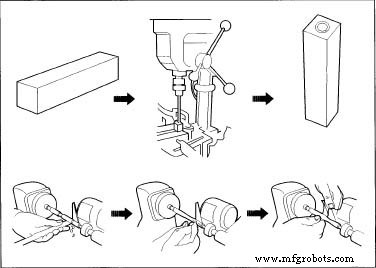
Preparing the Blank
- 1. Cut a rectangular wood blank (~0.75 in × 5 in). Use any dry, visually appealing wood.
- 2. Mark a 1‑in cut line (match mark) to separate upper and lower halves. Cross‑cut slightly longer than the brass tube to be inserted.
- 3. Clamp the blank and drill a central hole in each half for the brass tube.
Inserting the Brass Tube
- 4. Apply polyurethane glue to the tube’s exterior and the hole’s interior; insert the tube, rotating to distribute glue. Allow ~10 min to set.
- 5. Trim the tube with an adapter sleeve and barrel trimmer to match the blank, creating a brass curl.
Mounting and Turning the Blank
- 6. Mount upper and lower blanks on a split mandrel with bushings.
- 7. Rough‑turn the wood, removing excess material with a gouge; finish with a skew chisel.
- 8. Carve a notch around the upper blank for the metal trim ring.
Sanding and Finishing
- 9. Sand from 120‑ to 400‑grit (600‑grit for Dymondwood) to achieve a smooth, glossy surface.
- 10. Polish barrels with wax or plastic polish while spinning.
Preparing for Assembly
- 11. Slightly sand sharp barrel corners.
- 12. Cut a notch for the clip using a grinding wheel or file to avoid chipping.
Clips, Fittings, and Bands
- 13. Stamp metal clips and fittings; roll and hard‑solder bands and overlays.
Final Assembly
- 14. Attach ring, clip, and other trimmings. Use a drill press and jig to align parts. Press nib coupler into the lower barrel, flip, and insert end cap. Insert nib.
- 15. Insert trim ring and clip into upper barrel notches; secure closing cap with a cap adjuster or screwdriver.
- 16. Screw barrels together, test fit, and adjust as needed.
Automated Process
Mass‑produced pens are molded, stamped, and assembled by specialized machines, ensuring consistency and efficiency.
Quality Control
While no universal standards exist, most manufacturers implement rigorous inspections—surface quality, ink flow, cap fit, and more. Some models, like the Parker 75, undergo 792 inspections and receive a certificate signed by the final inspector.
The Future
Ballpoint pens have largely replaced fountain pens in everyday use, yet the latter maintain strong appeal among collectors and enthusiasts seeking a refined writing experience. In 2001, Parker identified the Far East, Middle East, and Europe as the fastest‑growing markets for fountain pens. A notable trend is the rise of independent makers who craft and sell pens via kits and online platforms, expanding access to this timeless art.
Where to Learn More
Books
Christensen, Kip, and Rex Burningham. Turning Pens and Pencils. United Kingdom: Guild of Master Craftsman, 1999.
World Book Encyclopedia. Illinois: Field Enterprises Educational Corporation, 1963.
Other Resources
Development of the Fountain Pen. 10 September 2001. https://bamyard.syr.edu/~vefatica/fountain.txt
Nishimura, David. "Filling Instructions." Vintage Pens Web Page. 10 September 2001. https://www.vintagepens.com/fill.htm
"Parker Plant Tour. July/August 1998." Pen World International Magazine Web Page. 10 September 2001. https://www.penworld.com/Issues98/julyaug98/parkemib.htm
WoodenPen.Com Web Page. 10 September 2001. http:/lwww.woodenpen.com/how.htm
Writing Instrument Manufacturers Association Web Page. 10 September 2001. https://www.wima.org
Kathy Saporito
Manufacturing process
- The Evolution and Modern Manufacturing of Ballpoint Pens
- Smart Pen: Real‑Time Handwriting & Movement Tracking with Raspberry Pi and IMU
- Build Your Own DIY Homework Writing Machine at Home
- 4 Proven Strategies for Crafting Effective Maintenance Checklists
- 5 Expert Tips for Crafting Clear Work Instructions
- Are 3D Printing Pens Safe? A Comprehensive Safety Guide
- Are 3D Pens Worth the Investment? A Comprehensive Review
- Why Won’t My 3D Pen Work? Quick Troubleshooting Tips
- How a 3D Pen Works: From Filament to Finished Model
- Unlock 3D Creativity: How a 3D Pen Transforms Ideas into Tangible Art