



Black Box Flight Recorders: From Early Prototypes to Future Integrated Designs
Background
Black boxes—officially known as Flight Data Recorders (FDR) and Cockpit Voice Recorders (CVR)—are essential safety systems on modern aircraft. They continuously log flight parameters such as airspeed, altitude, and heading, as well as cockpit audio, enabling investigators to reconstruct events after an incident. The first flight recorders appeared with the Wright brothers and Charles Lindbergh, but only in the 1940s did regulatory bodies mandate reliable data capture, leading to the development of robust, crash‑survivable units.
In the early 1950s, Professor James J. Ryan introduced the VGA Flight Recorder, a compact device that measured velocity, G‑forces, and altitude. This design, still foundational today, evolved from stylus‑and‑paper to magnetic tape and now to high‑capacity solid‑state memory that can record up to 300 flight variables.
Regulatory standards have progressively increased the resilience of black boxes. Current requirements, set by the FAA, demand survivability of 3,400 Gs for 6.5 ms, far beyond the 100 Gs tolerance of early models. Modern recorders must also withstand high temperatures, crushing forces, and prolonged underwater immersion.
Components
Both FDRs and CVRs share a core architecture: a power supply, crash‑survivable memory unit (CSMU), integrated controller board, aircraft interface, and an underwater locator beacon (ULB). The key features are detailed below.
Power Supply
Dual‑mode (115 VAC or 28 DC) power allows operation in diverse aircraft environments. Batteries provide 30‑day continuous power with a six‑year shelf life.
Crash‑Survivable Memory Unit (CSMU)
Designed to retain 25 hours of uncompressed digital data, the CSMU uses state‑of‑the‑art electronics to preserve flight information under extreme conditions.
Integrated Controller & Circuitry Board (ICB)
The ICB orchestrates data flow from input devices to the CSMU, ensuring accurate time‑stamping and error checking.
Aircraft Interface
For the FDR, the interface receives signals from instruments like the airspeed indicator, altimeter, and warning systems. The CVR interface captures cockpit audio via a microphone mounted on the overhead panel, recording pilot communications, engine noise, and other relevant sounds.
Underwater Locator Beacon (ULB)
When submerged, the ULB emits a 37.5 kHz acoustic pulse detectable by search vessels, enabling recovery from depths up to 14,000 ft (4,200 m). 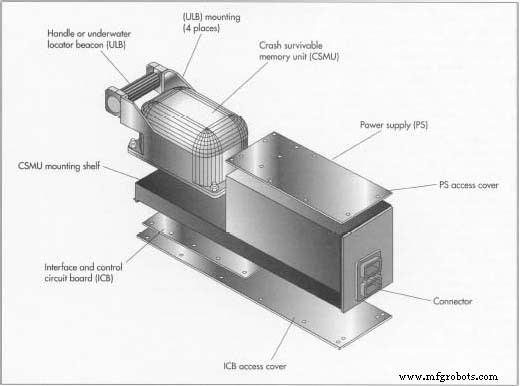
The Manufacturing Process
Creating a black box is a meticulous, multi‑stage process focused on maximum survivability.
- Individual modules—power supply, interface board, and memory circuits—are fabricated separately for modular replacement.
- A steel armor plate forms the outermost layer, protecting internal components.
- Insulation and a paraffin thermal block absorb heat during impact, maintaining the memory core’s integrity.
- The memory board and additional paraffin block are stacked between insulation layers, all secured on a steel mounting plate.
- The CSMU is bolted to a heavy metal shelf; the power supply attaches behind it.
- The ICB is fastened to the underside of the mounting shelf and covered by a protective metal lid.
- The ULB attaches to the front arms of the memory unit, protruding to serve as a handle; a hollow metal tube substitutes when a ULB is omitted.
- Finally, the casing is painted bright orange or red for post‑crash visibility.
Quality Control
Units undergo rigorous testing to confirm compliance with FAA standards. Tests include:
- Impact from a 10 ft drop onto concrete.
- Crushing under 5,000 lb pressure.
- Exposure to 2,012 °F (1,100 °C) for an hour.
- Submersion under 20,000 ft of seawater for one month.
- Dynamic diagnostics via the onboard microprocessor to verify 28 critical parameters such as time, altitude, and heading.
Successful units demonstrate an average failure interval exceeding 15,000 hours and are designed for minimal maintenance.
The Future
Industry leaders are converging FDR and CVR functions into a single Integrated Data Acquisition Recorder (IDAR). This device promises a 25% weight reduction while adding the capacity to record mandatory air‑traffic control data streams. As regulatory requirements expand, manufacturers are poised to deliver increasingly compact, data‑rich recorders that maintain, or even improve, survivability.
Manufacturing process
- Titanium: Key Properties, Applications, and Industrial Uses
- Castanets: History, Craftsmanship, and Performance
- The History, Production, and Future of Glue: From Ancient Adhesives to Modern Innovations
- Thread: Types, History, Production, and Quality Control
- Acetylene: Production, Uses, and Handling – A Comprehensive Overview
- Comprehensive Overview of Asbestos: From Ancient Uses to Modern Health Risks
- The History, Design, and Manufacturing of Dice: From Ancient Tools to Modern Gaming
- Plywood: History, Production, and the Path Ahead
- Tin: From Bronze Age to Modern Industry – Uses, Production, and Future
- Silver: History, Properties, and Modern Applications