



Automatic Drip Coffee Maker: History, Design, and Future Trends
Background
Coffee’s journey began in 6th‑century Ethiopia, where whole berries were eaten or fermented into wine. By the 13th century, roasted, ground beans were brewed into the beverage we recognize today, and the drink had spread across the Islamic world by the 15th century. Europe encountered coffee around 1615, initially prepared by boiling crushed beans in a long‑handled brass pot, a method still common in the Arab world as the Turkish coffee pot.
In England and America, boiling coffee in a saucepan was the standard technique for many years, often for extended periods and with added ingredients such as egg white, salt, or mustard. France pioneered more sophisticated methods: in 1711 the coffee bag, resembling a tea bag, was introduced; a year later, Archbishop Jean‑Baptiste de Belloy invented a three‑part drip pot. The 1825 percolator allowed water to cycle through coffee grounds, while the 1910 Melitta filter—a paper cone with a perforated base—revolutionized brewing. The glass Silex hour‑glass filter also emerged around the same time.
The automatic drip coffee maker built on these principles, using a paper filter and a controlled drip of heated water. The first commercial model, Mr. CoffeeTM, debuted in the United States in 1972 and instantly popularized the method. By 1996, 73% of American households owned one.
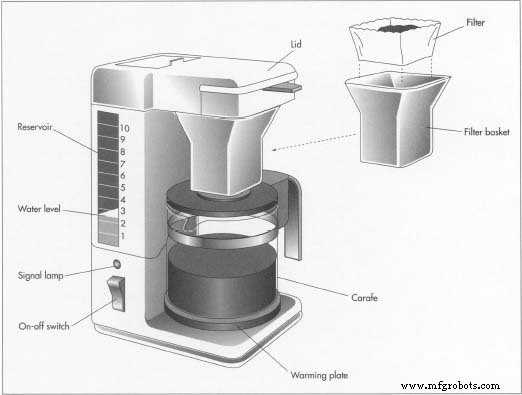
Inside an automatic drip machine, a measured amount of cold water is poured into a reservoir. A heating element brings the water to boiling, then steam rises through a tube, condenses, and is distributed over ground coffee via a shower‑head‑like nozzle. The water passes through the filter, extracts flavor, and collects in a carafe. A second heating element beneath the carafe keeps the brewed coffee warm. Advanced models feature programmable timers, auto‑shutdown, and pulsed‑drip functions for a slower, richer extraction.
Raw Materials
Most components are made of plastic—body, basket, and filter holder—while metal parts such as the base plate, warming plate, and heating unit are typically steel or anodized aluminum. The carafe is heat‑proof glass. Additional parts include electronic timers, switches, and wiring.
The Manufacturing Process
Parts are sourced from specialized suppliers: digital clocks, timers, and switches from electronics manufacturers; plastic parts from injection‑molding firms; metal components from stamping plants. Assembly occurs on a line where each worker focuses on a specific task.
Injection Molding
- The manufacturer designs plastic components and supplies the mold to a plastics company, which produces parts by forcing heated plastic into the mold under pressure, cooling, and ejecting the finished pieces for shipment to the assembler.
Stamping
- Metal base plates are created by rolling metal sheets and punching the required shapes in a stamping plant before delivery to the assembly line.
Assembly
- Electrical components are first installed, with parts snapping together for quick fit. Workers then attach the warmer plate, thermostat, and heating element. Wiring is completed using sonic welding on a conveyor. Remaining housings and reservoirs are assembled by snapping or screwing in place.
Packaging
- Finished units are placed in cartons, which are then grouped into larger shipping cartons. Barcodes are automatically printed for tracking, and the boxes are palletized for storage or dispatch.
Quality Control
Upon arrival, each part is inspected; defective items are removed before assembly. Random checks occur throughout the line, and a final audit samples 100 units to verify both internal and external quality.
The Future
European manufacturers are experimenting with single‑plastic coffee makers to improve recyclability. A single‑plastic design can be melted and reused, reducing waste. Although U.S. makers are currently less focused on this approach, the shift toward sustainable materials may become a global trend as recycling gains priority.
Manufacturing process
- How Lawn Sprinklers Work: Design, History, and Modern Manufacturing
- The Evolution of Pump‑Action Water Guns: From Invention to Global Market Leader
- Water: History, Types, and Modern Treatment Processes
- Instant Coffee: From History to Modern Manufacturing
- Salt: Production, Uses, and Health Impact
- Coffee: From Bean to Brew – History, Production, and Sustainability
- Smart IR-Activated Water Tap Controlled by Arduino UNO – Efficient & Eco-Friendly
- DIY Automatic Coffee Machine: Arduino, Bluetooth, and Android App
- SRF04-Based Automatic Water Level Controller for Residential & Commercial Use
- Automatic Water Pumps: How They Operate & Why They Matter