



Instant Coffee: From History to Modern Manufacturing
Background
Instant (or soluble) coffee has been a staple for decades, prized for its convenience. In the 1970s, almost one‑third of the roasted coffee imported into the United States was converted into instant products, generating sales of over 200 million pounds annually. Today, roughly 15 % of U.S. coffee consumption comes from instant granules mixed with hot water in homes, offices, and vending machines. High‑quality instant options have also helped bring coffee to tea‑drinking cultures worldwide.
Researchers have continually refined instant coffee to improve solubility, aroma retention, and flavor. Early powdered forms clumped in cups and lost fragrance quickly. Modern techniques produce granules that resemble ground coffee, while aroma‑enhancement treatments aim to make an opened jar smell as close as possible to freshly ground beans. The ultimate goal remains to replicate the taste of a freshly brewed cup.
The chief benefit is that consumers can prepare coffee with only a cup and stirrer, and at the same time avoid discarded damp grounds. Market studies reveal that many instant coffee drinkers cannot distinguish it from fresh‑brewed coffee, illustrating the success of these developments.
History
The quest for instant coffee—mixing a liquid or dry concentrate with hot water—dates back centuries. The earliest documented version emerged in Britain in 1771. The first American product appeared in 1853, and a cake‑form experimental batch was tested during the Civil War. In 1901, Japanese chemist Sartori Kato pioneered a stable powdered technique, later refined by British chemist George Constant Washington in 1910. Washington’s “Red E Coffee” dominated the U.S. market for three decades.
During the 1930s, Brazil leveraged instant coffee research to preserve excess harvests. Nestlé introduced Nescafé in 1938, combining coffee extract with soluble carbohydrate. The product proved indispensable to U.S. soldiers in World War II, with over one million cases shipped to the military in a single year. 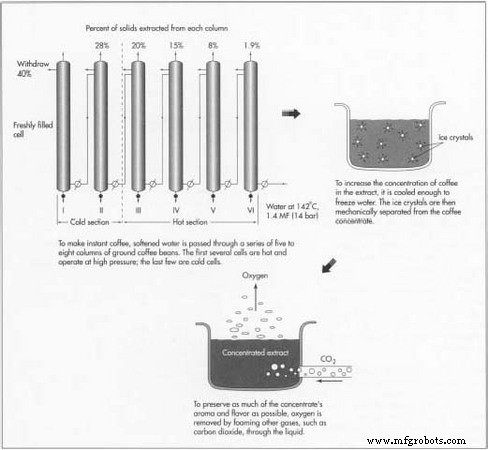
By 1950, Borden researchers eliminated the carbohydrate, creating pure coffee extract. This innovation increased instant coffee consumption from one cup in every 16 domestic cups in 1946 to one in every four by 1954. In 1963, Maxwell House launched freeze‑dried granules that more closely mimicked brewed coffee, and by the mid‑1980s, 40 % of U.S. instant coffee was freeze‑dried.
Raw Materials
Two of the 50 known coffee species dominate the industry: Arabica and Robusta. Arabica beans—grown mainly in Latin America, India, and Indonesia—offer a mild flavor and command a higher price due to hand‑picking at peak ripeness. Robusta beans, cultivated across Africa, India, and Indonesia, are more robust in taste but cheaper to grow because they tolerate a wider ripeness range and resist disease. Consequently, Robusta is the preferred choice for instant coffee production.
Beans for instant coffee are roasted above 300 °F (180 °C) to drive out moisture, typically leaving 7‑10 % residual water. They are then ground coarsely to prevent fine particles that could impede water flow in large‑scale brewing equipment.
The Manufacturing Process
Extraction
- Instant coffee production starts with highly efficient extraction. Softened water flows through 5‑8 columns of ground beans. Hot cells (284‑356 °F, 140‑180 °C) extract carbohydrates, while cold cells (~212 °F, 100 °C) capture flavor compounds. The resulting extract, cooled to ~40 °F (5 °C), contains 20‑30 % solids.
Filtration and Concentration
- After filtration, the brew is concentrated to ~40 % solids via centrifugation, evaporation, or freeze‑drying. These methods separate water from coffee solids to produce a dense extract ready for drying.
Recovery of Aromatic Volatiles
- Volatile aromatics lost during processing are reclaimed in several stages. Gases from roasting, grinding, and steam or solvent extraction capture aroma compounds. Aromatic oils are also expressed from spent grounds under high pressure (≥2,000 lb/sq in, 14 000 kPa). Distillation of the brewed extract further recovers these volatile components.
- Oxygen is displaced from the extract by foaming gases such as CO₂ or N₂ before dehydration, preserving flavor integrity.
Dehydration
Two primary dehydration techniques convert liquid extract into dry powder: spray drying and freeze drying. Spray drying operates at higher temperatures, making it cheaper but potentially altering taste; freeze drying preserves flavor more faithfully.
Spray Drying
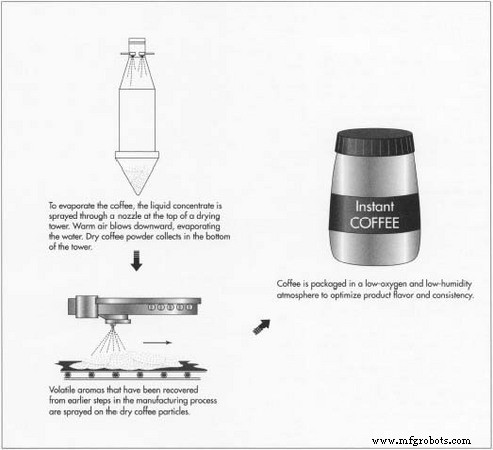
- Clarified concentrate is atomized into a 75‑ft (23‑m) tower. Hot air (~480 °F, 250 °C) evaporates water as it descends. Air is filtered and recirculated, and the resulting powder, 2‑4 % moisture, is free‑flowing and non‑dusty.
- Post‑drying agglomeration re‑wetting particles in steam or mist, then tumbling them, produces larger granules that dissolve more readily.
Freeze Drying
- Primary freezing chills extract to ~20 °F (‑6 °C), then further cools to ‑40 to ‑50 °F (‑40 to ‑45 °C). Rapid freezing yields light, small granules; slower freezing creates darker, larger ones.
- Frozen material is ground to the desired size, sieved, and any oversize particles are returned to the freezing stage.
- Finally, the slurry is dried under heat and vacuum, sublimating ice into vapor.
Aromatization
- Recovered aromatic gases are sprayed onto the dry particles during packaging, ensuring each cup delivers the full fragrance profile.
Packaging
- Instant coffee is hygroscopic, so it must be sealed in moisture‑proof containers under low‑humidity conditions. A low‑oxygen atmosphere—usually CO₂ or N₂—is also employed to lock in aroma and flavor until purchase.
Byproducts/Waste
The primary waste stream is spent coffee grounds from brewing. Some manufacturers incinerate these grounds to generate heat and steam for the process, creating an environmentally friendly loop that maximizes raw‑material use.
The Future
Since General Foods International Coffees launched flavored instant varieties in the 1970s, innovation has expanded to include latte and mocha mixes. Maxwell House is trialing an instant iced coffee line in vanilla, mocha, and original flavors.
Manufacturing process
- Custom Shop-Built Electric Coffee Grinder – Engineering a Precise Grind
- How Instant Lottery Tickets Are Made: Design, Security, and Future Trends
- Automatic Drip Coffee Maker: History, Design, and Future Trends
- Flavored Coffee Beans: From Bean to Brew
- Coffee: From Bean to Brew – History, Production, and Sustainability
- DIY Automatic Coffee Machine: Arduino, Bluetooth, and Android App
- Top 5 Coffee Roaster Manufacturers in 2023: Leading Brands & Innovation
- Understanding Coffee Plantations: Cultivation, Economics, and Impact
- Discover the Future: How a Robot Coffee Barista Enhances Home Brewing
- Automated Barista: Revolutionizing Coffee Service with AI and Robotics