



How Instant Lottery Tickets Are Made: Design, Security, and Future Trends
Background
Lottery tickets have become a mainstream legal gambling option across the U.S. Over the past 30 years, instant‑win or scratch‑off games have surged in popularity. These tickets hide the winning numbers under a removable coating. By simply scratching off the surface, players can immediately see whether they have won, eliminating the wait associated with drawn games. Because the payout is fixed at printing time, the manufacturing process must incorporate advanced security features to deter fraud.
Design
Instant‑win tickets come in a variety of themes—from sports and television to classic casino games—designed to attract buyers. Some states even involve the public in the design process; Oregon, for instance, held a “Designer Scratch‑it Contest” in 1993 to select themes based on originality and visual appeal.
Regardless of theme, every ticket is built to reveal numbers, letters, or symbols once the coating is removed. The design must also embed multiple security layers that make counterfeiting and tampering virtually impossible.
Security experts point to several attack vectors that manufacturers must guard against:
- Decoding the relationship between a ticket’s serial number and its hidden lottery number, which could expose batches with a higher probability of winning.
- Candling, where bright light is used to read numbers through the cover.
- Delamination, in which layers of the ticket are separated to expose the winning digits.
- Wicking, where solvents such as alcohol or ketones force the number ink to bleed through the coating.
To counter these threats, manufacturers employ random serial numbers generated by secure algorithms, ensuring that the serial number reveals no information about the ticket’s outcome. Additionally, front‑ and back‑side coding provides a tamper‑evidence layer that allows operators to verify authenticity during redemption.
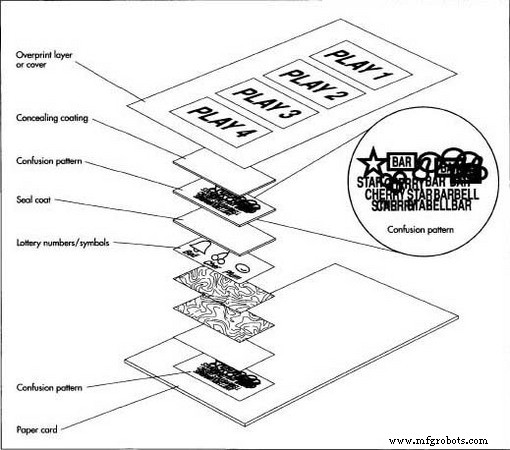
Concealment coatings vary in complexity. Heavy foil can block light but is costly and still vulnerable to delamination. A more reliable approach uses an opaque acrylic film layered over a primer, a confusion pattern (random lines or symbols matching the ticket’s color), the lottery numbers, a seal coat, and an outermost protective layer containing carbon black or aluminum paste mixed with acrylic resins and solvents such as methyl ethyl ketone. This multilayer system thwarts candling, delamination, and wicking while remaining user‑friendly for scratching.
Raw Materials
The foundation of a scratch‑off ticket is a sturdy paper stock. Some variants incorporate aluminum foil to reinforce durability. Essential raw materials also include specialized inks, adhesives for lamination, and acrylic‑based scratch‑off coatings.
The Manufacturing Process
Printing
- Tickets may be printed in one stage—embedding all data simultaneously—or in two stages, separating game information (price, rules, graphics) from secure numbers.
- Continuous‑feed presses run a strip of stock through a computer‑controlled printer, while sheet‑press machines imprint whole sheets using engraved plates. After printing, sheets are cut, stacked, and shuffled to randomize winning tickets and avoid patterns.
Serial Number Coding
- In continuous printing, a sequencer increments the serial number for each ticket. The number undergoes two algorithmic transformations: first to an intermediate sequence, then to the final lottery number. This dual conversion masks any correlation between serial and outcome.
- With sheet printing, a post‑cut serializer attaches a computer‑generated serial number using high‑speed ink‑jet printers. Sensors monitor print speed and position, enabling synchronized printing of front and back data in real time. Once both serial and lottery numbers are encoded, the ticket proceeds to concealment.
- Figure 1 illustrates the sensor‑driven print control system.
Lottery Number Concealment
- The cover applicator applies a series of coatings: a primer, a confusion pattern, the lottery numbers, a seal coat, and an outer protective layer. The final cover contains carbon black or aluminum paste blended with acrylic resins and solvents, making the numbers invisible until the user scratches.
Conversion and Packaging
- After printing and coating, tickets are sliced into rolls or perforated for vending machines. They are then boxed and shipped to distributors. At retail, the scratch‑off reveals the outcome; the ticket is presented to a vendor, the serial number is scanned, and if verified as a winner, the prize is paid.
The Future
Printing technology continues to evolve, opening doors to more secure encryption methods and cost‑effective concealment chemistries. Some lottery commissions are also exploring digital alternatives: video terminals or online instant‑win games that could replace paper tickets entirely.
Manufacturing process
- What is VMC Machining? An Expert Overview of Vertical Machining Centers
- Expert Guide to Aluminum Laser Marking: Precision, Durability, and Industry Applications
- How Instant Lottery Tickets Are Made: Design, Security, and Future Trends
- Instant Coffee: From History to Modern Manufacturing
- Instant Quote & Price Estimating Software: The Competitive Edge for 3D Printing Service Providers
- IoT: The Real Golden Ticket for Business Growth—or Just a Goose with a Golden Egg?
- Predictive Vibration Analysis Saves Machines—and Money
- Building Management Systems: Powering Smart Cities with IoT
- RapidDirect Enhances Instant Quote Platform with Advanced 2D Technical Drawing Features
- Shop Floor Control: Unlocking Real-Time Visibility & Maximizing ROI