



Building Management Systems: Powering Smart Cities with IoT

Sergiy Seletskyi, IoT practice leader and senior solution architect at Intellias, notes that building complexity is rising fast—modern office centers and malls now feature aquariums, wedding chapels, rollercoasters, and even artificial canals.
Such intricacy cannot be managed efficiently by people alone, and many businesses remain unaware of the resources they waste or the real cost of that waste.
Advances in technology now allow building operations to be monitored, automated, and optimized. While it might seem that only digitally native companies can benefit, the truth is far from it.
Every activity inside a building can generate data. Powered by IoT devices, a Building Management System (BMS) collects and analyzes that data, giving granular visibility into every aspect of a facility.
What is a BMS?
A BMS controls a building’s technical and electrical systems by maintaining predefined parameters as conditions change.
Half a century ago, early BMSs could only toggle equipment—lighting, pumps, elevators, HVAC—at scheduled times. Those simple controls already eased facility management.
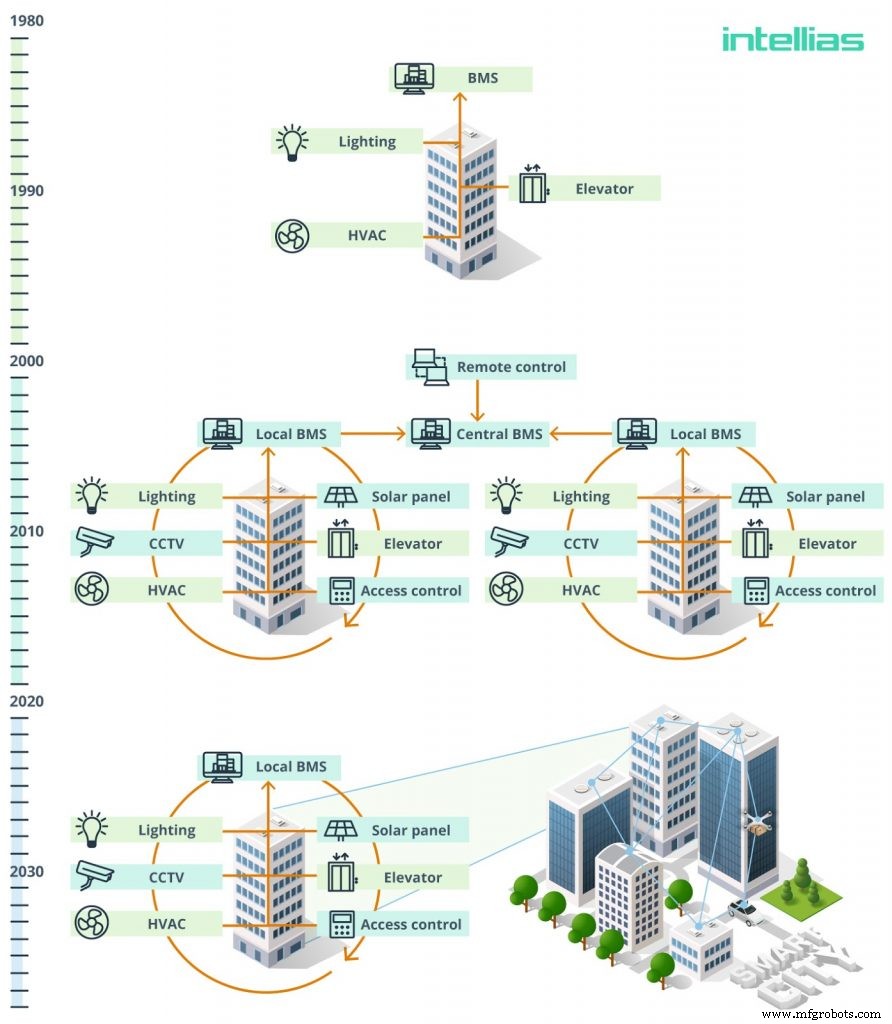
Today, a wide array of subsystems—fire and smoke detection, video surveillance, security, switchable glass, exterior shading, water reclamation, renewable energy—has been added. Each new subsystem adds complexity to the facility’s infrastructure.
To manage this complexity, modern BMSs have evolved into sophisticated IT ecosystems that integrate all subsystems via layers of communication protocols, networks, and controls.
With IoT-powered BMSs, facilities can cut energy consumption through HVAC monitoring, heat‑map analysis, and predictive maintenance. A modern BMS gives facility managers a holistic view, enabling data‑driven, business‑critical decisions.
Future BMSs will become even smarter, enabling inter‑building communication and contributing to a collaborative smart‑city ecosystem.
How does a BMS work?
A typical BMS architecture includes four core device categories: sensors, controllers, output devices, and a user interface.
First, you configure the system via a control panel. For instance, you might set a daily temperature schedule.
Sensors capture environmental data and energy usage. Controllers interpret this data against your settings and decide on adjustments—such as modulating outside air intake based on indoor CO₂ levels.
Output devices and actuators then execute the controller’s commands. The control panel remains available for real‑time monitoring, performance assessment, and configuration changes.
Benefits of a BMS
Energy Savings
Energy efficiency is the most significant benefit. A BMS with robust analytics can reduce consumption by up to 30%—cutting costs and boosting profitability.
For example, by correlating HVAC data with weather forecasts, a BMS can pre‑cool a building before peak demand periods, avoiding expensive energy charges. Similarly, integrating meeting schedules lets the system dim lights or adjust HVAC only where occupants are present.
Predictive Maintenance
IoT sensors embedded in equipment deliver real‑time metrics—power use, temperature, vibration—allowing AI analytics to detect abnormal patterns and predict failures before they happen.
This is critical in industrial plants where a single downtime can cost millions, and in retail settings where refrigeration units must stay reliably cold to protect inventory.
Enhanced Security
A BMS strengthens security, protecting assets, intellectual property, and people. Smoke or gas detectors trigger automatic route opening and guide occupants to exits during emergencies.
Video surveillance, motion sensors, and glass‑break detectors provide real‑time intrusion control. For instance, if a camera detects two people entering during off‑hours, the system cross‑checks entry logs; an anomaly triggers a security alert.
Personalized Environment
By aggregating data from sensors, beacons, Wi‑Fi, and device usage, a BMS can create a dynamic, comfortable setting tailored to each occupant.
Access cards can carry individual climate preferences; when a cardholder enters a zone, the BMS applies their preferred temperature and lighting automatically.
Is this technology right for your business?
Adopting an IoT‑based BMS for new or retrofitted facilities lets you optimize operations, reduce energy waste, strengthen security, and rethink space usage.
While new buildings are designed for smart functionality, older structures can also be retrofitted in scalable, smart increments—making sustainability accessible to all.
Technology transformation is not exclusive to digital natives; it’s for any organization willing to embrace advanced solutions.
Author: Sergiy Seletskyi, IoT practice leader and senior solution architect at Intellias.
About the author
Sergiy helps companies harness the right IoT technology stack to scale business and future‑proof operations. A strategic thinker with deep industry knowledge, he delivers innovative solutions across diverse domains.
Internet of Things Technology
- Essential IoT Building Blocks for Your Next Project
- Smart Lighting: The Cornerstone of a Truly Connected City
- Smart Waste Management: How IoT Drives Efficiency and Reduces Waste
- Smart Cities: Delivering Tangible Benefits Through Proven Connectivity Solutions
- LPWA Technologies Empower Smart Cities: Enhancing Air Quality and Water Management
- Smart Cities: Environmental Benefits, Data-Driven Decisions, and Economic Growth – Part 2
- How Smart City Technologies Transform Urban Life – Expert Insights
- Intelligent Reservoir Monitoring: Optimize Water Management for Your Business
- Smart Waste Management Systems: Transforming Urban Efficiency and Sustainability
- Advanced Drayage Management System: Optimizing Supply Chain Efficiency