



The Evolution and Science Behind Modern Insulated Bottles
Background
The insulated bottle has long been the go‑to solution for keeping beverages hot or cold on the move. Its effectiveness comes from a simple yet elegant design: a container within a container. The outer shell surrounds an inner chamber, and the space between them is either filled with insulating foam or sealed to create a vacuum. Foam‑packed bottles keep cold drinks cool, while vacuum‑packed models retain heat. Since the early 1900s, this dual‑layer strategy has become the standard for athletes, travelers, campers, hikers, and everyday commuters. Even many baby bottles now feature insulation for optimal temperature control.
History
Glass bottles date back to around 1500 BC in ancient Egypt, where molten glass was poured around a sand‑and‑clay core that was later removed. By 200 BC, glassblowing techniques spread to China, Persia, and Egypt, and the Romans adopted the method, disseminating it across Europe in the 1400s–1500s. The first U.S. glass‑making factory opened in Virginia in 1608.
The 1800s saw a wave of innovations: the baby bottle was patented in 1841; John L. Mason introduced the screw‑on Mason jar in 1858; Dr. Hervey Thatcher developed the glass milk bottle; and Coca‑Cola launched its first soda bottle in 1915. Standardized soda bottle shapes emerged after 1934, when companies began permanently printing colors, names, and logos on glass.
Automation transformed bottle production in 1865 with the first pressing and blowing machine. Michael J. Owens’s 1903 Owens Bottle Machine made large‑scale, inexpensive glass bottle manufacturing possible, fueling the growth of the carbonated beverage industry. By the 1940s, blow‑molding machines produced the first plastic bottles, which were initially squeezable polyethylene containers. Nat Wyeth designed a durable plastic bottle capable of holding carbonated drinks for the Du Pont Corporation.
The first insulated bottle was likely created by Sir James Dewar in 1896. Dewar sealed one flask inside another and evacuated the air, creating a vacuum that served as an effective insulator. Although he never patented the idea, German glassblowers Reinhold Burger and Albert Aschenbrenner marketed the device under the name “Thermos,” derived from the Greek word for heat. They founded Thermos GmbH in 1906 and secured U.S. rights in 1907 through the American Thermos Bottle Company.
The Thermos bottle quickly became iconic, favored by presidents, explorers, and early aviators. An early 1915 glass‑lined aluminum vacuum‑sealed bottle—now housed in the Henry Ford Museum—illustrates the enduring design that has kept liquids at their desired temperature for over a century.
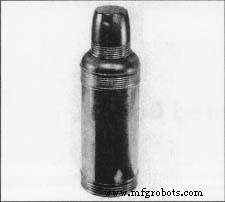 Glass‑lined aluminum vacuum‑sealed bottle made by the American Thermos Bottle Co. of Norwich, Connecticut, in 1915.
(from the collection of Henry Ford Museum & Greenfield Village, Dearborn, Michigan.)
Raw Materials
Insulated bottles are typically constructed from either plastic or stainless steel for the outer shell, and glass for the inner liner. The inner cup may also be made from stainless steel or foam‑lined for cold‑drink models. Production involves fitting the outer cup with its inner liner—often a pre‑manufactured glass or stainless‑steel filter—before adding the insulation layer.
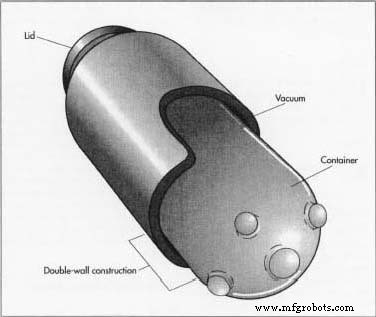 In an assembly line process, the formed outer cup is fitted with its inner liner. A glass filter, made outside the factory, or a stainless steel filter, pounded from a sheet of stainless steel, is placed inside the outer cup.
The Manufacturing Process
The Foam
- 1. Foam arrives as liquid “chemical balls” that react to form a heat‑generating mixture.
- 2. The mixture is gently heated to 75–80 °F (23.9–26.7 °C).
- 3. After the reaction, the mixture cools into a liquid foam ready for application.
The Bottle
- 4. The outer cup is shaped: plastic cups are blow‑molded from heated resin pellets; stainless‑steel cups are forged from sheets.
- 5. In line assembly, the outer cup receives the inner liner—glass or stainless‑steel—placed inside.
- 6. Insulation follows: for cold bottles, liquid foam is sprayed into the cavity and allowed to harden; for hot bottles, a vacuum machine evacuates the space between cups.
- 7. A silicone sealant bonds the components, forming a single unit.
- 8. Steel bottles are painted, and plastic bottles are coated with a protective finish.
- 9. Logos are pad‑printed or stickers are affixed, creating a permanent brand imprint.
- 10. Completed bottles undergo rigorous quality checks before being wrapped and shipped.
The Top
- 11. The cap is blow‑molded, often with a pull‑up stopper that allows liquid to pass through a small opening.
- 12. A precision hole is punched in the stopper to ensure smooth flow.
Quality Control
Insulated bottles undergo exhaustive inspections. Beyond visual checks, manufacturers test for cosmetic defects, heat retention, and leakage according to Military Standard 105E. A Macbeth lighting system verifies paint color fidelity, while foam batches are analyzed for rise, density, temperature, viscosity, voids, and discoloration before use.
The Future
Innovation continues to drive new insulated bottle designs that blend functionality with style. Companies explore adaptive features—such as interchangeable caps, smart temperature displays, and eco‑friendly materials—to meet evolving consumer demands. Strategic marketing through branded water bottles also serves as free advertising for sponsors. As the market expands into Asia, Latin America, Africa, and the Middle East, insulated bottle manufacturers are positioning themselves for global growth.
Manufacturing process
- Mastering the Art of Ship‑in‑a‑Bottle Modeling
- The History, Production, and Recycling of PET Soda Bottles
- Can Plant‑Based Packaging Replace Plastic Bottles? Coca‑Cola’s PlantBottle Leads the Way
- Proco Introduces Affordable Collaborative Robot Palletizer for Blow‑Molded PET Bottles
- Choosing the Ideal Bottle Printing Solution for Your Beverage Brand
- Smart Arduino Water Bottle – Real-Time Monitoring & Alerts
- Wiha 32084 5‑Piece Insulated Slotted & Phillips Screwdriver Set – Professional Torque & Electrical Safety
- Wiha 8‑Piece Insulated PicoFinish Screwdriver Set – Precision, Durability & Safety
- Can 3D Printer Resin Be Reused? A Comprehensive Guide
- Enhancing Product Safety: Automated Bottle Packaging to Minimize Contamination