



The History, Production, and Recycling of PET Soda Bottles
Background
The ubiquitous PET (polyethylene terephthalate) soda bottle is a lightweight, high‑strength plastic that dominates the beverage packaging market. PET accounts for 6.4 % of all packaging and 14 % of all plastic containers. It is the most common soft‑drink bottle, representing 43 % of sales, followed by aluminum at 34 % and glass now a small share of the market.
Plastics emerged in the 1800s from natural polymers and early synthetic variants. Early plastics were flammable and brittle. Polyesters—PET’s family—were first created in 1833 for liquid varnishes and only later evolved into the solid, versatile polymers we use today.
Purely synthetic plastics arrived in the early 1900s, but widespread commercial use lagged. PET was first synthesized in 1941, and it wasn’t until the early 1970s that the modern soda bottle was realized. Nathaniel C. Wyeth of Du Pont perfected a blow‑molding technique that yielded a strong, lightweight bottle.
Wyeth’s breakthrough was the invention of stretch blow molding in 1973, which solved earlier problems of uneven wall thickness, irregular necks, and trimming difficulty. The result was a flexible, durable bottle that could be produced at scale.
By 1991, U.S. production exceeded eight billion PET bottles. The volume has created a disposal challenge, but recycling rates are rising as manufacturers explore new applications for recycled PET.
Raw Materials
PET is a polymer made from chains of repeating organic molecules, ultimately derived from petroleum. It is formed by reacting terephthalic acid (C₈H₆O₄) with ethylene glycol (C₂H₆O₂).
Terephthalic acid is produced by oxidizing para‑xylene (C₈H₁₀) using air or nitric acid. Para‑xylene is obtained from coal tar or petroleum through fractional distillation.
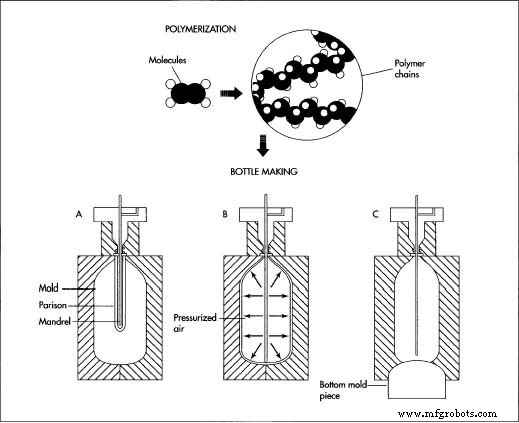
In manufacturing, PET is first polymerized to create long molecular chains. The polymer then undergoes stretch blow molding, where a heated parison (a long tube) is placed into a mold, forced against the mold walls by pressurized air, and shaped into a bottle with a concave base.
Ethylene glycol is derived from ethylene (C₂H₄) via ethylene oxide (C₂H₄O). Ethylene is produced industrially by heating ethane or an ethane‑propane mixture.
The Manufacturing Process
Polymerization
- 1. Terephthalic acid reacts with methanol (CH₃OH) to form dimethyl terephthalate and water.
- 2. Dimethyl terephthalate is esterified with excess ethylene glycol at 150 °C (305 °F) to produce bis‑2‑hydroxyethyl terephthalate and methanol.
- 3. The bis‑2‑hydroxyethyl terephthalate undergoes condensation polymerization under vacuum at 275 °C (530 °F). The process releases ethylene glycol, which is recycled. The resulting PET is cooled to prevent degradation and can be reheated for subsequent use.
Bottle‑making
- 4. PET pellets are injection‑molded into a thin parison, then cooled and cut to length.
- 5. The parison is reheated and placed in a bottle mold with a steel mandrel. Pressurized air inflates the parison, stretching it radially and axially. The high temperature and stretch align the polymer chains, producing a strong, lightweight bottle.
- 6. Cooling methods—water circulation, liquid CO₂, pressurized moist air, or ambient air—solidify the bottle quickly to prevent creep.
- 7. The bottle is ejected. In continuous production, a string of bottles is trimmed and separated; up to 25 % of plastic is recovered and reused.
- 8. Finished bottles are shipped to beverage companies. Lids and labels are produced separately; some manufacturers print labels on‑site before dispatch.
Quality Control
Polymerization is a complex reaction that cannot be interrupted once it starts. Side products and impurities remain in the final polymer, making purification costly and quality assessment challenging. Minor variations can be invisible in routine tests.
Key impurities include diethylene glycol and acetaldehyde. Diethylene glycol levels are tightly controlled to preserve PET properties. Acetaldehyde, which can impart a bitter taste, is minimized through rapid heating and optimized injection‑molding, keeping its concentration negligible.
PET bottles undergo a battery of tests aligned with industry standards. Impact resistance tests confirm shatter‑proof performance. Creep resistance ensures shape retention under pressure. Carbon dioxide permeability tests verify that carbonation remains trapped. Transparency and gloss are measured to meet visual quality expectations.
Recycling
With billions of PET bottles discarded annually, recycling is critical. PET’s recycling rate is the highest among plastics, although aluminum commands a higher price at recycling centers. Current recovery rates hover around 1–2 %, but are improving.
Recycled PET (rPET) is used in carpeting, concrete, insulation, and automobile parts. The first 25 % rPET soda bottle appeared in 1991, launched by Coca‑Cola and Hoechst Celanese in North Carolina. By 1992, 14 additional states adopted it, and competitors such as Pepsi followed suit.
Governments aim to raise PET recycling to 25–50 %, expand curbside programs to half the U.S. population, and deploy 4,000 curbside initiatives nationwide. In 1990, the National Association for Plastic Container Recovery reported 577 curbside programs; the target is a significant increase.
Manufacturing process
- Mastering the Art of Ship‑in‑a‑Bottle Modeling
- Premium Plastic Dolls: From Playtime to Collectible Art
- The Evolution and Science Behind Modern Insulated Bottles
- Acrylic Plastic: Properties, Production, and Future Trends
- Decorative Plastic Laminate: From Formica to Modern Manufacturing
- Pet Food Production: From Ingredients to Regulation – A Complete Guide
- Premium Plastic Food Wrap: Preserve Freshness & Seal Odors
- Baking Soda: Chemistry, Uses, and Production
- Choosing Between Plastic and Metal: Expert Insights for Optimal Material Selection
- Plastic vs. Wood Pallets: Selecting the Optimal Choice for Your Supply Chain