



Pet Food Production: From Ingredients to Regulation – A Complete Guide
Background
For the most current description of the pet food manufacturing process visit: www.petfoodinstitute.org
Pet food is a specialty product tailored to the nutritional requirements of domestic animals. It typically includes meat, meat by‑products, cereals, grains, vitamins, and minerals. In the United States, roughly 300 manufacturers produce over 7 million tons of pet food annually—making it one of the largest packaged‑food categories. Consumers can choose from more than 3,000 distinct products, ranging from dry kibble to canned and semi‑moist varieties, plus an expanding snack segment that includes biscuits, jerky, and kibbles. In the 1990s, this $8 billion industry fed 52 million dogs and 63 million cats across America.
Commercial pet food originated with a dry biscuit‑style dog food created in England in 1860. Soon thereafter, formulas grew more sophisticated, incorporating nutrients deemed essential for canine health. By the early 20th century, pre‑packaged foods were available in the U.S., initially composed mainly of dry cereals. After World I, canned dog food made from horse meat entered the market. The 1930s saw the introduction of canned cat food and a dry, meat‑meal dog food. By the 1960s, dry cat food, dry expanded‑type dog food, and semi‑moist pet food had become common.
From the 1980s onward, trends shifted toward dry foods while canned foods declined. Research linked canned diets with faster gum disease progression compared to dry foods. The growing public emphasis on health spurred demand for scientifically formulated pet foods, including life‑cycle products for puppies and seniors, therapeutic diets for weight loss or urinary health, and formulations that reduce fatty tissue while boosting protein. The snack category also grew, with products such as jerky, sausage‑shaped pieces, biscuits, and kibbles gaining popularity.
Raw Materials
The core ingredients in pet food are by‑products of meat, poultry, and seafood, feed grains, and soybean meal. Livestock, horses, and even household pets that are rendered after humane euthanasia contribute to the meat‑meal and bone‑meal components. According to the National Animal Control Association, about 5 million pets were processed into pet food during the 1990s.
Typical animal parts include damaged carcass sections, bones, cheek meat, and organs such as intestines, kidneys, liver, lungs, udders, spleen, and stomach tissue. Grains—soybean meal, corn meal, cracked wheat, barley—improve texture and reduce cost. Liquid ingredients include water, meat broth, or blood. Salt, preservatives, stabilizers, and gelling agents (bean and guar gums, cellulose, carrageenan, starches, thickeners) help achieve uniformity and moisture control. Palatability enhancers include yeast, protein, fat, fish solubles, sweeteners, or concentrated “digests.” Artificial flavors are generally avoided, though smoke or bacon flavors may be added to certain treats. Most manufacturers supplement pet foods with vitamins and minerals to offset losses during processing.
Ingredient profiles vary by product type. Canned food contains 70–80 % moisture, as it is typically made from fresh meat, whereas dry food holds no more than 10 %. Dry foods incorporate corn gluten feed, meat and bone meal, animal fats, oils, starches, protein adhesives (collagen, albumen, casein), and plasticizing agents. Semi‑moist products use binders derived from gels, cereal flours, sulfur‑containing amino acids, salts, and thiamin, as well as soybean flakes, bran flakes, soluble carbohydrates, emulsifiers, stabilizers, and dried skim milk or whey.
Antioxidants—BHA, BHT, tocopherol—prevent fat oxidation and rancidity. To inhibit mold and bacterial growth, producers use sucrose, propylene glycol, sorbic acid, or potassium and calcium sorbates.
The Manufacturing Process
Pet food production mirrors that of processed human foods. Raw meat must first be rendered—separating water, fat, and protein from soft off‑al and hard off‑al (bones, hoofs). Rendering is typically performed by external processors who supply the finished product to pet‑food manufacturers. Fresh meat for canned products is used within three days; frozen meat is used for dry foods.
The process begins by grinding and cooking the meat and by‑products. The mixture is then blended with other ingredients and, if required, shaped into the desired form. Finished products are filled into containers and shipped to distributors.
Technological advances have improved product quality and shelf life. Vacuum‑packed canned foods can last 3–5 years with minimal nutritional loss. Dry foods have a shelf life of 10–12 months and typically require preservatives; some producers now use natural options such as vitamins E and C.
Rendering the meat
- Rendering ruptures fat cells via heat, enzymatic, or solvent extraction, followed by drying the residue.
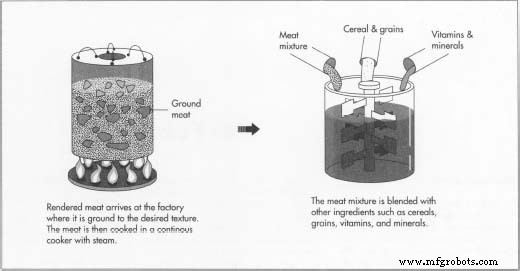
Grinding and pre‑cooking the meat
- The meat is coarsely ground to the desired texture.
- The ground meat is cooked in a continuous cooker with live steam at the correct temperature.
- After initial cooking, the flesh is re‑ground for a uniform consistency. For semi‑moist or chunky foods, batches are deliberately cooked unevenly to achieve the intended texture.
Blending and shaping
- The meat mixture is blended with grains, vitamins, and minerals.
- Dry and semi‑moist foods are often heated to partially dextrinize starch, thickening the mixture. For a marbled appearance, the mixture may be cooked unevenly and colored red and white. Semi‑moist foods must be stabilized to retain proper moisture distribution.
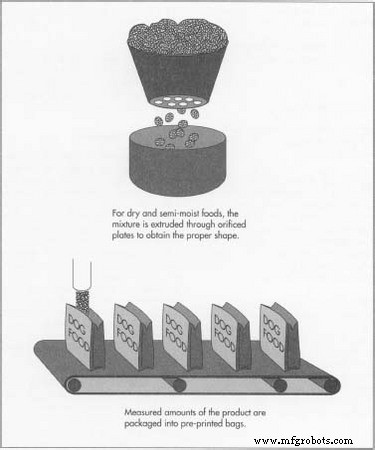
- Dry and semi‑moist foods may be extruded under high pressure through an orificed die to achieve the final shape—biscuits, kibbles, meat‑balls, patties, pellets, or slices. Alternatively, the mixture can be gelatinized and expanded. For marbled meat, a red‑white blend is extruded together and broken into chunks.
Packaging and labeling
- Measured amounts of product are packaged into suitable containers. Dry foods are poured into pre‑printed bags or boxes. Canned foods are vacuum‑sealed to reduce oxygen and prevent fat spoilage.
Sterilizing
- Can contents are sterilized in a retort (batch or continuous hydrostatic). Cans are heated to ~250 °F (121 °C) for 80 minutes, with variations based on contents, steam pressure, and can size.
- Rapid cooling to ~100 °F (38 °C) follows, then cans are dried, labeled, and packaged into corrugated cardboard or shrink‑wrapped trays.
- The finished pet food is ready for shipping to distributors.
Quality Control
Manufacturers must comply with regulations from the FDA, FTC, and USDA. The USDA governs meat quality and permits certain animals for pet food. The FDA sets nutrient limits and prohibits medications or antibiotics, protecting children from accidental ingestion. The Association of American Feed Control Officials (AAFCO) registers brands and sizes, ensuring consistency across the industry.
The “guaranteed analysis” statement on labels originated to prevent manufacturers from adding sand or limestone to bulk pet food. It guarantees minimum crude protein and fat, and maximum crude fiber and moisture. Other guarantees may include calcium, phosphorus, sodium, linoleic acid for dog food, and ash, taurine, magnesium for cat food. The maximum allowable moisture is 78 % for canned food and up to 12 % for dry food.
Labeling guidelines from the FDA’s Center for Veterinary Medicine and AAFCO require six core elements: product name, net weight, manufacturer or distributor name and address, guaranteed analysis, ingredient list, and nutritional information. Naming rules such as the 95 % rule, 25 % rule, three‑percent rule, and flavor rule prevent misleading claims. All ingredients must use AAFCO-approved names, and any preservatives, stabilizers, colors, or flavorings must be Generally Recognized as Safe (GRAS). The term “natural” applies only to products free of artificial additives.
Calories per serving and per container should be listed in kilocalories per kilogram, and package codes must appear on all containers. Oversight also comes from the American Animal Hospital Association, the American Veterinary Medical Association, and the Pet Food Institute.
How Pet Food Is Made
By Pet Food Institute – Washington, DC
Pet food manufacturing employs many of the same techniques used for human food: baking for treats, canning, extrusion for dry kibble (also used in breakfast cereals), sous‑vide for gentle cooking, and other advanced processes.
Dry Kibble
Dry kibble supplies the majority of calories for American pets, accounting for over 60 % of all cat and dog food sales. Products range from single‑pound boxes to 40–50 lb bags.
Dry products are produced via extrusion/expansion or drying.
Wet Pet Food
The most familiar wet form is the can. Innovations now allow wet foods in trays and pouches, mirroring popular human snack formats.
How Dry Pet Food Is Made
Extrusion—adapted from cereal production in the 1950s—is the most common method. The process is illustrated below:
- Ingredients are mixed into a moist dough.
- The dough is pre‑conditioned with heat.
- In the extruder, the dough is cooked under intense heat and pressure, then forced through a die to expand into kibble.
- Excess moisture is removed in an oven, followed by a cooling phase.
- Optional coating (flavor enhancer) is sprayed onto kibble.
- Packaging into bags, boxes, or pouches ensures precise weight.
How Wet Pet Food Is Made
Wet pet food follows the same federal regulations as low‑acid canned human foods (21 CFR Part 113). The process is summarized:
- Ingredients are blended in a mixer.
- Empty containers are filled to exact weight.
- Lids are applied and sealed.
- Sealed containers are cooked at a specified temperature and time to eliminate microbes.
- After cooling, labels are applied, completing the product.
Regulation of Pet Food
Pet food is heavily regulated at both federal and state levels. AAFCO’s work on ingredient definitions, nutritional requirements, labeling, and model laws ensures uniform standards across states, supporting consumer protection and interstate commerce.
Federal agencies—FDA, USDA, FTC—oversee labeling, advertising, ingredient safety, and product quality. They require products to be pure, wholesome, free of harmful substances, and truthfully labeled. Canned foods must also meet low‑acid canning regulations applicable to human food.
Regulatory agencies inspect facilities, test ingredients, and verify label claims. Violations can trigger stop‑sale orders or FDA warnings, prompting product recalls if necessary.
State regulations mandate that pet food labels be registered and approved, clearly identify the product, state the quantity, list manufacturer or distributor, provide a guaranteed analysis, and order ingredients by weight in compliance with AAFCO definitions.
Claims of “complete” or “balanced” nutrition are permissible only if the product meets the nutritional adequacy for all life stages, or if the claim is limited to a specific stage (e.g., senior, growth).
Pet Food Ingredients
Manufacturers source a wide array of agricultural ingredients—meat, poultry, seafood, grains, and by‑products of human food processing. Ingredients are chosen for their nutrient profile and functional role, ensuring balanced nutrition.
Vitamins, minerals, and preservatives are added as needed to maintain nutritional quality and shelf life. All ingredients must be approved by the FDA and USDA, the same agencies that regulate human food.
While most ingredients are domestic, supply constraints sometimes necessitate imports, especially for vitamins, amino acids, minerals, and micronutrients. For example, China supplies the bulk of the world’s vitamin C. Despite foreign sourcing, companies rigorously verify ingredient quality and safety.
Eating High Off the Hog
The phrase “eating high off the hog” refers to consuming premium cuts of meat. Historically, Americans ate every part of the animal, but today many nutritious cuts—livers, kidneys, tripe—are often discarded. In many cultures, these by‑products remain prized delicacies.
In the U.S., they are considered by‑products and used to produce high‑quality protein, vitamins, minerals, and essential fatty acids for pet food. Cats require animal proteins or synthetic taurine and arachidonic acid to prevent eye and heart disease, as they cannot synthesize these compounds.
No Fillers, Just Function
Formulating a complete and balanced pet food is complex; veterinarians identify 42–48 essential nutrients for cats and dogs. Meeting these needs requires a diverse ingredient list—often 30–40 components.
AAFCO’s 100‑year‑old ingredient definition system mandates precise labeling, ensuring consistency nationwide. Ingredient names reflect source, processing, and compliance with GRAS standards. Examples include wheat gluten (binder and high‑digestibility protein) and chemical compounds that deliver essential nutrients (e.g., sodium selenite for selenium, pyridoxine hydrochloride for vitamin B6).
Labeling uses the true chemical name to maintain transparency and regulatory compliance.
Sources of vitamins and minerals:
Sodium selenite – Selenium
Pyridoxine hydrochloride – Vitamin B6
Biotin – Vitamin B7
Menadione sodium bisulfite complex – Vitamin K (potassium)
Manganous oxide – Source of manganese
Manufacturing process
- The Science and Industry of Frozen Vegetables: From Harvest to Table
- TV Dinners: History, Production, and Future Innovations
- The Complete Guide to Freeze‑Dried Food: Preservation, Production, and Future Trends
- The History, Production, and Recycling of PET Soda Bottles
- Hill’s Pet Nutrition Upgrades Control System to Eliminate I/O Failures and Boost Productivity
- Ensuring Sanitary Practices in Pet Food Manufacturing: A Comprehensive Guide
- Pavlov’s Cat: IoT Dinner Timer to Train Your Cat
- Smart Pet Food Catapult – Automatically Toss Treats, Balls, and Toys for Your Furry Friends
- Food Quality Sensor: Detecting Food Freshness with Arduino
- Smart IoT Pet Feeder: Automated Feeding System with Motion Detection