



The Art and Science of Perfume: From Ancient Roots to Modern Innovation
Background
For millennia, humans have used perfume to mask or enhance personal scent, drawing inspiration from nature’s most pleasant aromas. Natural and synthetic materials alike are blended for skin, clothing, cosmetics, cleaning products, and ambient fragrance. Because body chemistry, temperature, and personal odor vary, each wearer experiences a unique scent profile.
Derived from the Latin words per (“through”) and fumum (“smoke”), early perfumes were extracted by pressing and steaming plant oils, then burned to fill the air. Today, the majority of consumer products incorporate perfume as a key fragrance component, and industrial formulations may even use odorants to mask unpleasant smells or create the illusion of an “unscented” environment.
While many scented liquids are colloquially referred to as perfume, true perfume is defined as an extract or essence comprising a specific percentage of oil distilled in alcohol, often with water as a diluent. The United States dominates the global market, with annual sales reaching several billion dollars.
History
The Bible records the Three Wise Men bringing myrrh and frankincense to the infant Jesus, a testament to early perfumery’s cultural significance. Ancient Egyptians burned kyphi—a blend of henna, myrrh, cinnamon, and juniper—as a religious offering. They also used aromatic wood, gum, and resins in fragrant body lotions and assigned distinct scents to deities, referring to perfume as the “fragrance of the gods.”
Egyptian techniques influenced Greek and Roman perfumers, and after the fall of Rome, perfume remained primarily an Oriental craft until the 13th‑century Crusaders introduced it to Western Europe. In the 17th century, physicians treated plague victims with cloves, cinnamon, and spices, believing these aromas could ward off disease.
French court culture elevated perfume to an art form. King Louis XIV, dubbed the “perfume king,” surrounded himself with a floral pavilion, infusing the palace with scents, and even bathing guests in goat’s milk and rose petals. Grasse in southern France emerged as a leading perfume center during this era.
By the late 1800s, the advent of synthetic chemistry enabled mass production. Nitrobenzene—an almond‑smelling compound—was among the first synthetic fragrances. Pioneers such as William Perkin (coumarin), Ferdinand Tiemann (synthetic violet and vanilla), and Francis Despard Dodge (citronellol) expanded the fragrance palette with laboratory‑derived scents.
The evolution of perfume bottles mirrored the craft’s sophistication. Ancient Egyptian glass vials, 18th‑century Venetian animal‑shaped containers, and today’s designer bottles all reflect the fragrance they hold.
Raw Materials
Perfume ingredients span flowers, grasses, spices, fruits, woods, roots, resins, balsams, leaves, gums, and animal secretions. Additionally, alcohol, petrochemicals, coal, and coal tar serve as carriers or fixatives. Of the 250,000 flowering plant species, only about 2,000 produce essential oils, necessitating synthetic compounds to replicate non‑oily aromas or create entirely new scents.
Animal derivatives—such as castoreum from beavers, musk from male deer, and ambergris from sperm whales—have historically been prized for their fixative qualities, prolonging fragrance longevity. Modern regulations (e.g., the 1977 ban on ambergris) and ethical concerns have shifted the industry toward plant‑based and synthetic alternatives.
Alcohol and, when necessary, water dilute and stabilize the fragrance. The ratio of alcohol to perfume oil determines whether a product is classified as “eau de toilette,” cologne, or a higher‑concentration perfume.
The Manufacturing Process
Collection
- Raw materials are sourced globally, often hand‑picked for optimal aroma. Animal products are extracted directly, while synthetic components are synthesized in specialized laboratories.
Extraction
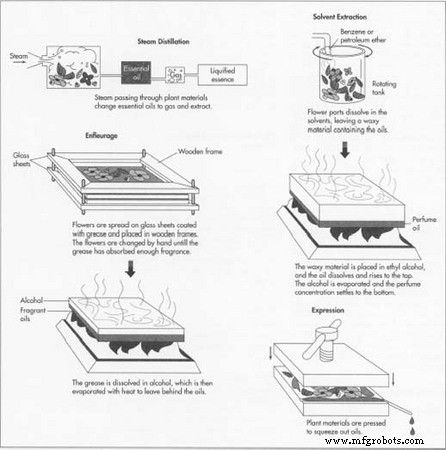
Essential oils are obtained through several techniques:
- Steam distillation: Steam passes through plant material, vaporizing oils that are then condensed into liquid form.
- Solvent extraction: Flowers are soaked in benzene or petroleum ether, producing a waxy extract that is later dissolved in alcohol.
- Enfleurage: Flowers are laid on greased glass; the grease absorbs the scent, which is later extracted with alcohol.
- Maceration: Warm fats soak flowers, capturing their aroma for subsequent alcohol extraction.
- Expression: The oldest method, where fruit or plant parts are pressed to release oils, still used for citrus zest.
Blending
Once oils are isolated, a master perfumer—known in the industry as a “nose”—crafts the fragrance using up to 800 distinct ingredients. The blend is then diluted in alcohol, with typical concentrations: 10–20% oil for full perfume, 3–5% for cologne, and 2% for eau de toilette.
Aging
Perfume is aged for months or even years, allowing the top, heart, and base notes to harmonize. Top notes (citrus, fresh) evaporate quickly, heart notes (floral) form the core scent, and base notes (woody, musky) provide longevity.
Quality Control
Perfumery’s reliance on seasonal plant harvests and rare animal products introduces supply volatility. Thousands of flowers may be required for a single pound of essential oil, and variations in terroir can alter scent profiles. Ethical sourcing and synthetic alternatives mitigate these risks, ensuring consistency and protecting endangered species.
The Future
Contemporary perfumery increasingly favors synthetic chemistry to reduce costs and broaden accessibility. Emerging trends focus on therapeutic benefits—aromatherapy’s role in mood regulation, immune support, and psychotherapy is gaining scientific backing. Additionally, research into human pheromones seeks to replicate natural attraction cues, potentially enhancing interpersonal chemistry while also providing novel wellness benefits.
As the industry evolves, the convergence of artistry, science, and health promises to reshape how we experience fragrance—making perfume not just a luxury, but a daily enhancer of well‑being.
Manufacturing process
- Titanium: Key Properties, Applications, and Industrial Uses
- Castanets: History, Craftsmanship, and Performance
- The History, Production, and Future of Glue: From Ancient Adhesives to Modern Innovations
- Thread: Types, History, Production, and Quality Control
- Acetylene: Production, Uses, and Handling – A Comprehensive Overview
- Comprehensive Overview of Asbestos: From Ancient Uses to Modern Health Risks
- The History, Design, and Manufacturing of Dice: From Ancient Tools to Modern Gaming
- Plywood: History, Production, and the Path Ahead
- Tin: From Bronze Age to Modern Industry – Uses, Production, and Future
- Silver: History, Properties, and Modern Applications