



The Art and Science of Pasta Production: From History to Modern Innovation
Background
Pasta is a globally cherished staple, with every culture offering its own noodle variant—China’s mein, Japan’s udon, Poland’s pierogi, Germany’s spaetzle, and countless others. Its widespread appeal stems from simple manufacturing, compact storage, ease of cooking, and a rich supply of complex carbohydrates.
Early Etruscan diets of gruel and porridge gradually gave way to unleavened bread cakes, which many historians see as the first cousins of modern pasta. While the exact birthplace of noodles remains debated, the Italian explorer Marco Polo is often credited with reintroducing the dish to Italy after his 13th‑century travels to the East. Some analyses of Polo’s journals suggest he compared Chinese noodles favorably with his Italian fare, hinting at an exchange rather than a one‑way import.
Chinese noodles have a documented history spanning centuries. Transparent vermicelli‑like strands, derived from germinated mung‑bean paste, are typically soaked before boiling or frying. Earlier preparations favored frying or grilling, as boiled noodles were deemed bland. Korean influence is credited with teaching the Japanese how to produce sobā in the 12th century, using buckwheat cultivated in rice‑poor northern regions.
French medieval writers referenced a dish called pastillum, a ravioli‑like pouch filled with meat. Despite these claims, Italians assert a preeminent claim, and today pasta is almost synonymous with Italian cuisine. The word pasta originates from the Italian phrase “paste alimentari,” meaning nourishing dough.
The first industrial pasta plant emerged in Naples in the early 15th century. Naples’ naturally fluctuating temperatures—rising and falling up to four times a day—created ideal drying conditions. Mechanical drying technology only arrived in the 1800s.
Raw Materials
Pasta is crafted from water and semolina flour. Semolina is a coarse‑ground flour derived from the endosperm of durum wheat, an amber‑colored, high‑protein hard wheat cultivated specifically for pasta. Its lower starch and higher protein content make semolina easily digestible. Farina, a slightly coarser variant of hard wheat flour, is also employed in select varieties. Before shipment, semolina and farina are fortified with B‑vitamins and iron.
Eggs may be incorporated to enhance color or richness, with federal standards requiring a minimum of 5.5 % egg solids in egg noodles. Vegetable juices—such as spinach, beet, tomato, and carrot—add natural color and flavor. Recently, herbs and spices like garlic, basil, and thyme have become popular flavoring agents.
The Manufacturing Process
Mixing and Kneading
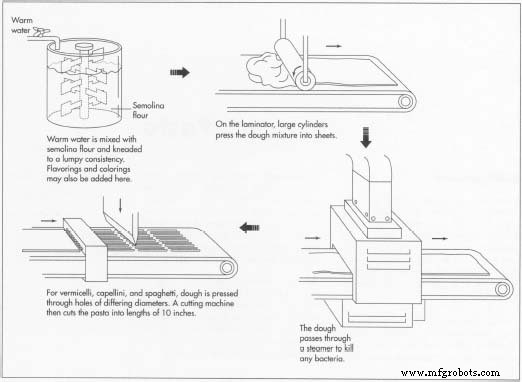
- 1. Semolina is stored in silos that can hold up to 150,000 lb (68,100 kg). Pipes transfer the flour to a mixing machine equipped with rotating blades, where warm water is added. The dough is kneaded to a lumpy consistency.
Flavoring and Coloring
- 2. Eggs are added for egg noodles. If a flavored pasta is desired, vegetable juices are incorporated here—tomato or beet for red pasta, spinach for green, carrot for orange. Herbs and spices can also be folded in for additional aroma.
Rolling
- 3. The mixture passes through a laminator, where large cylinders press it into sheets. A vacuum mixer further flattens the dough, expelling air bubbles and excess moisture to achieve an optimal 12 % water content.
Pasteurization
- 4. The rolled dough is steamer‑heated to 220 °F (104 °C) to eliminate bacteria.
Cutting
- 5. Depending on the desired shape, the dough is cut or extruded. Ribbon and string‑style pastas—fettuccine, linguine, spaghetti, capellini—are cut by rotating blades. Tubular or shell‑shaped varieties—rigatoni, ziti, elbow macaroni, fusilli—are formed by extrusion through metal dies. Die size dictates the pasta’s diameter and profile.
For vermicelli and capellini, the dough is extruded through holes 0.8–0.5 mm in diameter, then cut into 10‑inch (250 mm) lengths and twisted into curls. Spaghetti ranges from 1.5–2.5 mm in diameter and remains straight.
Tortellini are produced on a dedicated machine that cuts dough circles, deposits a measured ricotta filling, folds the dough, and seals the ends. Ravioli are made by placing a sheet of dough, depositing pre‑measured cheese filling on the next sheet, overlaying, and cutting into squares.
Drying
- 6. Pasta enters a controlled drying tank where heat, humidity, and airflow are precisely regulated. Drying times vary—from three hours for elbow macaroni and egg noodles to 12 hours for spaghetti. Rapid drying can cause breakage; overly slow drying increases spoilage risk. Oxygen levels are monitored, and lab technicians routinely test for Salmonella and other contaminants.
Special care during drying is essential; spaghetti, the most fragile noodle, is hung high to prevent breakage.
Packaging
- 7. Fresh pasta is folded into clear plastic containers, sealed, and vacuum‑packed with a CO₂/N₂ mix to extend shelf life. Labels list the noodle type, nutritional facts, cooking instructions, and expiration date.
Dried pasta is weighed and packed into stainless‑steel 304 containers or pre‑printed boxes, often on metal slides to protect delicate varieties like lasagna. Packaging lines—configured in “S,” “C,” or “Z” patterns or as horizontal belts—move pasta up to 10 ft (3 m) high. Workers monitor the process and can switch to manual packaging if needed.
Quality Control
Federal regulations mandate strict oversight of pasta production. Inspectors conduct regular visits to ensure compliance. Each company also establishes internal quality benchmarks, often before the raw material arrives. Lab technicians test semolina for color, texture, and purity; protein and moisture levels are tracked via sophisticated software.
Within the plant, continuous testing evaluates pasta elasticity, texture, flavor, and heat tolerance. Workers wear hard hats and gloves; machines are meticulously cleaned after each batch. The drying stage is vigilantly monitored to prevent spoilage.
Homemade Pasta
Pasta’s popularity has spilled into the kitchen. Kitchenware retailers and cookbooks now offer pasta‑rolling machines and recipe guides. The home process mirrors the industrial method, though eggs are almost always used in domestic recipes; oil may be added when using lower‑grade flour.
The dough is assembled on a wooden or marble surface. Flour is piled into a mound with a central well; eggs, water, oil, and optional ingredients are poured in and lightly mixed with a fork. Flour is then gradually incorporated into the center.
After ~5 minutes of kneading, the dough should form a smooth, elastic ball. Rolling into sheets is performed with a long Italian‑style rolling pin or machine. Many machines include attachments for cutting into shapes such as spaghetti, fettuccine, lasagna, or ravioli. Hand‑cutting with a sharp knife or rolling blade remains common. Marked rolling pins for ravioli or extrusion machines for tube‑style pasta are also available for home use.
The Future
Pasta consumption continues to climb. The National Pasta Foods Association projects that the average American will consume over 29 lb (13 kg) of pasta annually by the next decade. Its nutritional profile and convenience make it ideal for health‑conscious diners and those short on prep time.
Manufacturers respond with diverse offerings: no‑boil pasta that’s partially pre‑cooked at the plant, fat‑ and cholesterol‑free ravioli, organic lines, and wheat‑free varieties made from quinoa or kamut. These innovations promise to keep pasta at the forefront of global cuisine.
Manufacturing process
- What is VMC Machining? An Expert Overview of Vertical Machining Centers
- Expert Guide to Aluminum Laser Marking: Precision, Durability, and Industry Applications
- MIG vs. TIG Welding: Selecting the Right Arc Welding Technique for Your Project
- Comprehensive Guide to Laser Marking: Types, Benefits, and Applications
- Key Considerations for High‑Volume Swiss Machining
- CNC Prototyping Guide: Precision, Speed, and Cost‑Effective Production
- Expert Shaft Manufacturing: Precision Processes & Custom Solutions
- Fiber Laser Marking: Precision, Speed, and Versatility for Modern Industries
- The Art and Science of Pasta Production: From History to Modern Innovation
- Premium Machinery for Authentic Italian Pasta Production