



The Science and Industry of Frozen Vegetables: From Harvest to Table
Background
Frozen foods dominate modern grocery aisles, offering a convenient bridge between fresh produce and ready‑to‑cook meals. When harvested, fruits and vegetables are typically frozen within a few hours, preserving their flavor, texture, and most nutrients. The convenience of a microwave‑ready meal—often ready in under five minutes—has made frozen options a staple for busy households. Beyond convenience, freezing is a proven preservation method that inactivates many pathogens, ensuring food safety from farm to fork.
The frozen food industry traces its roots to the early twentieth century’s “cold‑pack” method, where produce was packed in large containers and stored in cold rooms. Slow freezing produced large ice crystals that damaged cell walls, leading to poor texture and taste after thawing. The breakthrough came with Clarence Birdseye’s quick‑freezing technique, which froze food in seconds, preserving quality and unlocking commercial potential.
Birdseye, born in Brooklyn in 1886, spent years in the Canadian Arctic, where he observed that freshly caught fish froze instantly in sub‑zero air and tasted flawless after thawing. He patented a mechanical freezing system in 1921, founded a frozen fish company in 1923, and ultimately sold his patents to General Foods for a record $22 million in 1929. General Foods aggressively marketed frozen foods, installing freezers in grocery stores and deploying refrigerated rail cars, laying the groundwork for the modern frozen food market.
Key technical advances include the use of circulating brine at –45 °F (–42.8 °C), the belt froster that cools food from top and bottom simultaneously, and the blanching process that deactivates enzymes before freezing. Modern methods range from air‑blast (ultra‑cooled air in a tunnel) and indirect freezing (food passes over chilled metal plates) to cryogenic freezing (liquid nitrogen temperatures of –80 to –120 °F, or –62.2 to –84.4 °C). Each technique is chosen based on the food’s texture, sugar content, and desired shelf life.
Not all produce freezes equally well. Varieties such as certain peas and strawberries excel because of their firm texture and optimal sugar composition. Consequently, many frozen food companies contract farmers to grow specialty varieties tailored for freezing.
Raw Materials
Raw materials encompass any item destined for freezing—fish, poultry, green beans, pizzas, and more. Products that will later be frozen are often cultivated or genetically selected for their freezing performance. For complex frozen desserts or entrees, recipes undergo extensive testing and adjustment to ensure they freeze uniformly. Large manufacturers source ingredients—like specific noodle widths or flour content—from suppliers that meet strict specifications.
Frozen meals generally require fewer preservatives than fresh products. Additives such as starch, xanthan gum, and carrageenan are common; they maintain texture after thawing. Many recipes incorporate a sauce or glaze to protect against dehydration during the rapid freezing process. Timing of harvest is also critical; produce is picked when tender to avoid post‑harvest softening.
Freezing equipment is typically stainless steel, and ammonia is the preferred refrigerant due to its environmental profile compared to Freon. Cryogenic systems use liquid nitrogen.
The Manufacturing Process
While the specifics vary by product, the core stages for a typical frozen vegetable—peas—are illustrated below.
Cultivating the peas
- Peas are mainly grown in Washington, Oregon, Wisconsin, and Minnesota. Processors contract farmers to cultivate varieties approved for freezing, such as Dark Skin Perfection and Thomas Laxton. Harvest schedules are coordinated to ensure immediate post‑harvest freezing.
Picking and washing
- Peas may be hand‑picked or machine‑harvested. A “viner” removes them from shells. If transported by truck, peas are cooled with ice water and stored in insulated containers. At the plant, they are washed and dust‑free.
Blanching
- Blanching involves a brief boil that halts enzyme activity without cooking the peas. After cooling, the peas pass through a gravity sorter.
Sorting
- Peas are separated by density in a salted brine bath; tender peas float, starchy ones sink. The floaters are rinsed and sent to inspection.
Inspection
- Workers rapidly scan the conveyor for discoloration, foreign matter, or defects, removing any off pieces.
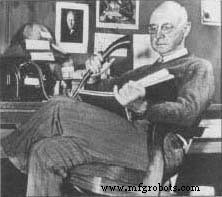
Clarence Birdseye’s pioneering work in quick freezing—first using sub‑zero brine and later a belt froster—enabled the rapid preservation of fish and vegetables. His research also introduced blanching, a technique still standard today. After selling his patents to General Foods, Birdseye continued to innovate, securing over 300 patents in areas ranging from infrared heat lamps to food dehydrating methods.
Packaging and freezing
- Packaging may precede or follow freezing, depending on plant design. Peas can be individually quick‑frozen then boxed, or frozen as whole bags. Freezing methods include blast tunnels (ultra‑cooled air), belt contact with chilled metal plates, or cryogenic tunnels. Packaged peas are then stacked in multi‑plate freezers before shipping.
Testing the frozen entrée recipe
- New frozen meals undergo rigorous recipe development in test kitchens, with ingredient trials and consumer feedback. The final formulation is refined over months of evaluation.
Pilot production
- Before full‑scale production, manufacturers run pilot batches to fine‑tune cooking times, packaging, and freezing parameters, resolving any process issues.
From the oven to the freezer
- Once the recipe is perfected, the meal is cooked and assembled on a tray. It can be frozen directly (naked air‑blast, cryogenic, or packaged and then air‑blasted) without a cooling step.
Packaging
- Automated lines bag, cartonize, and palletize finished meals. Pallets are stored in warehouses kept between 0 °F and –20 °F (–17.8 °C to –28.9 °C).
Distribution
- All distribution—trucks, rail, and storage—must maintain 0 °F (–17.8 °C) or colder to preserve product quality.
Quality Control
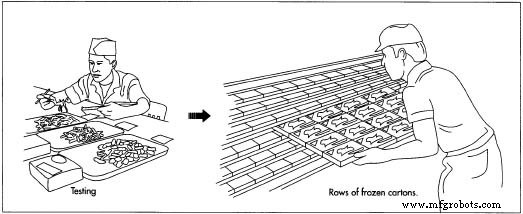
Quality control spans the entire chain. Incoming produce receives a visual and laboratory inspection for quality, bacteria, and foreign matter. Random samples of packaged frozen vegetables are cooked, tasted, and tested for texture and flavor. Equipment is cleaned at scheduled intervals to maintain sterility. Manufacturers collaborate with equipment suppliers to design easily cleanable machinery and to conduct preventive maintenance. USDA inspectors oversee meat‑containing frozen meals, ensuring temperature control and sanitation. For vegetarian or meat‑free products, the responsibility rests solely with the manufacturer.
The Future
Since the 1990s, the frozen food industry has shifted toward home meal replacements—complete meals that replace the need to cook from scratch. Consumers increasingly demand sophisticated flavors and textures, pushing manufacturers to innovate. Food scientists continue to explore the interplay of low‑molecular‑weight sugars and high‑molecular‑weight stabilizers to predict freezing behavior.
Cryogenic freezing is gaining traction for certain specialty items, but its benefits are food‑specific. Equipment makers are developing multi‑mode machines that combine air‑blast, indirect, and cryogenic technologies to accommodate diverse products.
Manufacturing process
- Popsicles: From Ancient Treats to Modern Manufacturing
- TV Dinners: History, Production, and Future Innovations
- The Complete Guide to Freeze‑Dried Food: Preservation, Production, and Future Trends
- Frozen Yogurt: History, Ingredients, and Manufacturing Insights
- Pet Food Production: From Ingredients to Regulation – A Complete Guide
- The Complete Guide to Cooking Oil: Production, Quality, and Sustainability
- Pavlov’s Cat: IoT Dinner Timer to Train Your Cat
- Food Quality Sensor: Detecting Food Freshness with Arduino
- Boost Your Frozen Food Business with Advanced Manufacturing Automation
- Optimizing the Frozen Food Supply Chain with Advanced Software Solutions