



Metal‑Detectable Plastics: Enhancing Food Safety in the Industry
 While enjoying a hot dog or a pint of ice‑cream, most of us never think about the possibility that a stray plastic or metal fragment could be hidden inside. Everyday food‑processing equipment—tote bins, shovels, pallets—contains plastic parts that can wear or break, introducing foreign particles into the products that end up on our grocery shelves.
Food processors operate under strict regulations from the U.S. FDA, USDA, and EU authorities. Violations can trigger costly recalls, negative media coverage, and a sharp drop in consumer confidence. To mitigate these risks, many manufacturers rely on metal detectors and X‑ray systems as part of their HACCP plans to identify metal, plastic, rubber, and other contaminants.
However, conventional metal detectors miss many plastic fragments, and X‑ray machines may fail to detect very fine particles. That is why the industry increasingly turns to metal‑detectable plastics. By incorporating magnetic additives, these resins become responsive to standard detection equipment, ensuring that even the smallest fragments—down to 27 mm³—are flagged.
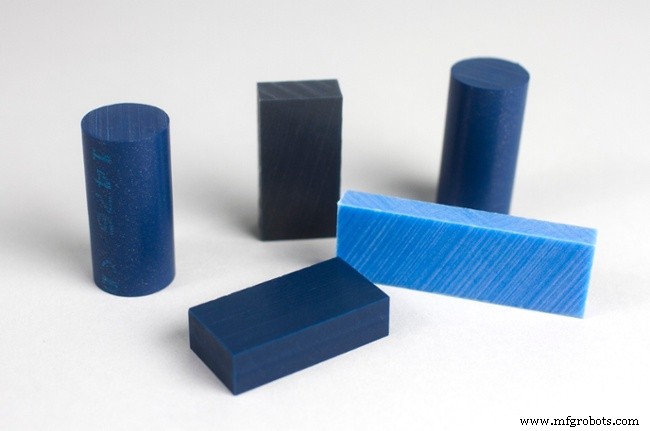 All thermoplastics and thermosets can be engineered for magnetic detectability at a modest cost. Additives such as iron‑oxide or cobalt‑based pigments grant the material sufficient magnetic permeability. Popular grades include UHMWPE, polypropylene, polycarbonate, PEEK, nylon‑6 (PA6), and acetal. The resulting plastics are typically blue—achieved with a gray additive—while darker options like PEEK appear grey. PEEK is favored for high‑speed lines and temperatures above 130 °C, though it is not X‑ray detectable. In contrast, acetal and PA6 retain X‑ray visibility. The visible blue tint also aids visual inspection.
These enhanced materials reduce breakage in high‑stress components, improving reliability and extending equipment life.
So next time you savor a bite of ice‑cream or grill a hot dog, rest assured that cutting‑edge materials help keep the food you consume free from hidden contaminants.
Recent recalls linked to particulate contamination include:
- Tyson Chicken Nuggets
- Kraft Mac n Cheese
- Entenmann’s Baked Goods
Questions or comments? Let us know below.
Interested in learning more about plastic materials? Download our free guide!

Resin
- High‑Performance Plastics: Essential Materials for Modern Semiconductor Fabrication
- Why Aerospace Ranks Plastics as the Ultimate Weight‑Saving, Corrosion‑Resistant Material
- Digitalisation in Food & Beverage: Enhancing Safety, Traceability, and Efficiency
- Rapid Sheet Metal Fabrication: The Food Industry’s Trusted Production Solution
- Advanced Hot Metal Stamping: Strengthening Cars While Reducing Weight
- China's Sheet Metal Fabrication Industry: Rapid Growth, Cutting-Edge CNC Tech, and Rising Demand
- Six-Axis Robots Revolutionize Plastics Production
- How Pick‑and‑Place Robots Revolutionize Food Production
- Nitrogen’s Role in the U.S. Plastics Industry: Key Applications Explained
- Driving Success: How Innovation Transforms Metal Fabrication