



Why Aerospace Ranks Plastics as the Ultimate Weight‑Saving, Corrosion‑Resistant Material
Without plastics, commercial air travel would cost significantly more, and military aircraft would lose vital stealth and endurance. Since 1970, aerospace plastic use has quadrupled. Interior components—overhead bins, navigation and propulsion parts, structural elements—are now routinely made from advanced polymers. Military jets also benefit: lighter weight extends range and improves radar evasion.
Plastics offer several advantages over traditional metal alloys:
- Lightweight – Many plastic parts are up to ten times lighter than their metal counterparts. A one‑pound weight reduction can save roughly $1,000 in fuel over a plane’s lifetime.
- Cost‑effective fabrication – Injection molding, extrusion, and 3D printing allow mass production at lower costs.
- Corrosion resistance – Most polymers perform well in chemically aggressive environments, eliminating rust‑related maintenance.
- Superior impact resistance – Transparent plastics often exceed glass in toughness, enhancing passenger safety.
Although plastics were first developed in the late 1800s and saw widespread use in the 1930s, it wasn’t until World War II that aerospace engineers began replacing rubber and metal with polymers. Early applications included fuel‑tank linings and component housings. Subsequent advances led to high‑performance materials now found in every cockpit and wing.
1) Polyetheretherketone (PEEK)
PEEK, marketed as PEEK™ (polyetheretherketone), is a semi‑crystalline polymer renowned for its exceptional mechanical strength, creep resistance, low flammability, and radiation tolerance. With an operating range up to 450 °F (232 °C), it thrives in extreme temperatures and vacuum, making it ideal for valve seats, pump gears, and other high‑stress components.
2) Thermosetting Polyimide
Thermosetting polyimides, such as MELDIN® 7001, combine high mechanical strength with excellent chemical resistance. Lighter than metal and tougher than ceramics, they are perfect for electrical standoffs, insulators, and threaded‑nut spacers.
3) Polyamide‑Imide (PAI)
PAI, sold under the Torlon® brand, retains its strength up to 500 °F (260 °C) and offers radiation resistance, flame retardancy, and zero smoke output. These traits make PAI a preferred replacement for many metal parts in aerospace systems.
4) Polychlorotrifluoroethylene (PCTFE)
PCTFE is a fluorochemical polymer that balances mechanical robustness, fire and chemical resistance, and minimal moisture absorption. With an operating window from –400 °F to +400 °F, it excels in corrosive or high‑altitude environments.
5) Polytetrafluoroethylene (PTFE)
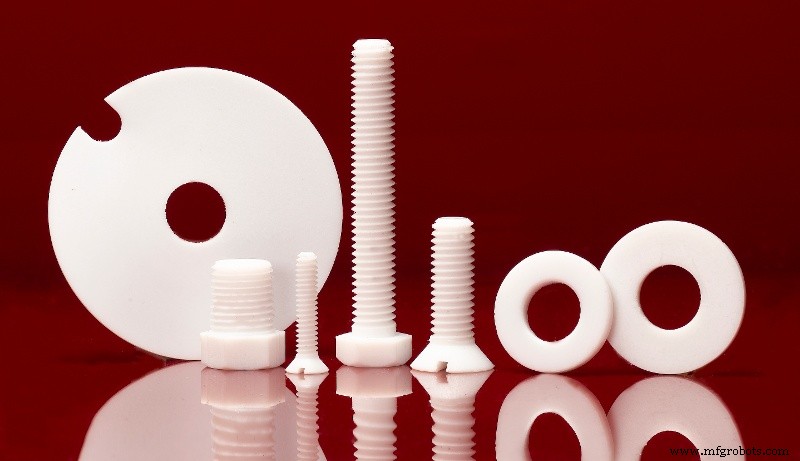 PTFE, or Teflon®, is an excellent electrical insulator with low flammability and high tear resistance, maintaining performance under aerospace conditions. It is widely used to insulate aircraft wiring and cabling.
Conclusion
In today’s high‑fuel‑cost landscape, airlines demand ever‑lighter aircraft to keep ticket prices competitive. Plastics—light, thermally stable, and corrosion‑resistant—offer a compelling alternative to metal alloys and rubber. The future may even feature aircraft with plastic wings and tails.
Did I miss an important material or application in the aerospace industry? Let me know in the comments below.
Looking for more information on these plastics? Download our free guide!
Resin
- Plastics: Driving the Future of Automotive Hardware Innovation
- High‑Performance Plastics: Essential Materials for Modern Semiconductor Fabrication
- How Plastic Materials Are Revolutionizing Modern Construction
- How Cryogenic Temperatures Affect High‑Performance Plastics: Expert Insights
- Metal‑Detectable Plastics: Enhancing Food Safety in the Industry
- From Ivory to Bakelite: Tracing the Evolution of Modern Plastics
- Current Trends and Innovations Shaping the Plastics Industry
- Market Trends in Aerospace and Precision Aircraft Components
- Robots Transforming Aerospace Production: Precision & Reliability
- Nitrogen’s Role in the U.S. Plastics Industry: Key Applications Explained