



10 Proven Plastic Welding Techniques That Outperform Glue
A frequent question we receive is whether to use adhesives or welding for joining plastics. While the right adhesive can be complex, welding offers a more robust, economical solution—especially when you have the proper equipment.
Below are ten widely used plastic welding techniques, each with its own strengths and ideal applications. These methods are proven in industrial settings and can be implemented with standard tools.
1. Extruded-Bead Sealing
A bead of the same thermoplastic is extruded between two parts and immediately pressed together. The heat in the bead melts the adjacent surfaces, forming a seamless joint.
2. Friction (Spin) Welding
High‑speed angular oscillations heat the parts. For non‑axially symmetrical pieces, the process is programmed to stop once the surfaces are perfectly aligned, ensuring a uniform weld.
3. High‑Frequency Electrical Welding
Electrodes from a high‑frequency generator contact the joint surfaces, generating localized heat that softens the plastic and creates a solid bond.
4. Hot‑Gas Welding
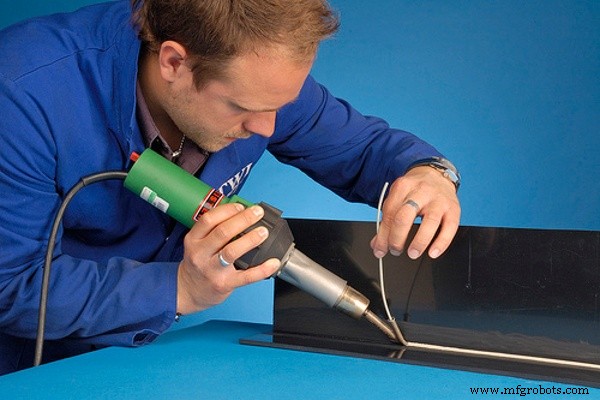 A heated chamber—often powered electrically or by gas—delivers dry air or nitrogen to the joint. A compatible rod is pressed onto the heated area, fusing the parts.
5. Hot‑Plate (Hot‑Tool) Welding
Both components are briefly held against a preheated metal plate (usually PTFE‑coated to prevent sticking). Once the surface layers melt, the parts are pressed together and cooled under light pressure.
6. Induction Welding
A conductive metal insert sits at the interface. While the parts are held together, a high‑frequency generator heats the insert, softening the surrounding plastic and creating a weld upon cooling.
7. Laser Welding
Under pressure, a laser beam travels along the joint line. The beam passes through the first component and is absorbed by the second (or an absorbent coating), generating sufficient heat to melt the interface.
8. Solvent Welding
A solvent that dissolves the polymer surface is applied, and the softened parts are pressed together. Bonding occurs as the solvent evaporates or is absorbed, and the polymer re‑solidifies.
9. Spin Welding
Two circular cross‑section parts are rotated against each other. Friction generates heat until the interface melts. The rotation stops, the parts are held under pressure, and the joint solidifies.
10. Ultrasonic Welding
Vibratory mechanical pressure at 20–40 kHz heats the joint. An ultrasonic transducer converts electrical energy into vibrations, delivered by a horn to the weld area, producing localized heat through friction.
Did any of these techniques resonate with your experience? Let us know in the comments.
Want deeper insights into plastic manufacturing? Download our free glossary!

Resin
- How to Weld and Glue 3D‑Printed Plastic Parts for Strong, Precise Assemblies
- 9 Must‑Watch TED Talks for Plastic Engineering Professionals
- Four Proven Techniques for Bonding Plastic Components
- Spray Welding Explained: Process, Techniques, and Safety
- Lead Welding: Expert Guide to Safe Techniques & Tips
- Mastering Plastic Prototype Fabrication: 4 Essential Techniques
- Top Welding Materials for Strong, Reliable Joints
- Spray Welding Explained: Processes, Techniques & Safety Guidelines
- Lead Welding Made Easy: Expert Tips & Proven Techniques
- Automated Plastic Welding Boosts Production Efficiency