



Spray Welding Explained: Processes, Techniques & Safety Guidelines
What is Spray Welding?
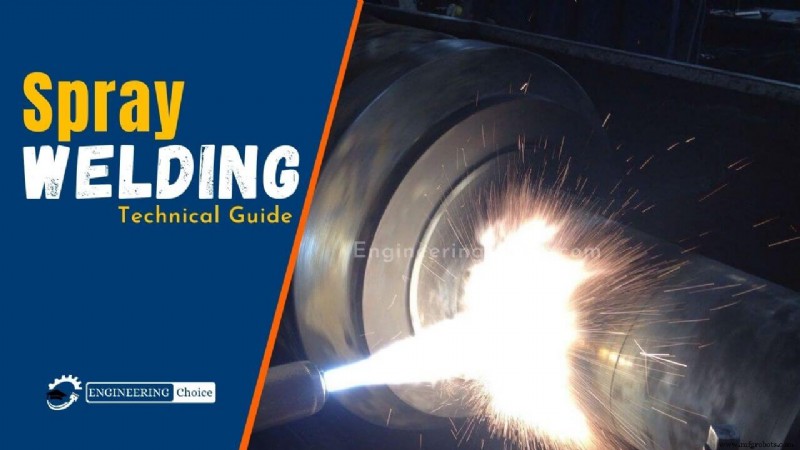
Spray welding refers to several welding processes in the form of thermal spraying. It is an industrial activity in which a powder or wire is atomized at high speed with compressed gas and sprayed onto a metal surface.
Spray welding involves the use of industrial plasma, flame, detonation guns, arc spray, and high-velocity oxyfuel. Due to the significant heat generated by spatter welding, procedures and regulations must be followed carefully and consistently to avoid harm to people and the environment.
Related: What is Welding?
How does Spray Welding Work?
Thermal spray is a general term that represents multiple coating processes. The entire welding involves the use of coating material, for instance, a rod, powder, or wire, which is melted by various sources of energy.
In simple terms, it can be defined as an industrial coating process consisting of a heat source and a coating material melted into droplets that are sprayed at a high velocity. The spraying is propelled towards a substrate by an atomization jet or gas.
Thermal spraying is quite a versatile process and is known to be highly efficient. It can be a good alternative for several surface treatments, which include heat or nitride treatment processes, chrome, nickel plating, anodizing, among other methods.
The coating thickness differs based on individual preferences. The coating repairs worn-out components and basic machine parts. It can also be applied to improve the performance and durability of the element. This can last up to 70% longer if well treated.
Related: What is Thermal Spray?
Different Types of Spray Welding Techniques
1. Spray Arc Welding
Spray arc welding is one of the methods of transferring molten material in the form of many small droplets, the diameter of which is smaller than that of the filler wire. Because there are no short circuits, the arc is stable and spatter-free.
A prerequisite for successful spray arc welding is that the current and voltage values are above certain limits. As a result, more heat is supplied to the workpiece than with short-arc welding, and only materials with a thickness of 5 mm or more are suitable for spray-arc welding.
Due to the high heat input, the weld pool is also large, so welding has to be carried out in a horizontal position. It should be noted that a pure spray arc cannot be achieved with CO2 as the shielding gas.
The shielding gas must be pure argon, preferably with a small amount of CO2 (maximum 25%) or O2. Spray arc welding is particularly suitable for MIG welding of aluminum and stainless steel, where the shielding gas is mainly argon.
Spray arc welding can be successfully performed at lower currents with a thin filler wire than with a thicker filler wire.
The arc voltage should be set just high enough to maintain a short-free arc. The filler wire is usually connected to the positive pole.
Advantages
Spray arc welding is a very efficient process. Key benefits of this process include:
- High deposition rate,
- Good fusion and penetration,
- good appearance of the weld,
- Ability to use larger diameter electrode wires and
- Presence of very little spatter.
Limitations
The limitations of spray-arc welding are:
- It is only used for material 1/8 inch (3mm) thick and thicker (handheld) and
- It is limited to flat and horizontal fillet weld positions
- Good fit-up is always required as there is no open root capability.
2. Flame Spraying Process
Flame spraying, also known as oxy/acetylene combustion spraying, is the original thermal spraying technique developed about 100 years ago. It uses the basic principles of a welding torch with the addition of a high-velocity airflow to propel molten particles onto the substrate.
The coating material can be in either wire or powder form. Flame spray coatings are often melted after application to improve adhesion and coating density.
Advantages
- High rates of deposition
- Low surface heating
- Versatile
- The process is simple and user-friendly
Disadvantages
- Relatively low adhesion
- Increased heating efficiency
- Not compatible with metals with melting points that exceed 2,800°C
3. High-Velocity Oxyfuel (HVOF)
The HVOF (High-Velocity Oxy-Fuel) process combusts oxygen and a select group of flammable gases including propane, propylene, or hydrogen. Although the HVOF system uses the basic principle of combustion, the spray gun is designed differently than the standard oxy-fuel spray gun.
The HVOF gun differences produce higher flame temperatures and higher velocities. The result is a more thoroughly melted powder and more kinetic energy available to “flatten” the melted particles of coating material. The HVOF process produces superior bond strength and coating density.
The HVOF process is most commonly used to deposit high melting temperature metals and metal alloys such as tungsten carbide, and chromium carbide.
Advantages
- Highly supports a thick coating
- Low porosity levels
- High adhesion levels
- More retained carbides as compared to flame spraying or plasma
Disadvantages
- Relatively loud with a noise level of up to 130 dB
- Low deposition rate
- Slightly expensive
4. Plasma Spraying Process (PTA)
The plasma spray process (non-transferred arc), uses inert gases fed past an electrode inducing the “plasma” state of the gases. When the gases exit the nozzle of the gun apparatus and return to their normal state, a tremendous amount of heat is released.
A powdered coating material is injected into the plasma “flame” and propelled onto the substrate.
Ceramic Coatings are most often applied using plasma spray due to their high melting temperatures. (Often > 3500 F). Several types of ceramic coatings can be applied using plasma spray.
Advantages
- Easy to apply
- Cermet particles are bigger in size
- Wear resistance
- Very low or zero porosity
- Thick coating
- Low substrate heating as compared to GTAW
Disadvantages
- High oxidation on the sprayed material
- Difficult to get a thin layer of 1mm or less
5. Detonation Spraying
Detonation spraying is one of the many forms of thermal spraying techniques that are used to apply a protective coating at supersonic velocities to a material in order to change its surface characteristics. This is primarily to improve the durability of a component.
It was first invented in 1955 by H.B. Sargent, R.M. Poorman, and H. Lamprey and is applied to a component using a specifically designed detonation gun (D-gun). The component being sprayed must be prepared correctly by removing all surface oils, greases, debris, and roughing up the surface in order to achieve a strongly bonded detonation spray coating.
This process involves the highest velocities (≈3500 m/s shockwave that propels the coating materials) and temperatures (≈4000 °C) of coating materials compared to all other forms of thermal spraying techniques.
This means detonation spraying is able to apply low porous (below 1%) and low oxygen content (between 0.1-0.5%) protective coatings that protect against corrosion, abrasion, and adhesion under low load.
This process allows the application of very hard and dense surface coatings which are useful as wear-resistant coatings. For this reason, detonation spraying is commonly used for protective coatings in aircraft engines, plug and ring gauges, cutting edges (skiving knives), tubular drills, rotor and stator blades, guide rails, or any other metallic material that is subject to high wear and tear.
Commonly the materials that are sprayed onto components during detonation spraying are powders of metals, metal alloys, and cermet’s; as well as their oxides (aluminum, copper, iron, etc.).
Detonation spraying is an industrial process that can be dangerous if not performed correctly and in a safe environment. As such there are many safety precautions that must be adhered to when using this thermal spraying technique.
6. Cold Spray Process
Cold spraying (CS) is a coating deposition method. Solid powders (1 to 50 micrometers in diameter) are accelerated in a supersonic gas jet to velocities up to ca. 1200 m/s. During the impact with the substrate, particles undergo plastic deformation and adhere to the surface.
To achieve a uniform thickness the spraying nozzle is scanned along the substrate. Metals, polymers, ceramics, composite materials, and nanocrystalline powders can be deposited using cold spraying.
The kinetic energy of the particles, supplied by the expansion of the gas, is converted to plastic deformation energy during bonding. Unlike thermal spraying techniques, e.g., plasma spraying, arc spraying, flame spraying, or high-velocity oxygen fuel (HVOF), the powders are not melted during the spraying process.
Advantages of Spray Welding
- Spray welding ensures a smooth weld
- It has high penetration and is suitable for metal thicker than 3/16
- It has high weld deposit rates, which increases productivity
- The presence of very little spatter
- Inexpensive: use of less expensive material and strengthen by spray
- Spray welding is versatile, most metals, ceramics, and plastics can be sprayed
- Works in a variety of thicknesses
- Fast processing speed: spray times from 3 to 60 lb/hour (depending on the process used)
Disadvantages Of Spray Welding
- Requires special welder training for spraying
- Gas costs are higher (>85%) due to higher argon concentrations.
- Recommended only for a flat position and horizontal fillets
- High heat can make welders uncomfortable
- Possibility of undercutting, especially at the edge of welds
- The coating is mechanically bonded, not metallurgically
- line of sight process
- The low resistance of the coatings to pinpoint loading
FAQs.
What is Spray Welding?Spray welding is a term used to classify several welding procedures in the form of thermal spraying. It is an industrial activity that involves atomizing and spraying a powder or wire onto a metal surface at a high velocity with compressed gas.
What is Spray Arc Welding?Spray arc welding is one of the methods of transferring molten material in the form of many small droplets, the diameter of which is smaller than that of the filler wire. Because there are no short circuits, the arc is stable and spatter-free.
How do I set up a spray arc?For higher production speeds use spray transfer. Greater than 80% argon mix set the voltage at 23-4 volts to begin. Set the amperage with about 300-400 inches of wire feed speed. Again increase/decrease wire feed speed until 150 amps are reached.
How thick can you spray weld?Thermal spraying can provide thick coatings (approx. thickness range is 20 microns to several mm, depending on the process and feedstock), over a large area at a high deposition rate as compared to other coating processes such as electroplating, physical and chemical vapor deposition.
Manufacturing process
- Gas Welding Explained: Process, Parts, and Applications
- Friction Stir Welding Explained: Process, Benefits, and Applications
- Robotic Welding Explained: Process, Benefits, and Applications
- Spray Welding Explained: Process, Techniques, and Safety
- Master Titanium Welding: Proven Process and Techniques
- Gas Welding Explained: Process, Components, and Applications
- Exothermic Welding Explained: Process, Uses, and Benefits
- Friction Stir Welding Explained: Process, Benefits, and Applications
- Robotic Welding Explained: Processes, Benefits, and Applications
- Master Titanium Welding: Proven Process & Techniques