



Gas Welding Explained: Process, Components, and Applications
What is Gas Welding?
Gas welding is a type of liquid state welding process in which fuel gas is burned to produce heat. This heat is also used to melt the interface of the welded plates that are held together to form the joint. Oxyacetylene gas is mainly used as fuel gas in this process.
This process can be done with or without the help of fillers. If filler metal is used, it is manually inserted directly into the weld area.
Simply put, gas welding is the process of cutting and/or joining metals using the heat generated by burning a fuel gas (such as acetylene). Gas welding is one of the most important types of welding due to its wide applications.
It is one of the oldest forms of heat-based welding and remains an option for many industries.
The reason for the popularity of this welding method is its ease of use and low cost. The gas welding process is relatively easy to perform and does not necessarily require a skilled welder.
With fuels such as acetylene, the flame can reach temperatures slightly above 5700°F (3200°C). This temperature is lower than the temperature obtained from arc welding machine, but the advantages mentioned in many types of repairs and construction work outweigh this disadvantage.
How Does Gas Welding Work?
Gas welding is one of the oldest types of heat-based welding that is used in many industries. The edges of the material are heated to joins to the metal so that it can be melted and fuse. There are many gases that burn at very high temperatures and this is possible.
Gas welding process is very simple compared to arc welding. All equipment is carefully connected in this process. Gas and oxygen cylinders are connected to the welding torch through pressure regulators. Then adjust the pressure of the gas and oxygen supplied to the burner to mix properly.
The flame is ignited by a striker. Note that the tip of the torch is pointing down. The flame is now controlled through a valve on the welding torch. Adjust the flame to natural flame, carburizing flame or oxidizing flame according to the welding conditions. Now the welding torch moves along the line to make the joint. This causes the interface parts to join together permanently.
Gas welding type
There are several gas welding methods, but the most common ones are called oxyacetylene welding or oxy-gasoline welding. Gas welding can melt both non-ferrous (not containing iron) and ferrous metals and does not require electricity to produce the weld.
In oxy-acetylene welding, a combination of oxygen and fuel gas (usually acetylene) is used, and it is mainly used for welding thin metal sections.
In oxy-gasoline welding, a combination of oxygen and gasoline is used. This method is more effective than acetylene for torch cutting steel.
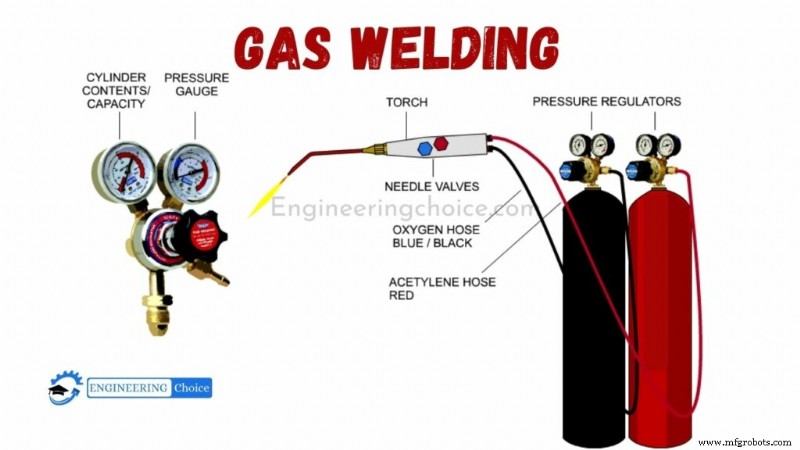
Main Parts of Gas Welding
You can guess some of the main components of a gas welding system, but what other parts do you need?
Let’s see:
- Fuel cylinder: One of the most important parts of the gas welding system is the fuel gas. This is usually stored in a cylinder. The cylinder is sealed and made of heavy gauge steel to prevent weakening of the compressed fuel cylinder. These cylinders are usually colored yellowish brown.
- Oxygen cylinder: Another important component of the gas welding system is the constant supply of pure oxygen. Oxygen cylinders hold the compressed oxygen needed for welding. Oxygen and fuel cylinders are both built to withstand the pressure of their respective gases. These are usually, but not always, painted black.
- Pressure Regulator: Both fuel and oxygen gases are stored at high pressure, so a method of reducing the pressure is required for safe use during the welding process. This is where a pressure regulator comes in handy. Typically, the equipment supplies oxygen at a constant pressure of 70-130 KN/M2 and gases at 7-103 KN/M2.
- Control valves: Both gases have separate control valves. Control valves are used to control the amount of gas released from the cylinder. Control valves are also important to control the ratio of fuel and oxygen.
- Mixing chamber: As the name suggests, this device is used for safe mixing of fuel and oxidant. A control valve is used to regulate the gas flow from the cylinder to the mixer chamber.
- Welding Torches: This is the “end of the job” for gas welders. Usually this also includes mixer chambers and control values. At the other end of the torch is a nozzle where a mixture of fuel and oxygen is burned together to facilitate the work of the welder.
Applications of gas welding
Some important applications are:
- For joining most ferrous and non-ferrous metals, carbon steel, alloy steel, cast iron, aluminum and its alloys, nickel, magnesium, copper and its alloys.
- For joining thin metals.
- For joining metals in automotive and aerospace industries.
- For joining metals in sheet metal processing plants.
- Connecting materials that require relatively slow heating and cooling.
Advantages of Gas Welding
The following are the advantages of gas welding:
- It can be used to bond different metals. Welding of ferrous and non-ferrous metals can be done with gas welding. This is one of the most important advantages over other welding methods.
- No need for electricity: Compared to other common welding techniques such as arc welding, gas welding does not require electricity to work. As a result, gas welding is sometimes used in areas where electricity is not available.
- Improved temperature control: by adjusting the gas flame, gas welding allows more control over the temperature of the metal in the weld.
- More control over the deposition of filler metal: Unlike arc welding, the heat source and filler metal are different in gas welding. This allows more precise control over the deposition rate of the filler metal.
- Low-cost equipment: compared to other types of welding, gas welding requires very little initial capital. It is very useful in various applications.
- No need for specialist/professional labor: Gas welding does not require high expertise. This makes it easier to find a gas welder and lowers labor costs.
- Gas welding equipment is very portable. Unlike other types of welding, gas welding is relatively easy to carry and handle.
Disadvantages of Gas Welding
Disadvantages include, but are not limited to:
- Not suitable for thick sections.
- Gas welding has a poor surface finish. This means that welds usually require a post-weld finish where aesthetics are important.
- Not for use with high strength steel. This is because, by its very nature, the heated zone can affect the mechanical properties of the base material.
- Lower heat and metal joining speed compared to other welding methods.
- It is not able to reach the boiling temperature of the arc welding
- There is no dedicated flux protection system. This can lead to very serious welding defects.
Manufacturing process
- Gas Welding Explained: Process, Parts, and Applications
- Exothermic Welding Explained: Process, Applications & Benefits
- Spray Welding Explained: Process, Techniques, and Safety
- Plasma Arc Welding (PAW): Process, Parts, and How It Works
- MIG Welding Explained: Techniques, Benefits, and How to Get Started
- Exothermic Welding Explained: Process, Uses, and Benefits
- Robotic Welding Explained: Processes, Benefits, and Applications
- Silver Brazing Explained: Process, Materials, and Practical Applications
- Spray Welding Explained: Processes, Techniques & Safety Guidelines
- Gas Welding Explained: Techniques, Applications, Pros & Cons