



Understanding Carbon Arc Welding: Equipment, Process, and Applications
What is Carbon Arc Welding?
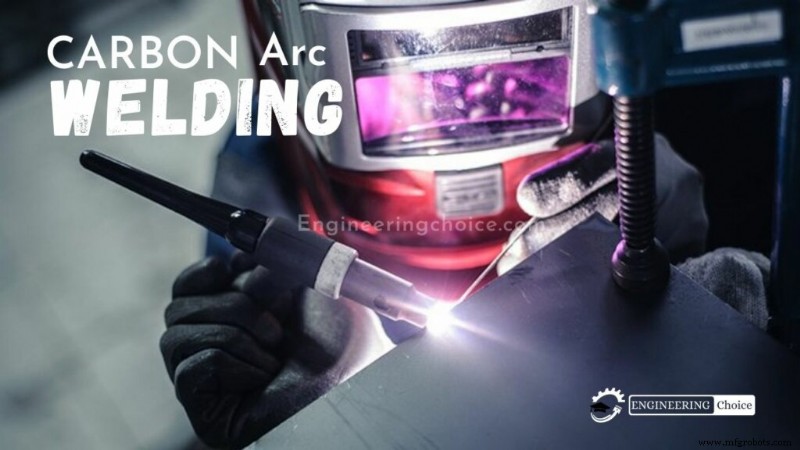
Carbon arc welding (CAW) is a process that produces the coalescence of metals by heating them with an arc between a non-consumable carbon (graphite) electrode and the workpiece. In carbon-arc welding, a carbon electrode is used to produce an electric arc between the electrode and the materials being bonded.
It was the first arc-welding process developed but is not used for many applications today, having been replaced by twin-carbon-arc welding and other variations. The purpose of arc welding is to form a bond between separate metals. This arc produces temperatures in excess of 3,000 °C. At this temperature, the separate metals form a bond and become welded together.
Related: What is Arc Welding?
The History Behind
Carbon arc welding is impossible without an electric arc. In 1800, Sir Humphry Davy discovered the electric arc. Later, Nikolay Benardos and Stanislaw Olszewski discovered the CAW process in 1981. Initially, this welding process was given the name Elektrogefest.
Equipment
- Electrode: The diameter of the electrode used in this process is around 3 to 22 mm.
- Power source: In the CAW process, direct current welding machines are used as a power source. These machines can be either of the rotating or rectifier types.
- Electrode holder: You may have a question; do we use the same conventional electrode holder in the CAW? No. As the temperature involved in this process is very much high, we can’t use the traditional electrode holder during this process.
Working Of Carbon Arc Welding
An electric arc is generated between the electrode and the parent metal. The heat generated due to the electric arc melts the base metal. After the solidification of the molten metal, the required weld is produced in the given region. You can vary the size of the electrode used in the process depending on the generated current.
One of the variations of the CAW is twin carbon arc welding (TCAW). TCAW is a slightly different process than CAW.
In the TCAW, a special type of electrode is used. TCAW is designed in such a way that one carbon electrode is movable and can be touch with the other to produce the arc.
During the twin carbon arc welding alternating current is used. Also, electrodes should be burned off at equal rates in the TCAW.
Advantages of Carbon Arc Welding
- Low cost of equipment and welding operation.
- High level of operator skill is not required.
- The process is easily automated.
- Low distortion of work piece.
Disadvantages of Carbon Arc Welding
- Unstable quality of the weld (porosity).
- Carbon of electrode contaminates weld material with carbides.
Manufacturing process
- Plasma Arc Welding (PAW): Process Overview, Parts, and How It Works
- Resistance Welding Explained: Types, Processes, and Advantages
- Friction Welding Explained: Process, Benefits, and Applications
- Carbon Arc Welding: Process, Equipment, and Modern Applications
- Plasma Arc Welding (PAW): Process, Parts, and How It Works
- Arc Welding 101: Types, Techniques, and How It Works
- Laser Welding Explained: Techniques, Types, and Industrial Applications
- Resistance Welding Explained: Types, Processes, and Benefits
- Friction Welding Explained: How It Works & Key Applications
- Stick Welding Explained: Equipment, Techniques, and Step‑by‑Step Guide