



Friction Welding Explained: How It Works & Key Applications
What Is Friction Welding?
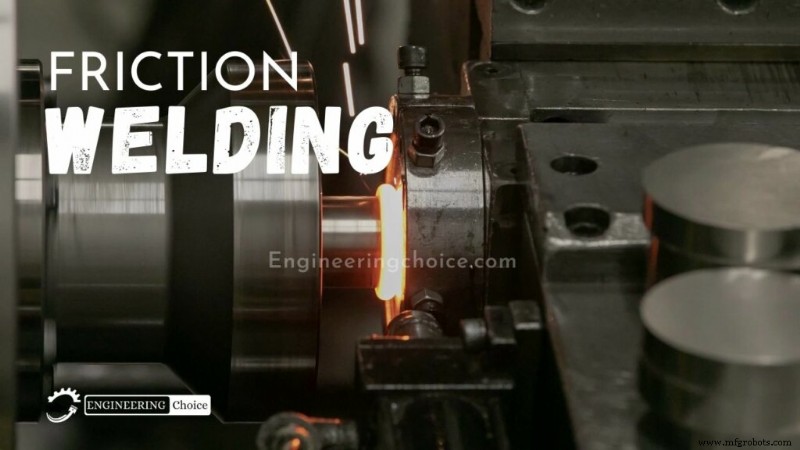
Friction welding is a solid-state welding technique that welds workpieces by generating heat through mechanical friction between workpieces in relative motion to one another, with the addition of a lateral force called “upset” to plastically displace and fuse the materials.
Because no melting occurs, friction welding is not a fusion welding process, but a solid-state welding technique more like forge welding. Friction welding is used with metals and thermoplastics in a wide variety of aviation and automotive applications.
In reality, an apparently smooth surface consists of many microscopic projections, called asperities. When one surface moves relative to another these asperities interact, generating friction the force resisting motion between two or more interacting surfaces.
Interaction of these asperities through elastic and plastic yielding generates heat. Friction welding utilizes this phenomenon for joining applications. The induced mechanical motion of friction welding generates heat, causing the materials to be joined to soften and become viscous. While in the softened state, the mechanical motion of the process mixes the materials to create a bond.
The way by which the frictional heat and material mixing occur is very dependent on the friction welding process utilized, of which there are four primary processes: Friction stir welding (FSW), friction stir spot welding (FSSW), linear friction welding (LFW) and rotary friction welding (RFW).
How does friction welding work?
FSW works by using a non-consumable tool, which is rotated and plunged into the interface of two workpieces. The tool is then moved through the interface and the frictional heat causes the material to heat and soften.
The rotating tool then mechanically mixes the softened material to produce a bond. FSSW is a variant of FSW and works by rotating, plunging, and retracting a non-consumable tool into two workpieces in a lap-joint configuration to make a “spot” weld. During FSSW there is no traversing of the tool through the workpieces.
LFW and RFW do not require a non-consumable tool, i.e., the individual workpieces to be joined are used to generate the frictional heat and mechanical mixing. LFW works by linearly oscillating one workpiece relative to another while under a compressive force.
The friction between the oscillating surfaces produces heat, causing the interface material to soften and mechanically mix. RFW is similar to LFW except that the workpieces are often round and are rotated relative to each other. During LFW and RFW the workpieces typically shorten (“burn-off”) in the direction of the compressive force, forming the flash.
During the burn-off interface contaminants, such as oxides and foreign particles, are expelled into the flash. Once free from contaminants, pure metal to metal mixing occurs, resulting in an integral bond. Although the generated temperatures during friction welding are very hot, the material remains in a solid-state condition (i.e., no melting occurs).
Applications
Friction welding can be used to build better industrial rollers, tubes, and shafts. The process is often used to manufacture these subassemblies for industrial printers, material handling equipment, as well as automotive, aerospace, marine, and oil applications.
Other examples of components include gears, axle tubes, drivelines, valves, hydraulic piston rods, truck roller bushes, pump shafts, drill bits, connection rods, etc.
Advantages Of Friction Welding
- Enables joining of dissimilar materials normally not compatible for welding by other joining methods.
- Creates narrow, heat-affected zone
- Consistent and repetitive process of complete metal fusion
- Joint preparation is minimal – saw cut surface used most commonly
- Faster Turn-around Times – compared to the long lead time of forgings, which are currently 6 months or longer.
- Greatly increases design flexibility – choose appropriate material for each area of a blank
- Suitable for diverse quantities – from single prototypes to high-volume production
- No fluxes, filler material, or gases required
- Environmentally friendly process – no fumes, gases, or smoke generated
- Solid state process – no possibility of porosity or slag inclusions
- Creates cast or forge-like blanks – without expensive tooling or minimum quantity requirements
- Reduces machining labor, thereby reducing perishable tooling costs while increasing capacity
- Full surface weld gives superior strength in critical areas
- Reduces raw material costs in bi-metal applications. Expensive materials are only used where necessary in the blank.
Disadvantages of friction welding
- This process used for only round bars of the same cross-section.
- Limited to angular and flat butt joints.
- Set-up cost is very high.
- Preparation of workpiece is difficult.
- Non-forgeable materiel cannot be weld.
- It can only be used for smaller parts of machines; big parts are not compatible with it.
Friction Welding Video
Manufacturing process
- Laser Welding Explained: Techniques, Types, and Industrial Applications
- Friction Stir Welding Explained: Process, Benefits, and Applications
- Friction Welding Explained: Process, Benefits, and Applications
- Friction Stir Welding (FSW): How It Works, Applications, and Key Pros & Cons
- Friction Welding Explained: Principles, Methods, Types, Applications, Benefits & Drawbacks
- Plasma Arc Welding (PAW): Process, Parts, and How It Works
- Ion Beam Machining (IBM): Principles, Process, and Industrial Applications
- Laser Welding Explained: Techniques, Types, and Industrial Applications
- Resistance Welding Explained: Types, Processes, and Benefits
- Friction Stir Welding Explained: Process, Benefits, and Applications