



Friction Stir Welding (FSW): How It Works, Applications, and Key Pros & Cons
Today we will learn about friction stir welding principle, working, application, advantages and disadvantages with its diagram. Friction stir welding (FSW) is a solid state welding process. It is commonly a type of friction welding but due to its versatile applications, it is considered as a separate welding process. In this type of welding process, no external heat is supplied and the joint formation takes place due to diffusion at interface surfaces under high pressure and friction force. In this process, no molten or plastic state involves so it is categorized into solid state welding process.
Friction Stir Welding (FSW):
Principle:
Friction stir welding works on same principle of friction welding. In this process, friction is used to generate heat at interface surface. This heat starts diffusion process at the mating surface. A high pressure force applied at these mating surfaces which accelerates metal diffusion process and form a metal to metal joint. This is basic principle of friction welding. In friction stir welding, a rotating tool is used to applied friction and pressure force at the plates. This tool rotates at its own axis and move longitudinally at the plates interface which generates heat by friction between rotating tool and work piece. This heat deformed the interface surface and diffuses the two piece of work piece into one another by applying a high pressure force. This joint is created due to thermo mechanical treatment at the interface surface. One big advantage which makes it versatile welding process is that, it can be easily automated and gives higher metal joining rate. It is mostly used to join aluminum alloy.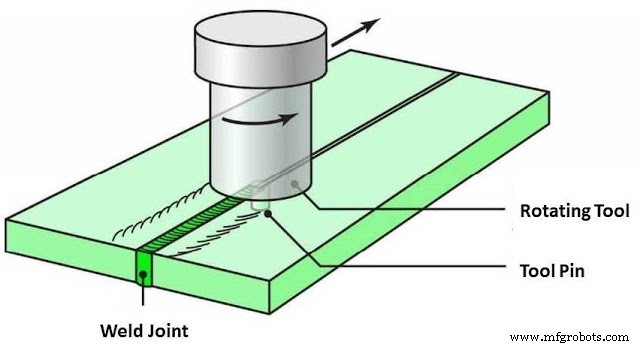 |
| Diagram of FSW |
Working:
The working process of friction stir welding can be summarized as follow.- First both the work plates are clamped together same as in butt joint. These both plate’s weldable surfaces are in contact with one another.
- Now a rotating tool pin is inserted into work pieces at the interface surfaces until tool shoulder touched the work piece. This will deform the material plastically due to heating by friction force. This is state of the joining process in which, inter molecular diffusion will deform the material plastically due to heating by friction force.
- Now the rotating tool is move forward along the joint line. This will form a joint behind the tool.
- The tool continuously move unlit the whole weld is form. After the joining process, tool is separated from the work piece. The hole created by tool pin remains in the welding plates.
Its working can be clearly understand by following video.
Application:
- FSW is mostly used in aircraft industries for welding wings, fuel tanks, aircraft structure etc.
- Used in marine industries for structure work.
- Used in automotive industries to weld wheel rims, chassis, fuel tanks and other structure work.
- It is used in chemical industries for joining pipelines, heat exchanger, air conditioner etc.
- Friction stir welding is also used in electronic industries for joining bus bar, aluminum to copper, connectors and other electronic equipment’s.
- It is widely used in fabrication industries.
Advantages and Disadvantages:
Advantages:
- It is a solid state welding so does not use flux, filler metal etc.
- FSW can be used to weld both similar and dissimilar metals.
- Fine grain size and quality weld can be obtain by this process
- Lower power consumption due to absence of external heating.
- Highly automated.
- Little maintenance required.
- Large welding joint design available and it can weld in all direction.
- Easy to operate and does not involve any environmental pollution.
Disadvantages:
- Complicated or special fixture arrangement required.
- It creates a visible hole in welding plates.
- High initial or setup cost.
- It is less flexible compare to arc welding process.
- FSW cannot make filler joints.
- Non Forgeable material cannot be weld.
Solid‑State Welding: Principles, Types, Applications, Benefits & Drawbacks
Forge Welding Explained: Principles, Techniques, Uses, Pros and Cons
Manufacturing process
- Ultrasonic Welding: Principles, Process, Equipment, Applications, and Pros & Cons
- Electroslag Welding Explained: Principles, Process, Applications, Pros & Cons
- Plasma Arc Welding: Principles, Types, Equipment, Applications, Benefits & Drawbacks
- Thermite Welding Explained: Principles, Process, Equipment, Applications, Pros and Cons
- Forge Welding Explained: Principles, Techniques, Uses, Pros and Cons
- Diffusion Bonding: Principles, Process, Applications, Benefits & Limitations
- Explosion Welding: Principles, Process, Types, Applications, and Pros & Cons
- Friction Welding Explained: Principles, Methods, Types, Applications, Benefits & Drawbacks
- Gas Welding: Principles, Techniques, Equipment, and Applications
- Mastering Electron Beam Welding: Principles, Process, Equipment, Applications, and Pros & Cons