



Forge Welding Explained: Principles, Techniques, Uses, Pros and Cons
Today we will learn about forge welding principle, working, application, advantages and disadvantages. Forge welding is a solid state welding process in which metal joint is created due to inter-molecular diffusion. As we know, forging is a technique of shaping any metal by application of high pressure and temperature. This welding process uses fundamental technique of forging to weld similar or dissimilar metals. it has been used from a very old period to join iron or steal work pieces. It was a simplest process of joining two metals in ancient time but now it has replaced by other more suitable and simplest welding processes like arc welding and gas welding.
Forge Welding:
Principle:
As we discussed, forge welding is a solid state welding process in which both the plates are heated quite below its melting temperature. This heating deforms the work pieces plastically. Now a repeated hammering or high pressurize load is applied on these plates together. Due to this high pressure and temperature, inter-molecular diffusion takes place at the interface surface of the plates which make a strong weld joint. This is basic principle of forge welding. One of the basic requirement of this types of welding, is clean interface surface which should be free from oxide or other contaminant particles. To prevent the welding surface from oxidation, flux is used which mixes with the oxide and lower down its melting temperature and viscosity. This allow to flow out the oxide layer during heating and hammering process.Working:
Forge welding was one of the most applied welding method in ancient time. This is a fundamental welding process of all solid state welding. Its working can be summarized as follow.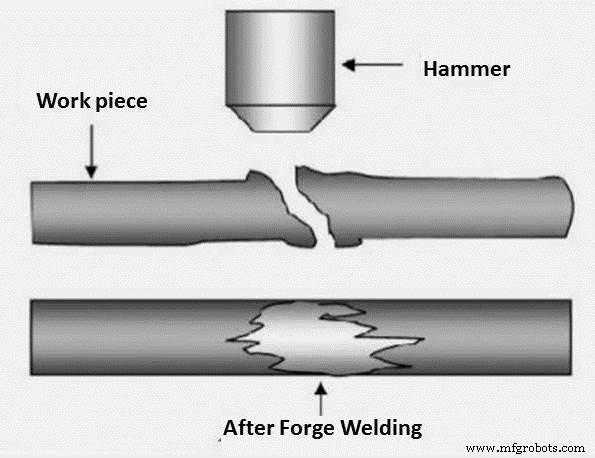
- First both the work plates heated together. The heating temperature is about 50 to 90% of its melting temperature. Both the plates are coated with flux.
- Now manual hammering is done by a blacksmith hammer for making a joint. This process is repeated until a proper joint is created.
- For welding large work pieces, mechanical hammering is used which is either driven by electric motor or by using hydraulic mean. Sometime dies are used which provides finished surface.
Application:
- It is used to join steel or iron.
- It is used to manufacture gates, prison cells etc.
- It is widely used in cookware.
- It was used to join boiler plates before introduction of other welding process.
- It was used to weld weapon like sword etc.
- Used to weld shotgun barrels.
Advantages and Disadvantages:
Advantages:
- It is simple and easy.
- It does not require any costly equipment for weld small pieces.
- It can weld both similar and dissimilar metals.
- Properties of weld joint is similar to base material.
- No filler material required.
Disadvantages:
- Only small objects can be weld. Larger objects required
large press and heating furnaces, which are not economical. - High skill required because excessive hammering can damage
the welding plates. - High Welding defects involve.
- It cannot use as mass production.
- Mostly suitable for iron and steel.
- It is a slow welding process.
This is all about forge welding principle, working, application, advantages and disadvantages. If you have any query regarding this article, ask by commenting. If you like this article, don’t forget to share it on your social networks. Subscribe our website for more interesting articles. Thanks for reading it.
Friction Stir Welding (FSW): How It Works, Applications, and Key Pros & Cons
Diffusion Bonding: Principles, Process, Applications, Benefits & Limitations
Manufacturing process
- Ultrasonic Welding: Principles, Process, Equipment, Applications, and Pros & Cons
- Electroslag Welding Explained: Principles, Process, Applications, Pros & Cons
- Plasma Arc Welding: Principles, Types, Equipment, Applications, Benefits & Drawbacks
- Thermite Welding Explained: Principles, Process, Equipment, Applications, Pros and Cons
- Friction Stir Welding (FSW): How It Works, Applications, and Key Pros & Cons
- Diffusion Bonding: Principles, Process, Applications, Benefits & Limitations
- Explosion Welding: Principles, Process, Types, Applications, and Pros & Cons
- Friction Welding Explained: Principles, Methods, Types, Applications, Benefits & Drawbacks
- Gas Welding: Principles, Techniques, Equipment, and Applications
- Mastering Electron Beam Welding: Principles, Process, Equipment, Applications, and Pros & Cons