



Water Jet Machining: Principles, Benefits, Drawbacks, and Applications
Water Jet Machining (WJM) also called water jet cutting, is a non-traditional machining process in which high-velocity jet of water is used to remove materials from the surface of the workpiece. WJM can be used to cut softer materials like plastic, rubber or wood. In order to cut harder materials like metals or granite, an abrasive material is mixed in the water. When an abrasive material is used in the water for the machining process then it is called Abrasive Water Jet Machining (AWJM).
Working Principle
It is based on the principle of water erosion. When a high-velocity jet of water strikes the surface, the removal of material takes place. Pure water jet is used to machine softer materials. But to cut harder materials, some abrasive particles mixed with the water for machining and it is called as AWJM (Abrasive Water Jet Machining)
Abrasive Materials
The most commonly used abrasive particles in AWJM are garnet and aluminum oxide. Sand (Si02) and glass beads are also used as abrasive. The function of the abrasive particles is to enhance the cutting ability of the water jet.
Also Read:
- Electrochemical Machining (ECM) – Working Principle, Equipment, Advantages and Disadvantages with Application
- Laser Beam Machining – Main Parts, Principle, Working with Application
- How Electron Beam Machining Process Works?
Main Parts of Water Jet Machining
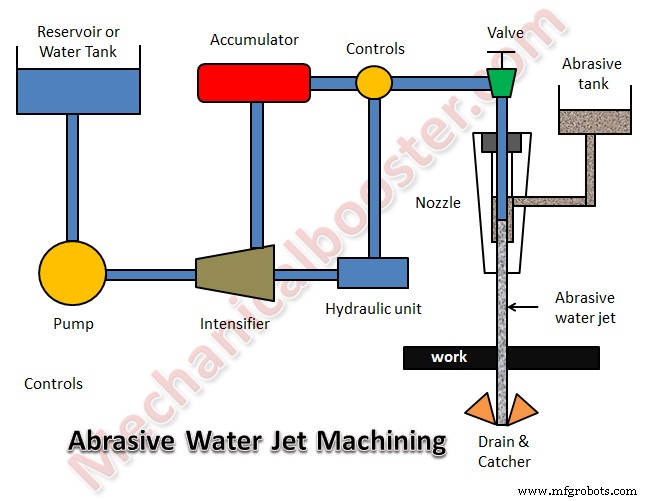
The various parts of water jet machining are
1. Hydraulic Pump
It is used to circulate the water from the storage tank during the machining process. The pump delivers water to the intensifier at low pressure of about 5 bars. A booster is also used which increases the initial pressure of water to 11 bar before delivering it to the intensifier.
2. Hydraulic Intensifier
It is used to increase the pressure of water to very high pressure. It receives the water from the pump at 4 bar and increases its pressure up to 3000 to 4000 bar.
3. Accumulator
It stores the high pressurized water temporary. It supplies that fluid when a large amount of pressure energy is required. It eliminates pressure fluctuation conditions in the machining process.
4. Mixing chamber or tube
It is a vacuum chamber where the mixing of abrasive particles into water takes place.
5. Control Valve:
It controls the pressure and direction of the water jet.
6. Flow Regulator or Valve
The flow of the water is regulated with the help of the flow regulator.
7. Nozzle
It is a device that is used to convert the pressure energy of water into kinetic energy in water jet machining. Here nozzle converts the pressure of water jet into high-velocity beam of water jet. The tip of the nozzle is made of ruby or diamond to prevent it from erosion.
8. Drain and Catcher System
After the machining, the debris and machined particles from the water are separated out with the help of the drain and catcher system. It removes the metal particle and other unwanted particles from the water and sends it back to the reservoir for further use.
Also Read:
- Ultrasonic Machining (USM) – Main Parts, Working Principle, Advantages and Disadvantages with Application
- Difference Between Up Milling and Down Milling – Which is Better?
- What is Lathe Machine? Main parts, Operations and Working
Working of Water Jet Machining
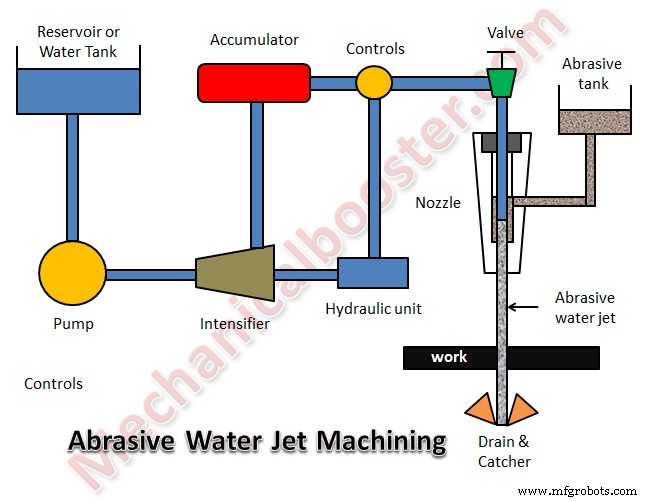
- The water from the reservoir is pumped to the intensifier with the help of a pump.
- The intensifier increases the pressure of the water from 5 bars to 3000 to 4000 bar. This high-pressure water from the intensifier is moved to the nozzle as wells as in accumulator.
- The accumulator stores the high-pressure water and supplies it at any instant when it is required. It is used to eliminate the fluctuation of the high-pressure requirement of machining hard material.
- The high-pressure water is then passed to the nozzle where the high-pressure energy of the water is converted into kinetic energy. A very high-velocity jet of water (1000 m/s) comes out through the nozzle in the form of a narrow beam.
- Abrasive such as garnet or aluminum oxide is mixed with water within the nozzle. A mixing chamber is there in the nozzle where the abrasives get mixed with the high-pressure water.
- This high-velocity jet of water when strikes the surface of the w/p removes the material from it.
- The water jet after machining it gets collected by the drain and catcher system. Here the debris, metal particles from the water are removed and it is supplied to the reservoir tank.
Advantages
- It has the ability to cut materials without disturbing its original structure. And this happens so because there is no heat-affected zone (HAZ).
- It is capable of producing complex and intricate cuts in materials.
- The work area in this machining process remains clean and dust-free.
- It has low operating and maintenance cost because it has no moving parts.
- The thermal damage to the workpiece is negligible due to no heat generation.
- It is capable of cutting softer materials (WJM) like rubber, plastics or wood as well as harder material (AWJM) like granite.
- It is environment-friendly as it does not create any pollution or toxic products.
- It has a greater precision of the machining. The tolerances of an order of ± 0.005 inch can be achieved easily.
Disadvantages
- It is used to cut softer materials. But AWJM can cut harder material of limited thickness.
- Very thick material cannot be machined by this process.
- The initial cost of WJM is high.
Application
- Water jet machining is used in various industries like mining, automotive and aerospace for performing cutting, shaping and reaming operations.
- The materials which are commonly machined by water jet (WJM or AWJM) are rubber, textiles, plastics, foam, leather, composites, tile, stone glass, food, metals/ paper and much more.
- WJM is mostly used to cut soft and easy to machine materials such as thin sheets and foils, wood, non-ferrous metallic alloys, textiles, honeycomb, plastics, polymers, leathers, frozen, etc.
- AWJM is typically used to machine those materials which are hard and difficult to machine. It is used to machine thick plates of steel, Al and other commercial materials, reinforced plastics, metal matrix, and ceramic matrix composites, layered composites, stones, glass, etc.
- Besides the Machining process, the high-pressure water jet is used in paint removal, surgery, cleaning, peening to remove residual stress, etc.
- AWJM can also be used to perform drilling, pocket milling, turning and reaming.
Industrial Technology
- Water Jet & Abrasive Water Jet Machining: Principles, Process, Equipment, Applications, Pros & Cons
- Electron Beam Machining: How It Works, Equipment, Applications, and Pros & Cons
- Laser Beam Machining: Principles, Process, Equipment, Applications, Advantages, and Disadvantages
- Abrasive Jet Machining Explained: Principles, Equipment, and Pros & Cons
- Ultrasonic Machining Explained: Principles, Equipment, Applications, Benefits & Drawbacks
- Abrasive Jet Machining: Components, Mechanics, and Practical Uses
- Water Jet Machining: Principles, Applications, and Benefits
- Electrochemical Machining (ECM): Principles, Equipment, Benefits, Drawbacks, and Practical Applications
- Ultrasonic Machining (USM): Core Components, Principles, Pros & Cons, and Practical Applications
- Water Jet Machining: How It Works, Parts, Benefits, and Applications – PDF Guide