



Plasma Arc Machining (PAM): How It Works and Its Industrial Applications
Today, we will learn about the Plasma Arc machining (PAM), Its working, applications, advantages, disadvantages. So, what are you waiting for? Let’s get started.
What is Plasma?
Whenever we heard the word Plasma Arc Machining we firstly think about what is plasma? So, let’s have a close look at what is plasma?
When a gas or air heated at high temperatures, the number of collisions between atoms increases. When you heat the gas above 5500ºC, it partially ionises into positive ions, negative ions and neutral ions. When you further heat the gas above 11000ºC then, it completely ionises. Such a completely ionised gas is called Plasma. Plasma State lies in between temperatures 11,000ºC to 28,000ºC.
What is Plasma Arc Machining?
Basically, Plasma Arc Machining (PAM) is a metal cutting process where metals are cut with plasma arc, tungsten-inert-gas arc or a torch. It is mostly used for the metals that cannot be cut by an oxyacetylene torch. Do you know when the PAM was introduced? Well, PAM was introduced in the industries in 1964 as a method that would help in the arc welding and that would require less current supply. Plasma Arc machining is also referred as PAM. In PAM, different gases are used according to different material. Different material means a workpiece. Your workpiece may be made up of aluminium, iron or steel. For example, for aluminium nitrogen is used, for argon hydrogen is used. In most of the cases, nitrogen and hydrogen are used. Plasma Arc Welding employs a high-velocity jet of high-temperature gas to melt and displace material in its path.
Also Read:
- Water Jet Machining – Working Principle, Advantages and Disadvantages with Application
- How Electron Beam Machining Process Works?
- What is Electrical Discharge Machining (EDM) Process and How it Works?
Construction
Plasma arc machining consists of a Plasma gun. Plasma gun has an electrode made up of tungsten situated in the chamber. Here, this tungsten electrode is connected to the negative terminal of DC power supply. Thus, the tungsten acts as a cathode. While the positive terminal of DC power supply is connected to the nozzle. Thus, the nozzle of the plasma gun acts as an anode.
Working of Plasma Arc Machining
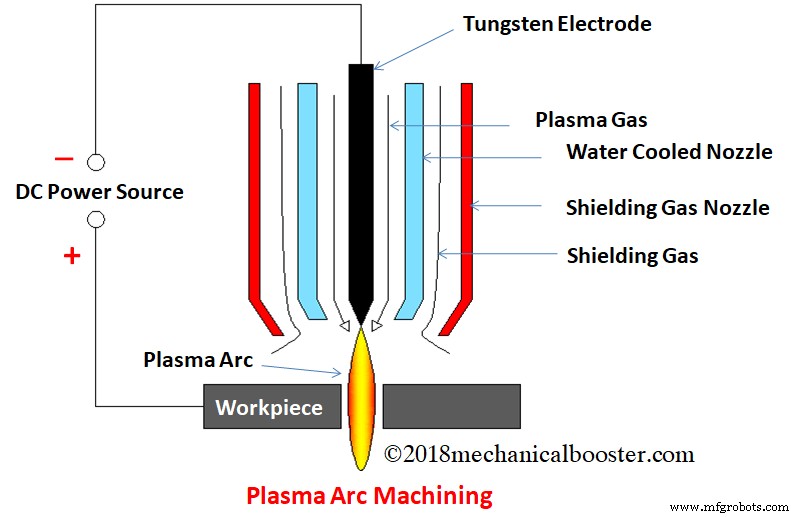
As we give the power supply to the system, an electric arc develops between the cathodic tungsten electrode and an anodic nozzle. As the gas comes in contact with the plasma, there is a collision between the atoms of gas and electrons of an electric arc and as a result, we get an ionised gas. That, means we get the plasma state that we wanted for Plasma Arc machining. Now, this plasma is targeted towards the workpiece with a high velocity and the machining process starts. One thing to note down is that a high potential difference is applied in order to get the plasma state.
In the whole process, high temperature conditions are required. As hot gases come out of nozzle there are chances of overheating. In order to prevent this overheating, a water jacket is used.
Following are some of the parameters involved in PAM that you must consider are:
- Current: Up to 500A
- Voltage: 30-250V
- Cutting speed: 0.1-7.5 m/min.
- Plate thickness: Up to 200mm
- Power require: 2 to 200 KW
- Material removal rate: 150 cm3/min
- Velocity of Plasma: 500m/sec
- Material of workpiece: As previously stated, you can use any metal as material of workpiece. For instance, aluminium and stainless steel are highly recommended for this process.
Also Read:
- Electrochemical Machining (ECM) – Working Principle, Equipment, Advantages and Disadvantages with Application
- Ultrasonic Machining (USM) – Main Parts, Working Principle, Advantages and Disadvantages with Application
- Laser Beam Machining – Main Parts, Principle, Working with Application
Advantages
Following are the advantages of PAM that you must know:
- In Plasma Arc Machining, hard as well as brittle metals can be easily machined.
- It can be applied to almost all types of metals.
- The best part of this process is that we get high cutting rate.
- We get a better dimensional accuracy in case of machining small cavities.
- It is a simple process to carry out and a very efficient process.
- It takes a big part in automatic repair of jet engine blades.
Disadvantages
Apart from the advantages of the Plasma Arc machining let us discuss some of the disadvantages of it:
- PAM involves various equipment but the cost of this equipment is very high.
- This entire machining process consumes a high amount of inert gases.
- Production of narrower surfaces takes place which is unnecessary.
- The most harmful part of PAM is that metallurgical changes takes place on the surface.
- The operator or person handling the whole process must take proper precautions. This process can affect human eyes so a proper googles or helmet must be worn by an operator.
Applications
- It is mostly used for cryogenic, high temperature corrosion resistant alloys.
- It is also used in case of titanium plate up to 8mm thickness.
- PAM is used in nuclear submarine pipe system and for welding steel rocket motor case.
- PAM is prominent for the applications related to stainless tube and tube mills.
In this high-tech weld, Plasma Arc Machining has a huge significance. Though, it has some disadvantage it is highly beneficial in all of its applications.
So, today we learnt about the Plasma Arc Machining. If you get some worthy knowledge after reading this article then, do share this article because Sharing is Caring!
Industrial Technology
- Plasma Arc Welding (PAW): Process Overview, Parts, and How It Works
- Plasma Cutting Explained: How It Works and Key Benefits
- Plasma Arc Machining Explained: Components, Operation, and Applications
- Electrochemical Grinding Explained: How It Works & Key Benefits
- Understanding Ransomware: How It Works & Why It Matters
- Understanding LED StarBoard: Design, Function, and Heat Dissipation Benefits
- Optocoupler Basics: Function, Types, and Practical Applications
- Refrigerator Alarm: The Smart Solution to Keep Your Food Fresh
- Precision Machining Series – Part 1: Definition, Processes, and Material Compatibility
- Plasma Arc Machining Explained: Parts, Process, and Applications